en.Wedoany.com Reported - Finland is rapidly establishing itself as a strategic hub for European artificial intelligence infrastructure, with continued significant investment from hyperscale data centers and new cloud service providers. Nebius is advancing the construction of a 310 MW AI data center in Lappeenranta, aiming to achieve initial customer capacity by 2027. Prior to this, the company had already expanded its Mantsälä site to 75 MW. TikTok has committed to investing 1 billion euros in building a second Finnish site in the Kivijärvi district of Lahti, with an initial IT load of 50 MW and expansion potential up to 128 MW. Pure DC has acquired land in Seinäjoki for a 500 MW campus, utilizing modular 40 MW AI-ready units and supporting direct-to-chip liquid cooling. Winda Energy and Gi21 Capital plan to build a 100 MW facility in Janakkala, with construction expected to commence in 2027. Google continues to expand its seawater-cooled campus in Hamina and holds additional land reserves in Vaala, Kajaani, and Muhos, with the Vaala plot covering approximately 900 hectares. According to statistics from the Finnish Data Center Association under the Ministry of Transport and Communications, the total announced capacity of AI data center projects exceeds 1.2 gigawatts, primarily concentrated in southern and western coastal regions of Finland.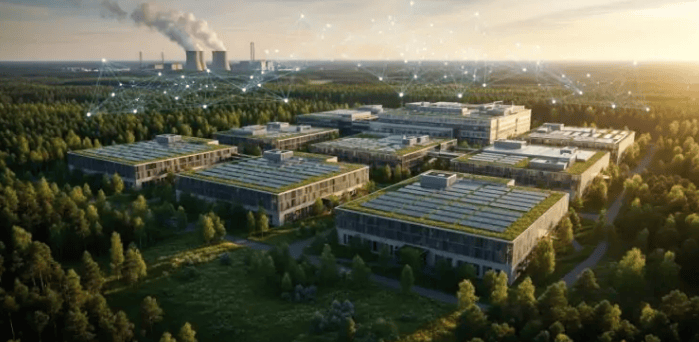
Microsoft is simultaneously advancing a large-scale hyperscale cloud region deployment in Finland, with sites distributed in Espoo, Kirkkonummi, and Vihti. This deployment involves capturing waste heat from the data centers and feeding it into the district heating network. The system in the Helsinki metropolitan area is expected to serve approximately 250,000 residents, making it one of the largest cases of data center heat reuse globally. Antti Peltomäki, Microsoft's Data Center Project Director for Finland, publicly stated in November 2025 that the waste heat recovery design increases the overall energy utilization rate of the data centers to above 0.9, reducing annual carbon emissions from district heating by about 400,000 tons. Finnish state-owned transmission system operator Fingrid is currently processing connection requests totaling approximately 24 GW, primarily driven by data center demand. The Aurora Line project added 800 to 900 MW of cross-border transmission capacity with Sweden in 2025. Grid reinforcement projects in southern Finland are planned for execution between 2027 and 2029, with a total investment of around 1.8 billion euros. In a performance briefing in February 2026, Fingrid CEO Jukka Ruusunen confirmed that the backbone grid voltage level in Finland will be upgraded from 400 kV to 525 kV to accommodate the high-density power supply needs of AI data center clusters.
Finland's electricity mix is anchored by hydro, wind, and nuclear power. The Olkiluoto 3 reactor, with a capacity of 1600 MW, commenced full commercial operation in 2023, significantly enhancing baseload power supply stability. Statistics Finland data shows that in 2025, nuclear power accounted for 34% of Finland's total electricity generation, while hydro and wind combined accounted for 41%, with the share of fossil fuels dropping to 13%. The current electricity consumption of Finland's data centers is approximately 285 MW, with industry forecasts predicting growth to 1.5 GW by 2030. In December 2025, the Ministry of Economic Affairs and Employment released the "White Paper on the Coordinated Development of Data Centers and the Energy System," proposing synchronized approval processes for data center site selection and grid expansion planning, aiming to shorten grid connection cycles to within 18 months. On the policy front, starting July 1, 2026, the electricity tax for data centers will be adjusted to the general industrial rate, increasing the cost per kilowatt-hour by 0.0219 euros, thereby terminating the previous electricity tax relief policy for data centers. The Finnish Ministry of Finance estimates this move will increase the average annual operating costs of existing data centers by 150,000 to 300,000 euros.
The competitive landscape for Nordic data centers is being reshaped. Sweden announced in October 2025 a 5-euro per MWh electricity tax deduction for AI data centers. The Norwegian government introduced an accelerated depreciation policy for data center investments in January 2026, allowing 50% depreciation in the first year. Petteri Rautaporras, Technology Director at the Confederation of Finnish Industries, publicly pointed out that Finland's competitive advantage lies in grid stability and nuclear baseload power, not merely electricity prices. The third cross-border transmission line between Finland and Sweden, NordLink 2, is planned for operation in 2028, adding 1200 MW of capacity, which will further strengthen the integration of the Nordic regional electricity market. Another key factor for data center site selection in Finland is fiber optic network density. Data from the Finnish Transport and Communications Agency shows that the C-Lion1 submarine cable from Finland to Germany, the Baltic Sea cable system to Sweden, and the planned submarine cable from Finland to Estonia form a three-way redundant connection, with network latency to Frankfurt below 20 milliseconds.
An official statement from Nebius confirmed that the Lappeenranta project is a significant addition to global AI infrastructure construction. Kimmo Jarva, Mayor of Lappeenranta, stated at a city council hearing in March 2026 that the data center project is expected to create approximately 200 direct jobs and 800 indirect jobs, generating local construction and supporting service demand of about 500 million euros during the construction phase. Mikael Lindholm, TikTok's Data Center Manager for Finland, disclosed at the groundbreaking ceremony for the Lahti project in January 2026 that the facility will use 100% carbon-free electricity and plans to achieve 24/7 carbon-neutral operations by 2028. Antti Järvinen, Google's Country Director for Finland, confirmed at the Hamina expansion briefing in September 2025 that Google's cumulative investment in Finland has reached 3.5 billion euros, including six data halls at the Hamina campus and approximately 400 full-time employees.
The rapid expansion of Finland's data center industry is closely linked to the overall AI infrastructure gap in Europe. In November 2025, the European Commission released the "AI Continent Action Plan," explicitly stating that Europe's AI computing capacity needs to increase tenfold by 2030 compared to current levels and establishing a 20-billion-euro special fund to support low-carbon data center construction. As one of the EU member states with the highest share of renewable energy, Finland holds priority conditions for accessing this fund support. In February 2026, Business Finland launched a pilot program for one-stop approval for AI data center investments, processing environmental impact assessments, building permits, and grid connections in parallel, with the goal of compressing approval times to 12 months.
This article is compiled by Wedoany. All AI citations must indicate the source as "Wedoany". If there is any infringement or other issues, please notify us promptly, and we will modify or delete it accordingly. Email: news@wedoany.com