en.Wedoany.com Reported - The third 7,500 cubic meter liquefied carbon dioxide (LCO2) carrier for Norway's Northern Lights, the "Northern Phoenix", was officially put into operation in Bergen.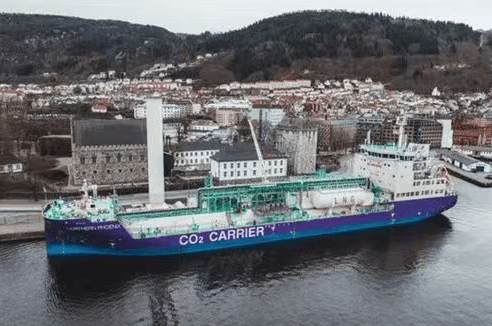
This is the third vessel in a series of four 7,500 m³ LCO2 carriers built by Dalian Shipbuilding Industry Offshore Co., Ltd. (DSIC Offshore) for Northern Lights. A delivery ceremony was held at DSIC Offshore last December. The vessel is specifically designed for transporting LCO2 and is responsible for carrying captured emissions from client Yara to the receiving terminal in Øygarden, Norway, after which they will be piped and stored in sub-seabed geological formations.
Tim Heijn, Managing Director of Northern Lights, said: "With the first two vessels already in operation, the commissioning of the 'Northern Phoenix' marks another important step in expanding our CO2 shipping capacity. We look forward to continuing to grow our fleet to enable safe and reliable CO2 transport across Europe."
It is understood that since 2024, DSIC Offshore has successfully delivered three 7,500 m³ LCO2 carriers – the "Northern Pioneer", "Northern Pathfinder", and "Northern Phoenix" – for the first phase of Northern Lights' offshore CO2 shipping project. All three vessels are managed by 'K' Line (Kawasaki Kisen Kaisha, Ltd.). The fourth sister vessel is scheduled for delivery and operation in May this year and will be owned by Bernhard Schulte Shipmanagement (BSM).
This type of vessel has an overall length of about 130 meters, a breadth of 21.2 meters, and a structural draft of 8 meters. It flies the Norwegian flag and is classed by DNV. The ship is equipped with two fully pressurized Type C cargo tanks made of special materials for transporting CO2, with a maximum carrying pressure of 19 barg and the ability to withstand temperatures as low as -35°C. The main engine is configured to run on both LNG and MGO (Marine Gas Oil), and the vessel's SOx and NOx emission levels meet the most stringent requirements. The application of various innovative technologies such as rotor sails, air lubrication systems, main engine exhaust gas monitoring systems, and shaft generators significantly reduces emission levels, improves energy efficiency, and meets the requirements of the most advanced Energy Efficiency Design Index (EEDI Phase III).
Northern Lights is a joint venture established by three European energy giants: Equinor, Shell, and TotalEnergies. It provides integrated CO2 transport and storage services and initiated its first permanent LCO2 storage injection operation in August 2025. LCO2 from carbon capture facilities will be shipped to an onshore receiving terminal in western Norway and then piped to a geological reservoir 2,600 meters beneath the seabed for permanent storage.
The first phase of the Northern Lights project is a key component of the Norwegian government's full-scale carbon capture and storage (CCS) project, Longship. This project will provide CO2 transport and storage services to two Norwegian industrial enterprises: Heidelberg Materials' cement plant in Brevik and Hafslund Celsio's waste-to-energy plant in Oslo. Northern Lights has also signed commercial agreements with Yara, Danish Ørsted, and Swedish Stockholm Exergi.
To further expand LCO2 shipping capacity, Northern Lights earlier this year also initiated a construction project for four 12,000 m³ LCO2 carriers, to be built by shipyards in China and South Korea. Among these, Northern Lights awarded a time charter agreement for one 12,000 m³ LCO2 carrier to a consortium of Japan's 'K' Line and Malaysia's MISC Berhad. This vessel will be built by DSIC Offshore. Northern Lights is also expected to award a contract for a second sister vessel to the same consortium in April 2026.
Furthermore, Northern Lights awarded time charter agreements for two 12,000 m³ LCO2 carriers to Japan's Mitsui O.S.K. Lines, Ltd. (MOL). MOL's two vessels will be constructed by South Korea's HD Hyundai Heavy Industries.
The aforementioned newbuildings are scheduled for delivery from the second half of 2028 to the first half of 2029 and will be chartered to Northern Lights to provide cross-border CO2 transport services for commercial clients in Europe. Northern Lights' capacity expansion aligns with its signed customer agreements and expansion projects, with the goal of increasing CO2 transport and storage capacity to over 5 million tonnes per year.
This article is compiled by Wedoany. All AI citations must indicate the source as "Wedoany". If there is any infringement or other issues, please notify us promptly, and we will modify or delete it accordingly. Email: news@wedoany.com