en.Wedoany.com Reported - DeepRoute.ai held a technology conference at the Beijing International Automotive Exhibition on April 25. Ruan Chong, former head of DeepSeek's R&D and a core researcher in multimodal technology, made his first public appearance as the Chief Scientist of DeepRoute.ai. Zhou Guang, CEO of DeepRoute.ai, announced at the conference that the company's multimodal large model capabilities achieved a breakthrough in early 2026, and that the starting point of the large model autonomous driving route is already far superior to previous generations of technology. The company has fully shifted to the large model route, with the 2026 goal of achieving a thousand-kilometer-level MPCI (Miles Per Critical Intervention) metric.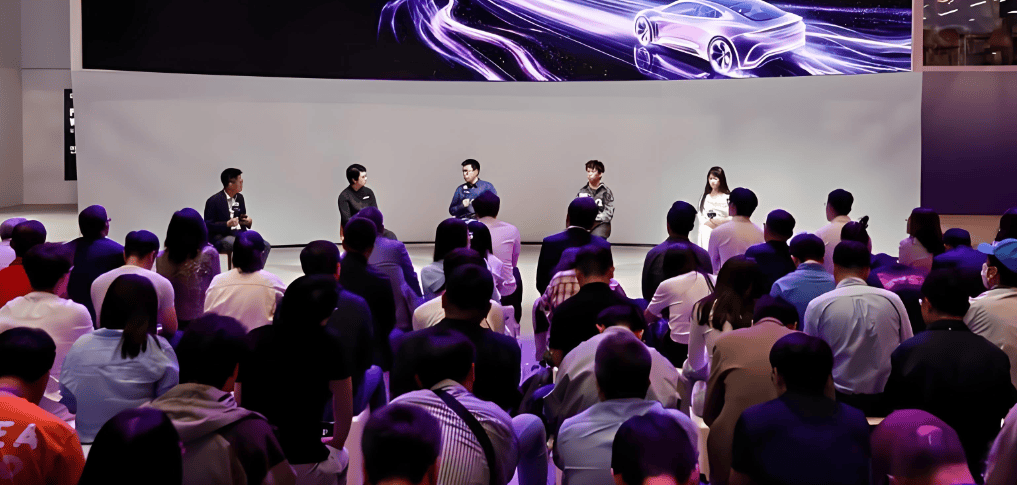
Ruan Chong's joining was a key highlight of the press conference. During his time at DeepSeek, Ruan Chong was the core R&D lead for multimodal technology, deeply involved in the development of the DeepSeek-V series multimodal models. In his first public speech as DeepRoute.ai's Chief Scientist, he systematically shared the company's technical architecture and phased achievements in the foundational model domain, and introduced the latest progress in building autonomous driving cognitive capabilities. Zhou Guang set a long-term strategic vision for DeepRoute.ai: to become the AI Infrastructure for the physical world, supporting the operation of the real world just like communications and electricity.
Regarding the choice of technical route, Zhou Guang gave a clear judgment: traditional small-model autonomous driving suffers from a significant "seesaw effect". The same system performs markedly differently in different time periods and cities, making iterative optimization unable to achieve substantial improvement or offer full-scenario safety coverage. Ruan Chong further pointed out that as autonomous driving enters the stage of mass production, the previous method of relying on multiple small models to handle tasks in a distributed manner has begun to expose issues like insufficient system stability and fluctuating performance in long-tail scenarios. The autonomous driving user experience has yet to form a stable and reliable foundation of trust.
Facing this stage-specific challenge, DeepRoute.ai proposed a new-generation technological path centered on a foundational model. Ruan Chong explained that the company is transitioning from a multi-small-model architecture to a unified foundational large model architecture. This foundational model unifies driving decision-making, scene understanding, and behavior assessment capabilities within a single framework, giving rise to three more specific models: Driver, Analyst, and Critic. The core logic of this architecture is to use larger model scales, higher quality data, and faster data loops to upgrade the autonomous driving system from an "execution system" to a "cognitive system," fundamentally solving the issue of capability fluctuations of small models in complex long-tail scenarios.
Improved R&D efficiency is a direct benefit brought by the foundational model. Ruan Chong disclosed that the single model iteration cycle has been compressed from over 100 hours to approximately 10 hours, and the data loop iteration cycle has been shortened from about 5 days to about 12 hours, significantly increasing operational efficiency. Ruan Chong also illustrated three paths the foundational model provides for accelerating development: identifying model problems through direct training and quickly recognizing data insufficiencies, using simulated operating environments to evaluate data quality and shorten iteration cycles, and real-time assessment and correction of the AI driver's performance.
Production data provides critical support for the continuous iteration of the foundational model. DeepRoute.ai disclosed at the conference that more than 300,000 production vehicles are currently equipped with its city-level assisted driving solution. Over the past year, vehicles equipped with the active safety system have collectively accumulated over 1.3 billion kilometers of real road operation, and total user driving companionship time has reached 44.8 million hours. The company has collaborated with brands including Great Wall Motor, Geely, Smart, and others, covering over 15 vehicle models with a price range mainly between 150,000 and 300,000 RMB. In 2026, DeepRoute.ai plans to push the delivery volume of its assisted driving system beyond 1 million vehicles, improve the MPCI indicator to over 1,000 kilometers, and increase the high-frequency user usage rate to over 50%.
Commercialization deployment for Robotaxi is also proceeding in parallel. During the Beijing Auto Show, Desay SV and DeepRoute.ai signed a cooperation agreement. They will jointly build an autonomous driving solution for Robotaxi L4 commercial scenarios based on the NVIDIA DRIVE Hyperion platform and embedded NVLink technology, advancing Robotaxi from technical validation to large-scale deployment. Zhou Guang further stated in an interview after the press conference that "to succeed in AI, mass production is the only path." Mass production is not just a story of scale; it is the starting point for the data flywheel—the larger the vehicle deployment, the faster the data loop, and the higher the evolution efficiency of the system becomes.
At the organizational level, AI technology is profoundly reshaping DeepRoute.ai's own R&D and management processes. Ruan Chong pointed out that from knowledge base question answering to automatic generation of programming code, from cross-departmental human-machine collaboration to the autonomous completion of experimental analysis, AI capabilities have permeated multiple core aspects of the company. The conference also held a cross-border dialogue on the theme "AI for what," hosted by Fudan University Professor Zhang Li, and participated in by Huo Jian, General Manager of Alibaba Cloud Intelligence AI Automotive Industry Solutions; Xu Yinghao, Head of World Models and Embodied Intelligence Technology at Ant Lingbo Technology; Hao Jingfang, founder of Aurora Wafter Academy; and Ruan Chong. The discussion covered the boundaries of large model capabilities, the technical route debate between world models and VLA models, and the societal impact of physical AI. Concurrently, DeepRoute.ai showcased a preview of its cockpit-driving integrated Agent functionality. This feature is positioned not as a traditional voice assistant but rather as an "AI brain" evolution of the system, capable of understanding user needs and proactively responding in complex scenarios.
This article is compiled by Wedoany. All AI citations must indicate the source as "Wedoany". If there is any infringement or other issues, please notify us promptly, and we will modify or delete it accordingly. Email: news@wedoany.com