en.Wedoany.com Reported - Besançon, France recently witnessed the completion of ViliaSprint², Europe's largest 3D-printed multi-residential building. Developed by Plurial Novilia, the project covers an area of 800 square meters and comprises 12 units across three floors. The building envelope was constructed using a COBOD BOD2 construction 3D printer and Holcim's printable concrete, making it a multi-residential building entirely formed through 3D printing construction processes.
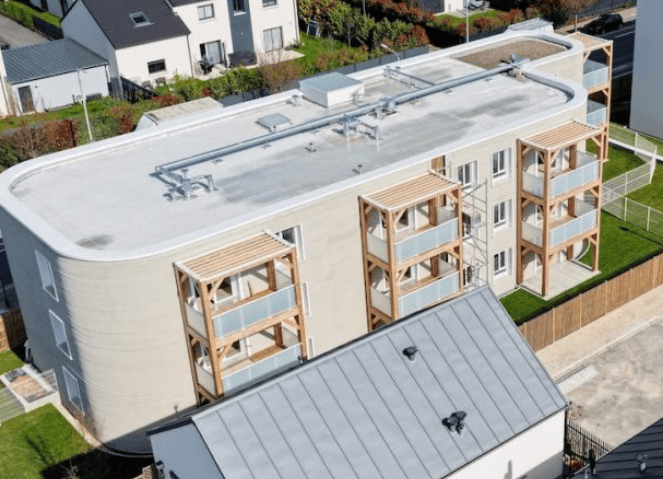
PERI 3D Construction managed the on-site printing operations. The wall printing for the entire 3D-printed building took 34 days, significantly less than the initially estimated 50 days. Henrik Lund-Nielsen, Founder and General Manager of COBOD International, stated that future 3D-printed building projects could reduce printing time to just 14 days if a 5 cm layer height is adopted.
As part of a comparative experiment, Plurial Novilia constructed a nearly identical building using traditional methods on the same plot. The comparison showed that the 3D-printed building was completed three months ahead of its traditionally built counterpart, reduced on-site personnel from six to three, lowered material waste from 10% to 5%, and decreased overall material usage by 10% due to the curved design.
Fabian Meyer-Brötz, Managing Director of PERI 3D Construction, stated that this project demonstrates how 3D construction printing can now achieve faster construction, fewer workers, and fully load-bearing structures. The walls of the 3D-printed building are fully load-bearing, with all loads transferred directly to the 3D-printed walls.
The 3D-printed building utilizes Holcim's printable concrete based on TectorPrint technology, reinforced with synthetic coarse fibers, and belongs to the carbon-reduced ECOPlanet series. Other features include perlite insulation, wooden balconies, photovoltaic panels, and a hybrid gas/heat pump system, achieving approximately 60% energy self-sufficiency and complying with the French RE2020 2025 standard.
Plurial Novilia and its partners plan to construct approximately 40 3D-printed units next, deploying two 3D printers to work simultaneously. The printing time is expected to be reduced by a factor of four, with costs potentially approaching those of traditional construction.
This article is compiled by Wedoany. All AI citations must indicate the source as "Wedoany". If there is any infringement or other issues, please notify us promptly, and we will modify or delete it accordingly. Email: news@wedoany.com