en.Wedoany.com Reported - According to the quarterly analysis report released by the SEMI Silicon Manufacturers Group (SMG) in Milpitas, California, USA, on April 29, 2026, global silicon wafer area shipments reached 3,275 million square inches in the first quarter of 2026, an increase of 13.1% compared to the 2,896 million square inches shipped in the same period of 2025. On a quarter-over-quarter basis, shipments decreased by 4.7% compared to the 3,437 million square inches in the fourth quarter of 2025, aligning with typical seasonal fluctuation patterns.
In the report, Yada Ginji, Chairman of SEMI SMG and Chairman of SUMCO North America, stated that silicon wafer demand related to AI data centers remains robust, covering advanced logic chips, memory, and has expanded into the power management device sector. Yada Ginji also noted that while overall demand is improving, the recovery is uneven. Several equipment companies have observed signs of improvement in the industrial semiconductor sector, and as wafer inventories are gradually absorbed, a broader recovery is taking shape. Weak smartphone and personal computer shipments in the first quarter may indicate tightening memory supply due to decisions regarding AI high-bandwidth memory allocation.
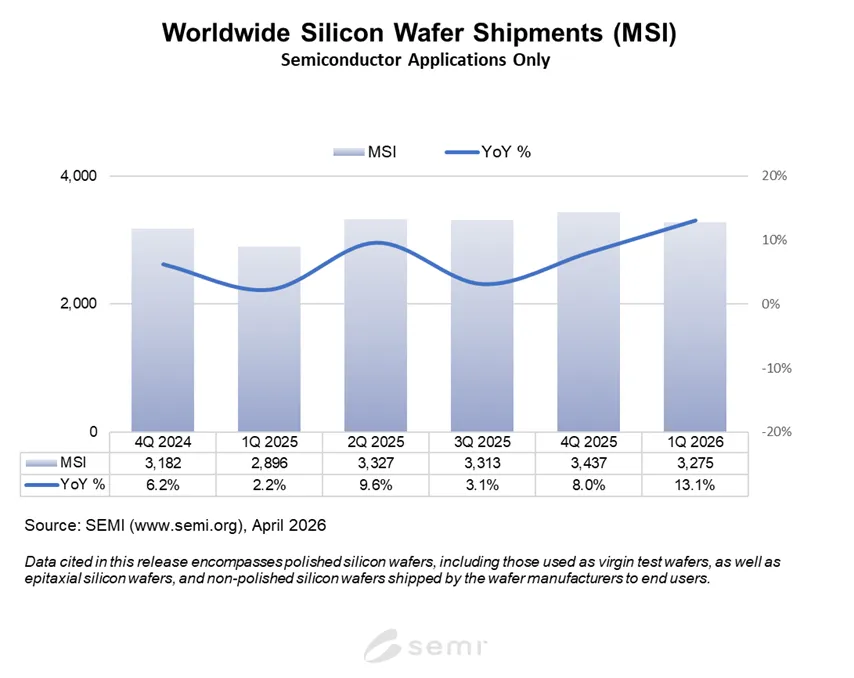
SEMI SMG is the industry-recognized authoritative source for global semiconductor silicon wafer shipment statistics, with its members covering over 90% of global silicon wafer producers, including major manufacturers such as Shin-Etsu Chemical, SUMCO, GlobalWafers, Siltronic, and SK Siltron. Silicon wafer area shipments, measured in millions of square inches, serve as one of the core leading indicators for gauging the health of the semiconductor industry, with the data directly reflecting the demand intensity for basic raw materials in the integrated circuit manufacturing sector.
From a demand structure perspective, the pull effect of AI data centers on advanced process silicon wafers remains significant, with advanced logic chips and memory sectors forming the demand base. The expansion of demand for power management devices reflects that AI infrastructure power supply systems are becoming a new growth pole. The weakness in consumer electronics and the high prosperity in the AI sector have created a structural divergence. Memory supply is tightening due to capacity crowding by AI high-bandwidth memory, and this supply-demand structure will continue to influence the silicon wafer market in the coming quarters.
This article is compiled by Wedoany. All AI citations must indicate the source as "Wedoany". If there is any infringement or other issues, please notify us promptly, and we will modify or delete it accordingly. Email: news@wedoany.com