Australia's Q-CTRL and IBM Achieve 3000x Acceleration in Quantum Material Simulation, Completing a 100-Hour Classical Supercomputing Task in 2 Minutes
en.Wedoany.com Reported - Sydney, Australia-based quantum infrastructure software company Q-CTRL announced on May 6, 2026, in Los Angeles, California, that it has achieved a 3,000-fold speed improvement in energy material science simulations using IBM's quantum computing platform. The demonstration compressed a computational task that would take a classical supercomputer over 100 hours into just 2 minutes. Q-CTRL CEO and founder Michael J. Biercuk stated in the announcement that this result marks quantum computing's entry into the "practical quantum advantage" phase—where quantum computers begin generating a positive return on investment for commercially relevant problems that early adopters genuinely care about.
The core technology carrier for this demonstration was a 120-qubit quantum processor on the IBM Quantum Platform, running a dynamical evolution simulation of the Fermi-Hubbard model, a foundational framework for describing electron interactions in one-dimensional materials. The simulation executed over 10,000 two-qubit logic gate operations and up to 90 Trotter steps, a depth that typically leads to significant error accumulation on noisy intermediate-scale quantum hardware.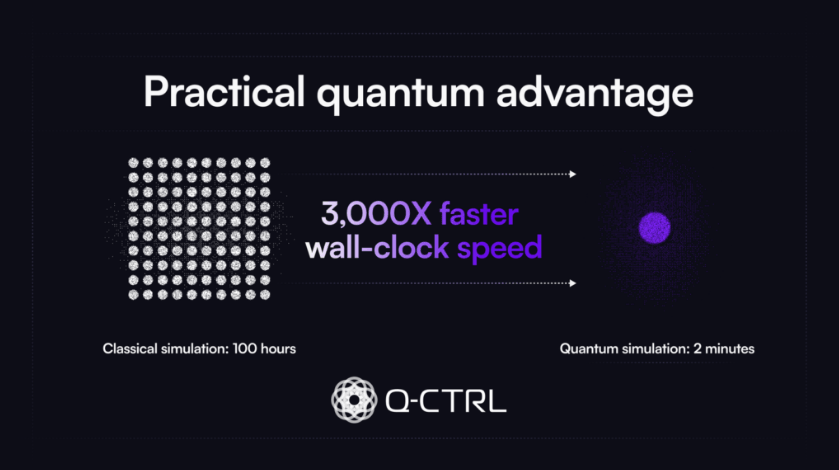
To overcome this bottleneck, Q-CTRL deployed its performance management infrastructure software, Fire Opal, implementing runtime error suppression. This kept the root-mean-square error of the computation results within approximately 1% of the classical benchmark while maintaining the hardware's native speed. Unlike traditional error mitigation methods that rely on large-scale sampling, this software-defined, real-time error correction strategy directly reduced computational overhead, ensuring end-to-end acceleration efficiency for the entire machine.
The Q-CTRL team directly compared the quantum computation results with a classical time-dependent variational principle solver developed by the Flatiron Institute. According to publicly disclosed data, at low resolution, the quantum simulation results were consistent with the classical method; when the classical side increased resolution for higher precision, its computation time rapidly exceeded 100 hours, while the quantum processor continued to return solutions of equivalent accuracy in about two minutes. This comparison forms the quantitative basis for the 3,000x acceleration. In more granular experiments, the team conducted specialized tests using 62 qubits and successfully observed the spin-charge separation phenomenon, where electron spin and charge propagate at different speeds. The simulated evolution time reached t=9 in natural units, surpassing previously publicly reported quantum simulation results in both scale and resolution. The paper has been published on arXiv, with preprint number 2605.04025.
The Fermi-Hubbard model chosen for this demonstration is directly relevant to core energy sector topics such as research into superconductivity mechanisms, optimization of photovoltaic material efficiency, and design of energy storage materials. Public data indicates that nearly one-third of the computing time at global supercomputing centers is currently dedicated to chemistry and materials-related computational tasks. Large energy companies spend hundreds of millions of dollars annually on computing costs within their materials simulation stacks. A 3,000x compression in wall-clock time translates to a step-change efficiency improvement, from producing one simulation result per week to generating a complete material phase diagram in minutes. Q-CTRL has integrated the software configuration used in this demonstration into the IBM Quantum Platform and will soon make it available to industrial and academic researchers worldwide as a Qiskit Function, allowing quantum-accelerated simulations to be directly embedded into existing materials discovery workflows. Andre Konig, CEO of Global Quantum Intelligence, commented that Q-CTRL's emphasis on runtime error suppression proves that speed is a key advantage of quantum computers, and that quantum hardware can indeed surpass state-of-the-art classical architectures in end-to-end execution time. A spokesperson for the IBM quantum ecosystem stated that the industry has moved past the discussion of "whether quantum computers are useful" and entered the phase of "how to best use quantum computers."
This article is compiled by Wedoany. All AI citations must indicate the source as "Wedoany". If there is any infringement or other issues, please notify us promptly, and we will modify or delete it accordingly. Email: news@wedoany.com
Related Products
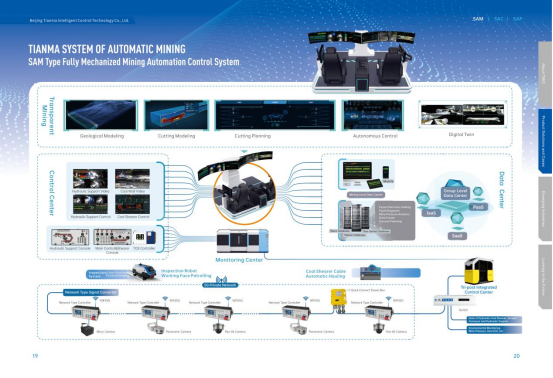

Comprehensive Mining Automation Control System
Beijing Tianma Intelligent Control Technology Co., Ltd.

GYTA Type Non-Self-Supporting Aerial/Duct Optical Cable
TONGDING INTERCONNECTION INFORMATION CO., LTD.
Industrial and Commercial Point-Type Gas Detector
Jinan Benan Technology Development Co., Ltd.


TWP16 P-Band Tropospheric Wind Profile Radar
China Huayun Meteorological Technology Group Co., Ltd.
20 Inch 1600*900 Full HD 60Hz TFT LED Monitor with VGA and DP Interfaces for Desktop Computers-Business Use
Guangzhou Zanying Optoelectronics Technology Co., Ltd.
Multi-function Marine Monitoring Low-altitude Detection Radar Sea-air Boundary Ocean Dynamic Environment Measurement
Chengdu Dixin Technology Co., Ltd.