en.Wedoany.com Reported - Researchers from the German Fraunhofer Center for Silicon Photovoltaics (CSP), the Fraunhofer Institute for Microstructure of Materials and Systems (IMWS), and the Forschungszentrum Jülich have jointly developed a non-destructive method for quantifying moisture ingress in photovoltaic modules on-site. This technique utilizes Near-Infrared Absorption (NIRA) spectroscopy, calibrated via Karl Fischer Titration (KFT), allowing inspectors to determine internal humidity levels without disassembling the modules.
"This method requires no modification to the bill of materials or the addition of extra sensors, and once calibrated, it is broadly applicable to field modules," said corresponding author Anton Mordvinkin. "It does not rely on assumptions such as Henry's Law, nor is it affected by variations in barrier properties or uncertainties in the internal microclimate."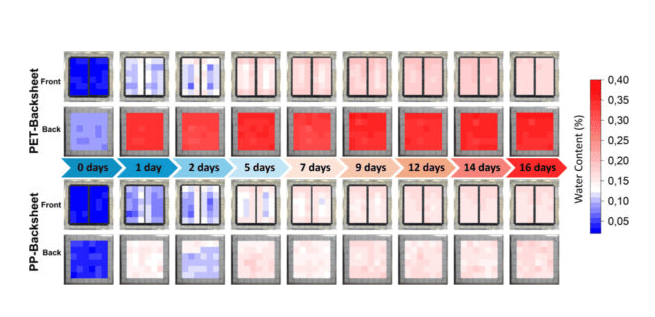
The research team conducted damp heat tests on encapsulation materials like Ethylene-Vinyl Acetate (EVA) and Polyolefin Elastomer (POE), as well as backsheets such as PET and PP, establishing calibration curves between NIRA signals and absolute moisture content. Field tests showed that PET-based modules absorb more moisture than PP-based modules; modules with cracked backsheets and cells exhibited moisture content as high as 50%, while modules with cracked AAA backsheets absorbed water ten times faster than intact ones.
"The improved barrier performance of PP is primarily determined by its lower water solubility, while the diffusion coefficients of the two materials are similar," said Mordvinkin. He added: "After 7 years of outdoor exposure, modules with severely degraded backsheets exhibit non-uniform moisture distribution, with significantly enhanced local moisture accumulation at cell micro-cracks, correlating with snail trail patterns, indicating a coupling between mechanical degradation and moisture ingress."
The study, published in Progress in Photovoltaics: Research and Applications, provides a new tool for photovoltaic module lifetime prediction and power plant inspection.
This article is compiled by Wedoany. All AI citations must indicate the source as "Wedoany". If there is any infringement or other issues, please notify us promptly, and we will modify or delete it accordingly. Email: news@wedoany.com