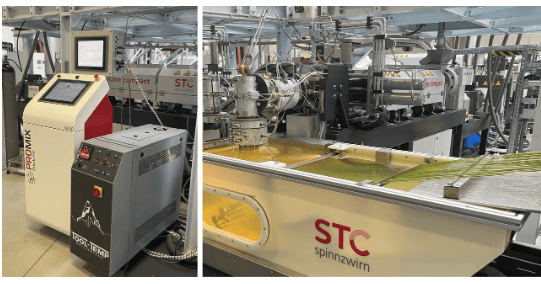
en.Wedoany.com Reported - Promix Solutions AG of Winterthur, Switzerland, and STC Spinnzwirn GmbH of Chemnitz, Germany, have jointly developed a patent-pending process that increases the volume of artificial grass blades by 10% to 20% through microcellular technology, using the same raw materials, or reduces plastic consumption by 10% to 20% while achieving equivalent density. The technology integrates the Promix Microcell system into STC's fiber extrusion line, creating a microcellular structure within polyolefin filaments.
Conventional fiber extrusion produces monofilaments or tapes that must then be tufted into grass mats, requiring more raw material to increase density. The new process injects a precise amount of environmentally neutral gas (such as CO₂ or nitrogen) into the polymer melt during extrusion. Through cooling and mixing, the gas is completely dissolved. After the melt temperature is lowered, extremely fine microcellular bubbles are formed through the spinneret. Technical documentation notes: "The challenge lies in precisely controlling bubble formation to achieve the smallest possible and highly uniform cell structure." The filaments are subsequently stretched 4 to 10 times without breaking, with production speeds maintained at 100 to 600 kilograms per hour.
The microcellular fibers develop a textured surface, presenting a natural grass appearance with green hues shimmering in different shades, greatly improving upon the plastic look of traditional artificial grass. Mechanical tests show that their tensile strength and elongation at break are slightly lower than conventional fibers, and they currently do not meet the durability requirements for high-wear scenarios such as football fields. Researchers are attempting to encapsulate the microcellular structure with a conventional outer layer to enhance performance.
This technology directly reduces plastic consumption and lowers costs, promising to accelerate the adoption of artificial grass in water-scarce regions and applications focused on sustainability. Promix and STC have evaluated its use in carpets and apparel made from polyester, polypropylene, or polyamide fibers, where future products will become denser or lighter. This microcellular technology offers plastics processors a competitive advantage by reducing material usage by up to 20% while maintaining product characteristics.
This article is compiled by Wedoany. All AI citations must indicate the source as "Wedoany". If there is any infringement or other issues, please notify us promptly, and we will modify or delete it accordingly. Email: news@wedoany.com