en.Wedoany.com Reported - Dutch company inSystem.io has recently launched a new sorting device called the "Gravity Sorter," capable of removing up to 50 portable batteries per second from mixed waste streams, achieving a purity rate of over 96% in recent facility trials. The announcement points out that global recycling operators face the severe problem of batteries entering household waste in large quantities.
According to information provided by the company, only about 50% of portable batteries are recycled in the Netherlands, with the global recycling rate estimated at around 15%. Recent studies indicate that a fully loaded municipal waste collection truck contains an average of 252 portable batteries. Once batteries enter the municipal solid waste stream and undergo processes like shredding, screening, and magnetic separation, they become difficult to separate from metallic components, causing economic and operational issues for recycling facilities, as batteries contain both recyclable materials and pose contamination and fire risks.
inSystem.io stated that previously, the only available method for the municipal solid waste battery stream was manual sorting, which brings safety, accuracy, and labor cost issues, while unsorted batteries contaminate ferrous metal waste output or cause fires downstream. The Gravity Sorter is specifically designed for a material range of 5 mm to 70 mm, where traditional optical sorting systems often encounter difficulties due to small material size, high density, irregular shapes, and unpredictable aerodynamic properties.
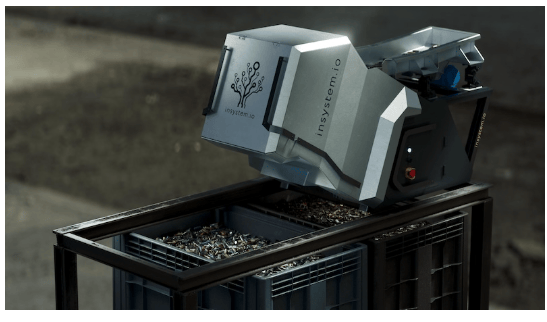
The device does not use a conveyor belt sorting method but processes materials in free fall. An artificial intelligence vision system operating at 400 frames per second tracks the movement, rotation, and trajectory of each object as it falls, with compressed air nozzles ejecting target materials at precisely timed intervals. Evgeny Gudov, CEO of inSystem B.V., said: "We built the Gravity Sorter to handle material fractions that have historically been difficult to sort at scale. By developing a new approach, we eliminated conveyor belts and delay-based ejection. The device works in free fall, with AI cameras tracking the speed, acceleration, and rotation of each object during its descent for precisely timed ejection. This saves energy and improves accuracy."
Gudov also stated that the free-fall method reduces energy consumption compared to conveyor-based sorting systems. He said: "If an object is going to hit a wall anyway, why waste energy accelerating it to 3 m/s on a conveyor belt? If you just drop it from the height of an ordinary chair, gravity accelerates it to the same speed. The same logic applies to air. Nozzles open only at the calculated ejection moment and only according to the object's shape. With 500 on/off cycles per second, no air is wasted on gaps between objects. This alone saves a significant amount of compressed air compared to older systems. In some cases, the energy saved is enough to pay for the equipment itself."
The company states that the system can process 6 tonnes of material per hour, is designed to integrate into existing recycling lines without major modifications, and can be used for e-waste fragments, plastics, non-ferrous metals, construction waste, and incinerator bottom ash recovery. The system can also be upgraded with sensing technologies such as NIR, SWIR, LWIR, and X-ray imaging for identifying different plastic polymers and material types. According to inSystem.io, the Gravity Sorter garnered strong interest at the IFAT Munich 2026 trade fair, with recycling operators and plant engineers from Europe, Canada, Australia, and Latin America requesting pilot evaluations. The company is currently accepting pilot projects and early commercial orders for the system.
This article is compiled by Wedoany. All AI citations must indicate the source as "Wedoany". If there is any infringement or other issues, please notify us promptly, and we will modify or delete it accordingly. Email: news@wedoany.com