en.Wedoany.com Reported - With the deep integration of big data, cloud computing, artificial intelligence, and Internet of Things technologies, data elements are becoming the core production factor driving the development of the digital economy. Against the backdrop of continuously deepening market-oriented allocation reforms for data elements and escalating demands for enterprise digital transformation, how to break down data silos, revitalize data assets, and efficiently transform massive, multi-source data into business capabilities that can be aggregated, governed, shared, and operated has become a core issue of common concern for government and enterprise organizations.
As a key hub connecting data resources and business scenarios, the data middle platform can integrate core capabilities such as data collection, storage, computing, governance, analysis, services, and security control, supporting data asset management, agile development, and scenario-based implementation. To guide enterprises in scientifically planning, orderly constructing, and continuously optimizing their data middle platforms, the China Academy of Information and Communications Technology (CAICT), relying on the Big Data Technology and Standards Promotion Committee of the China Communications Standards Association (CCSA TC601), joined forces with dozens of industry institutions and enterprises, including China Mobile Communications Group Co., Ltd., Industrial and Commercial Bank of China Limited, Shanghai Pudong Development Bank Co., Ltd., China United Network Communications Co., Ltd., Ping An Bank Co., Ltd., and Alibaba Cloud Computing Co., Ltd., to jointly develop the "Data Middle Platform Capability Maturity Model" series of standards.
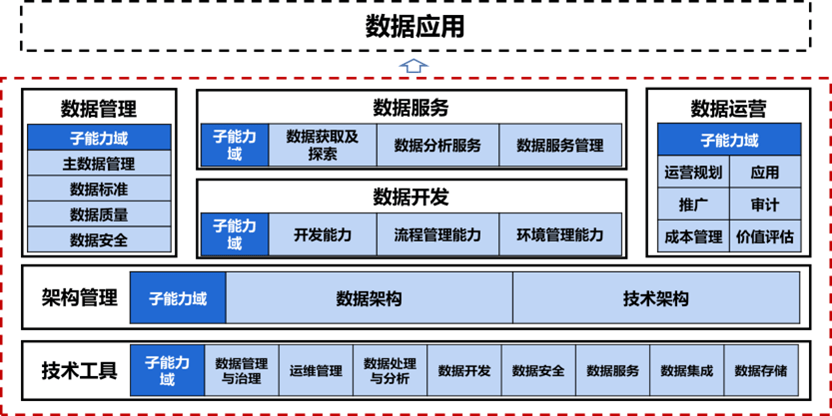
This series of standards systematically outlines the evaluation methods for data middle platforms, covering six major capability domains: technical tools, architecture management, data development, data services, data management, and data asset operations. The technical tools capability domain, from a product functionality perspective, collectively represents the complete set of technical tool capabilities required for an enterprise to build a data middle platform. It is specifically subdivided into sub-capability domains such as data management and governance, operations management, data processing and analysis, data development, and data security, further broken down into 283 capability items, each with detailed graded capability requirements. The architecture management capability domain specifies capability requirements for each level across five dimensions: service architecture, data architecture, data integration architecture, platform architecture, and security architecture.
In terms of maturity level classification, this series of standards divides evaluation results into five levels: Entry Level, Progressive Level, Excellent Level, Superior Level, and Leading Level. Enterprises can use this to systematically assess their own data middle platform construction and application levels, clarify their current maturity stage, and identify capability gaps and improvement directions. In the evaluation practices already initiated, the Industrial and Commercial Bank of China (ICBC) successfully completed all content of the Data Middle Platform Capability Maturity Model – Data Service Capability Domain evaluation, becoming the first enterprise in the financial industry to complete this assessment. This evaluation covered three major capability domains: data acquisition and exploration services, data analysis and mining services, and data service management, encompassing a total of 115 capability items. To date, ICBC's data middle platform has achieved full coverage of ratings for DataOps, Data Asset Management (DCMM), technical platform support, and data services. Its big data R&D work efficiency has increased by approximately 50%, model R&D work efficiency has increased by about 40%, empowering high-quality digital transformation across more than 1,000 business scenarios throughout the bank.
Evaluation Process
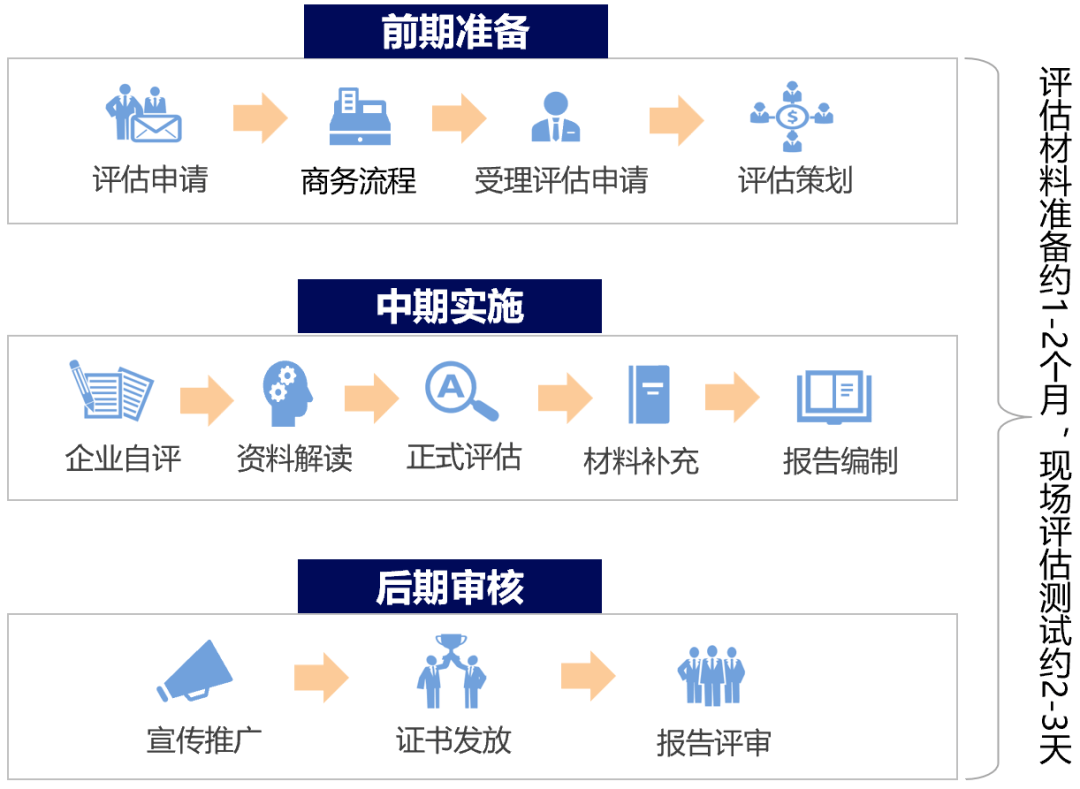
As an internal organization of the China Communications Standards Association, CCSA TC601 has long focused on identifying and addressing major issues facing the development of big data and artificial intelligence, conducting research on common foundational standards in areas such as big data technology, data asset management, data circulation and utilization, data security, large models, and intelligent agents. The committee has established six major standard systems, has 351 partners and 15 working groups, and has previously carried out multiple initiatives in the data middle platform domain, resulting in the "Data Middle Platform Solution Graded Capability Requirements" for product suppliers, the "Data Middle Platform Supplier Service Capability Graded Capability Requirements" for implementation service providers, and the "Data Middle Platform Capability Maturity Model" series of standards for application parties. This series of standards complements the DCMM (Data Management Capability Maturity Model) led by CAICT; DCMM focuses on evaluating an organization's overall data management capabilities, while the Data Middle Platform Capability Maturity Model focuses on evaluating the capabilities of the middle platform as a specific technical platform.
The successive release and implementation evaluation of the "Data Middle Platform Capability Maturity Model" series of standards provide a quantifiable technical reference framework for enterprises across various industries in the construction planning, capability evaluation, and continuous optimization of data middle platforms. This holds positive practical significance for promoting the standardized and orderly development of China's big data industry and accelerating the digital and intelligent transformation process of government and enterprises.
This article is compiled by Wedoany. All AI citations must indicate the source as "Wedoany". If there is any infringement or other issues, please notify us promptly, and we will modify or delete it accordingly. Email: news@wedoany.com