en.Wedoany.com Reported - Orbia's Fluorine & Energy Materials (FEM) business unit has received £1.4 million (approximately US$1.87 million) in funding from the UK government to establish the country's first graphite recycling project. The project aims to address the issue that graphite content in lithium-ion batteries is far higher than lithium—graphite is used in the anode to store lithium ions and accounts for about 30% of the battery's weight.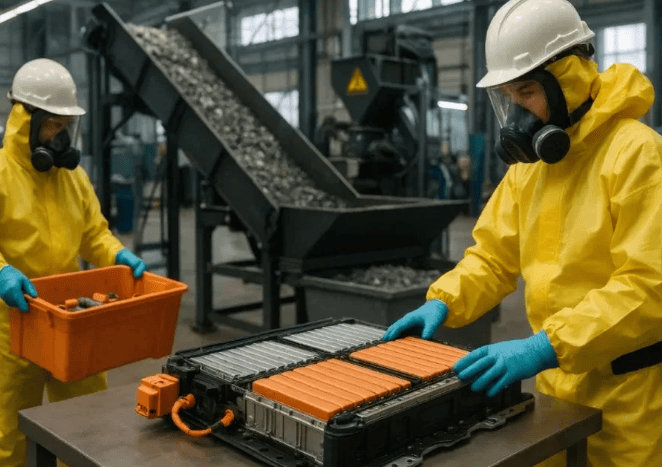
As electric vehicle demand grows and renewable energy and energy storage components increase, graphite is crucial to the energy transition. The project aims to support the UK's domestic battery supply chain and advance the circular economy. The recycling hub is part of the UK's £4 billion (approximately US$5.4 billion) DRIVE35 project, implemented in partnership with the Department for Business and Trade, the Advanced Propulsion Centre UK, and Innovate UK. Ultimately, this collaboration aims to accelerate automotive sector R&D and scale up for a low- or zero-emission future.
Graphite currently faces serious supply-demand issues; global graphite demand is projected to exceed supply by approximately 2.3 million tonnes by 2035. The UK's investment aims to reduce reliance on overseas supply chains, particularly dependence on regions like China—which supplies 95% of the world's natural and synthetic graphite. "This investment marks a significant milestone, representing a major step towards establishing a domestic circular supply chain for battery materials and supporting the UK's transition to a more sustainable, zero-emission future," said John Jaddou, Global New Business Development Director at Orbia FEM. "It also creates high-skilled jobs in this foundation, which is critical for electric vehicles, the circular economy, and long-term decarbonization. With decades of expertise in scaling complex fluorine-based chemical industrial processes, Orbia is uniquely positioned to prove that graphite recycling is technically robust and commercially viable, laying the groundwork for future industrial-scale facilities."
According to Orbia, most graphite is sent to landfill or incinerated, leading to material waste and CO2 emissions. It is estimated that by 2030, over 236,000 tonnes of graphite will be available for recycling annually, creating a US$2.6 billion market opportunity. Natural graphite requires mining, classification, and extensive processing, while synthetic graphite, made from petroleum by-products, is produced through high-temperature graphitization (up to 3000°C), consuming vast amounts of energy and emitting significant CO2.
Orbia's FEM business unit has developed a proprietary technology for recovering, purifying, and upcycling graphite from domestic feedstocks. The process focuses on extracting graphite from "black mass"—the powder produced after end-of-life batteries are shredded and valuable metals like lithium, nickel, and cobalt are removed. Using a multi-step purification method involving hydrofluoric acid, Orbia refines the recovered graphite to meet the physical and chemical standards required for battery anodes, ultimately yielding ultra-high-purity upcycled graphite with performance comparable to virgin graphite.
"These projects demonstrate the UK's determination to lead the transition to zero-emission transport," said Ian Constance, CEO of the Advanced Propulsion Centre UK. "By driving the UK government's DRIVE35 funding program, we are transforming world-class innovation into industrial capability. Together with partners at the Department for Business and Trade and Innovate UK, we are supporting manufacturers, empowering SMEs, and strengthening the UK's sovereign supply chain. This multi-million-pound support package is not just an investment in technology, but an investment in the people, skills, and businesses that will define the future of clean transport. Together, we are building a competitive, resilient, and sustainable foundation for the automotive industry."
A key advantage of Orbia's technology is its commercial viability. The project will operate in kilogram-scale batches, establishing a critical foundation for future large-scale industrial plants. Orbia's multi-phase project is in the planning stage and is expected to commence in early 2026; installation and output are anticipated by the end of 2026. The company has also established R&D capabilities in the UK through its Energy Materials business unit, with a dedicated technical center in Chester playing a core role in advancing battery material innovation, including electrolyte and solvent system development, lithium-ion battery prototyping and testing, and inorganic materials research.
Traditionally, graphite recycling has been uneconomical because graphite's market value is lower than other battery materials like lithium, nickel, and cobalt. Orbia's innovation changes this dynamic, making recycled graphite cost-competitive with virgin graphite while having a significantly lower carbon footprint. Preliminary assessments by Orbia's sustainability team indicate that its recycled graphite has a carbon footprint only one-quarter that of synthetic graphite and half that of mined natural graphite. To support large-scale commercialization, Orbia is collaborating with leading OEMs and battery manufacturers to build a fully circular supply model, aiming to return upcycled graphite directly into customer supply chains for use in batteries and other automotive applications, helping to achieve net-zero goals.
This article is compiled by Wedoany. All AI citations must indicate the source as "Wedoany". If there is any infringement or other issues, please notify us promptly, and we will modify or delete it accordingly. Email: news@wedoany.com