Norway's Svalbard Global Seed Vault Wins Princess of Asturias Award, Storing 1.3 Million Seed Samples
en.Wedoany.com Reported - The Svalbard Global Seed Vault has recently been awarded the 2026 Princess of Asturias Award for International Cooperation, an accolade recognizing its status as a "model of international cooperation for safeguarding global food security." Located in the frozen mountains of the Arctic Svalbard archipelago, over 1,000 kilometers from the North Pole, the facility stores more than 1.3 million seed samples from nearly every country in the world, aiming to ensure the survival of critical crops in the face of war, natural disasters, or climate crises.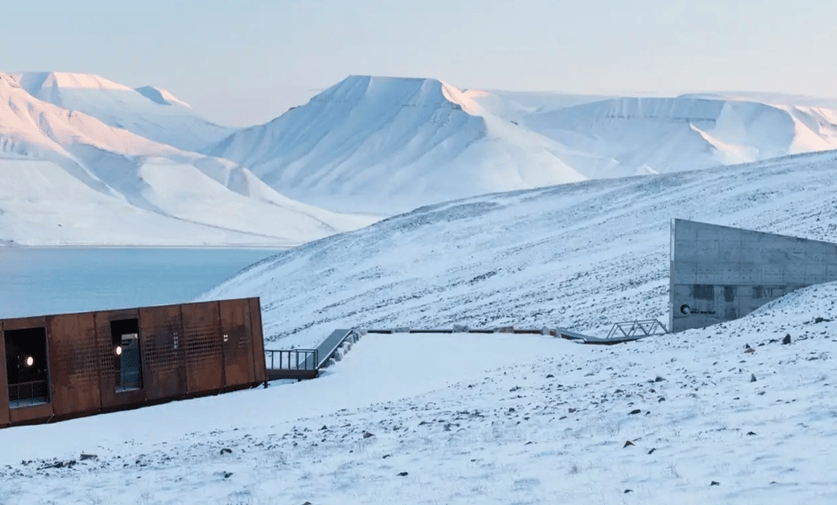
Designed by architect Peter W. Söderman for the Norwegian Ministry of Agriculture in 2008, the seed vault operates as the world's largest backup facility for seeds and crops. Its core objective is to protect agricultural genetic diversity against the impacts of natural disasters, conflicts, or climate change. According to the Norwegian government, the approximately 1,000-square-meter facility utilizes the natural cold of the permafrost and its own geological conditions as a backup cooling system. The seeds are stored at around minus 18 degrees Celsius in three underground chambers at the end of a 130-meter-long tunnel. Managers estimate that the vault has already preserved about 50% of the planet's plant diversity.
From the outside, the only visible part of the seed vault is a geometric concrete structure protruding from the mountain, like the bow of a ship breaking through snow, described by MAST Architects as "a concrete prow jutting out of the mountain." The facility is designed to withstand earthquakes, war, volcanic activity, and rising sea levels, intended as a sanctuary that can last for centuries. The entire design is extremely austere, with every decision serving preservation and durability.
The entrance incorporates a powerful visual intervention. The artwork "Permanent Echoes," created by Norwegian artist Dyveke Sanne, is installed on the roof and upper entrance facade, using highly reflective stainless steel triangles to make the building visible from a distance both day and night.
With climate change and new technical requirements, the complex underwent an expansion in 2019. Norwegian architecture firm Snøhetta was commissioned by Statsbygg and Olav Olsen to design the technical extension. The new building serves as a service and registration space before seeds are transferred to the underground storage chambers and contains administrative offices and technical rooms, where the heat generated is insulated to avoid affecting the permafrost.
The extension maintains a minimalist aesthetic, with volumes designed to be as flat as possible so as not to alter the Arctic landscape. The building is clad in black steel, intended to oxidize over time due to the extreme climate into a reddish-brown hue, symbolizing the seasonal color changes of the Svalbard landscape. The structure is supported on steel piles anchored into the ground to cope with the pressures generated by the seasonal thawing of the permafrost. Snøhetta's documentation explains that this design allows the building to withstand the continuous movement of the ground while maintaining a contemporary feel.
This article is compiled by Wedoany. All AI citations must indicate the source as "Wedoany". If there is any infringement or other issues, please notify us promptly, and we will modify or delete it accordingly. Email: news@wedoany.com
Related Products



Industrial and Commercial Point-Type Gas Detector
Jinan Benan Technology Development Co., Ltd.
MH220E Two-Row Hybrid Packaged Cotton Picker
CHINA RAILWAY CONSTRUCTION HEAVY NDUSTRY XINJIANG CO., LTD.

4HS-8 High-efficiency Peanut Inverted-laying Harvester
Hebei Yongfa Hongtian Agricultural Machinery Manufacturing Co., Ltd.
714CD Series C-Band Weather Radar
Chengdu Zhongdian Jinjiang Information Industry Co., Ltd.