Incus and MetShape Promote Lithography-Based Metal Manufacturing, Dental Bracket Production Capacity Tripled
en.Wedoany.com Reported - Incus GmbH and MetShape GmbH are jointly advancing Lithography-based Metal Manufacturing (LMM) from research laboratories to factory floors, with the technology making progress in medical devices, dental products, and precision engineering. During AMA Healthcare 2025, Dr. Gerald Mitteramskogler, CEO and founder of Incus, and Dr. Lucas Vogel, CEO of MetShape, shared how LMM technology is establishing decisive advantages in the niche market of small, complex metal parts.
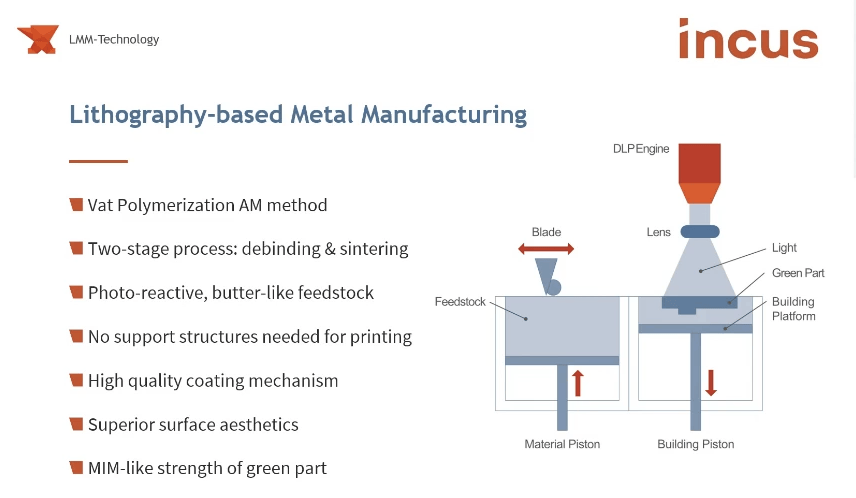
LMM works by using a projector to cure metal powder-filled resin layer by layer, followed by debinding and sintering the parts to near full density. This process provides a manufacturing route for producing highly complex metal parts, addressing issues that metal injection molding (MIM) or other additive technologies struggle to handle effectively with small parts. Two data points illustrate the development pace: MIM production capacity for dental brackets tripled, and costs for surgical instrument components reduced by up to ten times; a target under development is achieving an annual output of two million parts using only two printers.
Lithography-based Metal Manufacturing borrows the optical mechanism of stereolithography, applied to photopolymer resins with a metal powder loading of approximately 55% by volume. The resin is solid at room temperature, liquefied layer by layer by a heated recoater blade, and then cured from above by a projector. The green parts require no support structures, as the material acts as its own support medium during manufacturing, directly impacting surface quality and geometric complexity. Mitteramskogler stated that this can produce metal additive manufacturing green parts that are essentially unmatched in quality, complexity, and surface aesthetics. The powder used has a D50 in the range of 8 to 12 micrometers, consistent with MIM feedstock, with particles as small as 4 to 6 micrometers used when necessary. The 45% volume shrinkage accompanying debinding is predictable and isotropic, compensable during the design phase.
Incus offers two machine categories. The Hammer Evo has a build platform of 89.6 by 56 millimeters, suitable for prototyping and small batch production. The Hammer Pro series expands the build area to 200 by 204.55 millimeters, focusing on densely placing small parts on each platform to reduce unit costs. The Hammer Pro is approximately seven times more cost-effective per part than the Evo, due to platform utilization. The production environment requires no handling of loose powder, high-power laser equipment, or inert atmospheres; any unused resin after a print job is fully recyclable, with non-recoverable losses estimated at about one percent.
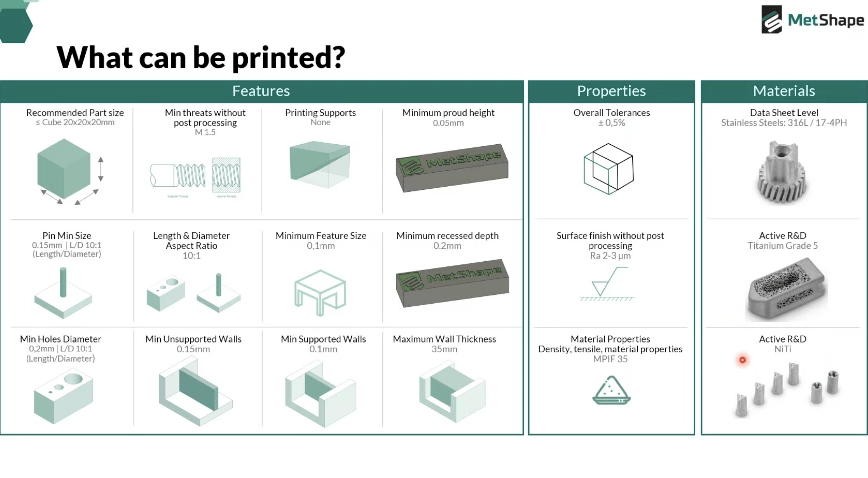
MetShape, a spin-off from Pforzheim University, offers manufacturing services and application development. The company supports customers from feasibility verification to target quantity production. A project under development targets 2 million parts per year, manufacturable with just two printers. The cost-effectiveness threshold for production applications is approximately a 2-centimeter cube; parts within this range allow dense arrangement on the build platform. MetShape demonstrates surface roughness of about 2 micrometers Ra without post-processing, internal threads machined directly to M1.5 in the sintered state, and dimensional tolerances below 0.5% of the target value, with debinding and sintering for most part geometries completed in 24 hours or less.
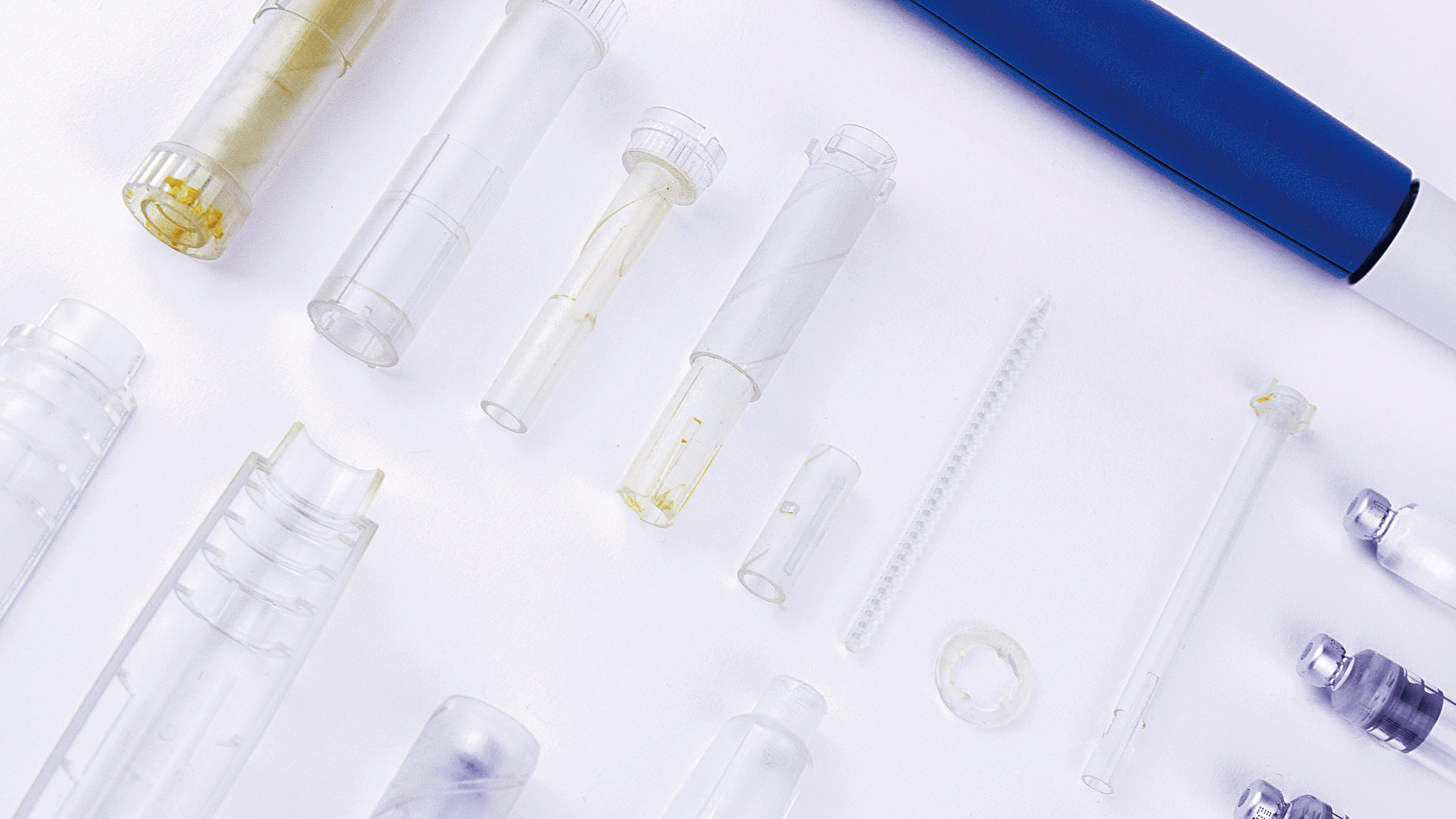
In medical applications, two public cases form the core of the demonstration. The first involves a colorectal stapler developed by the Dutch company Implican, whose functional head contains multiple precision metal parts manufactured by MetShape, achieving cost reductions of six to ten times compared to traditional routes, with first-in-human studies expected in 2026. The second case involves dental brackets; on the Hammer Pro, MetShape demonstrated production capacity nearly three times that of MIM, while retaining the geometric freedom to introduce new bracket profiles without mold investment. In research and development, nickel-titanium alloys have become a focus, with their pseudoelastic properties suitable for minimally invasive surgical tools and actuators.
The gap LMM targets is moving from demonstrating process capability to delivering consistent and cost-effective output at clinical volumes. The strategy of both companies revolves around vertical specialization to compress the distance from prototype to production-ready components for small parts. AM Ventures invested in MetShape's expansion in 2021, with the seed round based on the argument that sintering-based two-step processes are becoming increasingly important for producing larger quantities of metal parts. These signals indicate that LMM is no longer viewed as a research-stage technology; the current question is how quickly it can gain qualification in applications where precision, part complexity, and unit cost intersect.
This article is compiled by Wedoany. All AI citations must indicate the source as "Wedoany". If there is any infringement or other issues, please notify us promptly, and we will modify or delete it accordingly. Email: news@wedoany.com