South Korea's HanmiGlobal to Host Global PM Summit in the AI Era
en.Wedoany.com Reported - On June 2, South Korean construction project management company HanmiGlobal announced that it will host the "Global PM Summit 2026" on June 19 at the Art Hall on the 4th floor of the West Wing of POSCO Center in Gangnam-gu, Seoul. With the theme "Rewriting the Future of Global PM in the AI Era," the summit will focus on the impact of artificial intelligence on construction project management models, technological tools, and industry growth paths.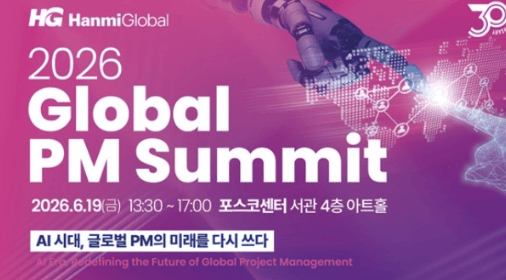
This summit is part of the series of events celebrating HanmiGlobal's 30th anniversary, with topics clearly pointing to the ongoing changes in management methods within the construction industry. Traditional construction project management primarily revolves around schedule, cost, quality, safety, contracts, and multi-party coordination. The larger the project scale, the more pronounced issues become, such as information fragmentation, schedule changes, risk identification, and delayed on-site feedback. With the introduction of AI into construction project management, the industry's focus is shifting from mere planning and manual coordination to data-driven process monitoring, schedule prediction, risk early warning, design conflict identification, and cross-disciplinary collaboration. The summit will concentrate on discussing key technologies such as digital twins, BIM, AI-based schedule monitoring, and system autonomy, reflecting the transition of PM from experience-based management to intelligent decision support.
The lineup of international guests also highlights the global positioning of the event. David Whysall, Chief Operating Officer of the UK-based project management company Turner & Townsend, will deliver a keynote speech on the company's growth strategy in the AI era and the future direction of PM. André Borrmann, Director of the Center for AI in Construction at the Technical University of Munich, Germany, will share the latest technological trends and application possibilities around "AI in the Built Environment." Rafael Sacks, Director of the National Building Research Institute at the Technion – Israel Institute of Technology, will give a special lecture titled "How AI Will Change Construction Project Management." The summit will also provide simultaneous interpretation to lower the communication barrier between international guests and South Korean construction industry participants.
For the construction industry, PM in the AI era is not just about adding a new set of software tools; it involves reorganizing project data, engineering processes, and decision-making responsibilities. Large-scale construction projects often involve owners, designers, contractors, supervisors, supply chains, government approvals, and operators. If information from multiple parties cannot flow within the same data environment, it is difficult for AI to truly function effectively. Digital twins can connect physical project progress, equipment status, spatial data, and operational needs; BIM provides a shareable model foundation for design, construction, and operation and maintenance; AI-based schedule monitoring has the potential to identify lag risks early through image recognition, sensors, drone inspections, and on-site data comparison. System autonomy further points towards automated scheduling, resource optimization, and assisted decision-making in complex scenarios. These capabilities will gradually reshape the service boundaries of PM companies.
HanmiGlobal's summit also includes an expert discussion session, moderated by a professor from Yonsei University. Participants will include overseas guest speakers, a professor from Seoul National University, executives from HanmiGlobal, and relevant officials from POSCO E&C. The discussion topics will cover PM growth strategies in the AI era, changes in the global PM industry, innovation directions in AI project management, and opportunities for industry-academia collaboration. In recent years, the South Korean construction industry has been continuously seeking upgrades in overseas projects, super-tall buildings, infrastructure, and digital construction. With the integration of AI and PM, the competitiveness of project management companies will increasingly depend on data assets, technology integration capabilities, cross-border delivery experience, and the ability to make proactive judgments on complex engineering risks.
The subsequent impact will depend on whether the summit can move from discussing trends to actionable management tools, pilot cases, and industry cooperation mechanisms. As AI enters architectural design, construction scheduling, cost control, and on-site management, PM companies need to simultaneously understand engineering logic, software systems, and organizational coordination. By focusing its 30th-anniversary event on the future of global PM in the AI era, HanmiGlobal indicates that the construction project management industry is viewing artificial intelligence as a key variable for the next round of service upgrades and international competition.
This article is compiled by Wedoany. All AI citations must indicate the source as "Wedoany". If there is any infringement or other issues, please notify us promptly, and we will modify or delete it accordingly. Email: news@wedoany.com
Related Products


Industrial and Commercial Point-Type Gas Detector
Jinan Benan Technology Development Co., Ltd.
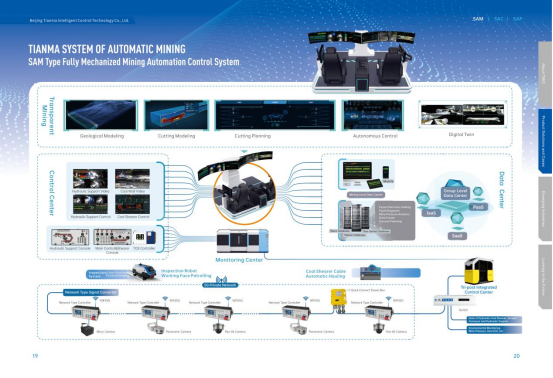
Comprehensive Mining Automation Control System
Beijing Tianma Intelligent Control Technology Co., Ltd.
Flat Portable Satellite Terminal 0.35m Aperture Manual Portable Terminal
China Starwin Science & Technology Co., Ltd.
20 Inch 1600*900 Full HD 60Hz TFT LED Monitor with VGA and DP Interfaces for Desktop Computers-Business Use
Guangzhou Zanying Optoelectronics Technology Co., Ltd.



G.652.D Wavelength-extended Non-dispersion Shifted Single-mode Optical Fiber
HONGAN GROUP CO., LTD.
GYTA Type Non-Self-Supporting Aerial/Duct Optical Cable
TONGDING INTERCONNECTION INFORMATION CO., LTD.

TWP16 P-Band Tropospheric Wind Profile Radar
China Huayun Meteorological Technology Group Co., Ltd.