en.Wedoany.com Reported - Schindler's R.I.S.E (Robotic Installation System for Elevators) has been deployed at 36 construction sites worldwide, installing approximately 50,000 anchors—critical structural components in elevator shafts. The projects span Austria, Poland, India, the United Kingdom, Brazil, China, Singapore, and other locations, with growing interest in robotic elevator installation.
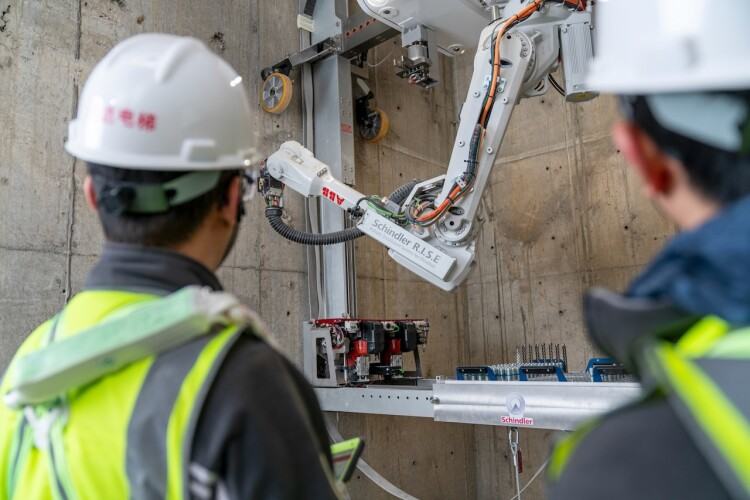
Faruk Osmanbasic, Head of Advanced Installation Technologies at Schindler, stated that global demand is rising as construction projects face tighter deadlines and place increasing emphasis on safer and improved working conditions on site. Elevator installation involves confined spaces where workers may be exposed to noise and dust from drilling for extended periods. Contractors are recognizing the broad benefits these robots bring.
The key component of each elevator system is the guide rail—long, precisely aligned steel rails that ensure smooth vertical operation. These rails are fixed to the shaft wall via brackets, each secured with multiple anchors. Schindler's R.I.S.E prepares the shaft wall by measuring positions, drilling, and installing anchors for guide rails and elevator doors. A high-rise elevator shaft typically requires around 1,000 anchors, a number that increases rapidly in supertall buildings or seismic zones. In a recent project, a single elevator group required over 4,900 anchors at one site.
The robot and all necessary accessories are delivered in two wooden crates, ready for deployment upon arrival. The unit is mounted on a transport cart, positioned at the shaft opening, suspended by its own winch system, and secured by integrated safety mechanisms. The robot can move up and down the shaft, operating autonomously based on a pre-uploaded digital work plan. Once in position, the system safely supports itself within the shaft, scans the concrete surface to avoid drilling into rebar, drills with high precision, and installs anchors at preset heights and positions. Each step follows a detailed digital layout prepared in advance for the specific building, with the operator monitoring the entire process via a tablet interface, viewing real-time camera feeds and performance data to track progress.
This article is compiled by Wedoany. All AI citations must indicate the source as "Wedoany". If there is any infringement or other issues, please notify us promptly, and we will modify or delete it accordingly. Email: news@wedoany.com