en.Wedoany.com Reported - Recently, Innodisk, an industrial-grade storage and edge AI solutions provider from Taiwan, China, showcased a five-layer edge AI ecosystem at Computex 2026. Centered around five layers—computing, memory, storage, perception and communication, and software—the company offers AI systems, industrial modules, and application demonstrations deployable in local environments for enterprise and industrial clients, with a focus on production-grade edge AI implementation.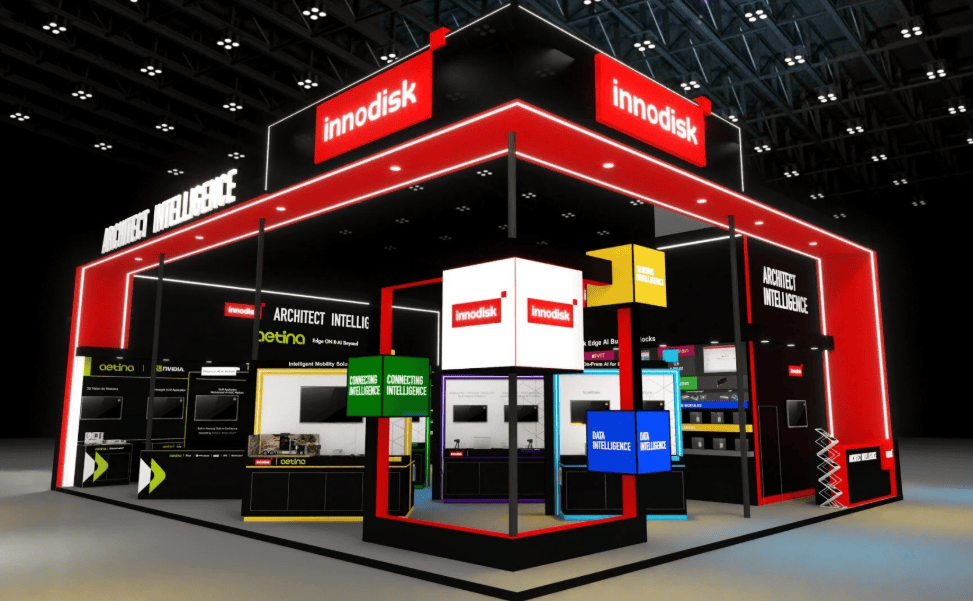
The core value of this showcase lies in Innodisk's reorganization of capabilities previously scattered across industrial computers, storage modules, cameras, network interface cards, AI acceleration platforms, and management software into a unified edge AI foundation for industrial clients. Common challenges for enterprises advancing AI applications are not solely about the models themselves, but whether models can be deployed on-site equipment, stably integrate with sensors and visual data, and perform inference, fine-tuning, and remote deployment without relying on public clouds. Innodisk's newly launched AccelBrain enables fully localized deployment of open-source large language models based on the APEX-X200, emphasizing data sovereignty. AccelTune offers a no-code large model fine-tuning experience, demonstrated on the APEX-S100, which is equipped with Intel Xeon 6700 series processors and supports dual NVIDIA RTX PRO GPUs. Such combinations transform edge AI from a "single-point computing device" into a "configurable, manageable, and scalable" enterprise AI infrastructure.
Industrial on-site demonstrations cover areas such as heavy machinery safety, machine vision, mobile robots, and remote model management.
In the heavy machinery safety solution, Innodisk uses eight ruggedized GMSL2 camera modules with IP67 and IP69K ratings, combined with AI surround-view stitching, driver monitoring systems, and blind spot detection capabilities to enhance operator perception in harsh working environments. Its APEX-E400 edge AI system, powered by an Intel Core Ultra Series 3 processor, leverages a heterogeneous architecture of CPU, GPU, and NPU, supporting parallel AI model inference for up to 16 video streams and demonstrating adaptive load distribution across different computing engines via OpenVINO. Collaboration with Qualcomm Technologies focuses on the Dragonwing IQ9, IQ10, and IQ-X series processors, targeting compact, low-power edge inference scenarios. On-site demonstrations include thread detection, multi-channel visual processing, and an AMR solution integrating GMSL cameras, depth cameras, ROI safety zone recognition, and automatic emergency braking.
On the software front, Innodisk combines Edge Impulse's end-to-end edge AI machine learning operations platform with its own iCAP intelligent cloud management platform to showcase automated remote model updates and deployment capabilities. Supporting hardware includes DDR5 8000 RDIMM, CUDIMM, CSODIMM, 12800 MRDIMM, CXL add-in cards, as well as EDSFF and U.2 form factor data center SSDs, and 218-layer 3D TLC SSDs among other storage products. On the connectivity side, the company launched the ELPL-82F1 SFP28 25GbE network card and showcased the EGPL-T2F1 M.2 form factor SFP+ network card, which previously won an Embedded World 2026 award. As industrial clients move AI applications from pilot projects to production lines, in-vehicle equipment, warehousing and logistics, security, and on-site operations, edge AI systems must simultaneously meet requirements for low latency, local data loops, equipment durability, software updatability, and long-term supply. Innodisk's five-layer architecture is designed around these deployment constraints.
From an industry chain perspective, edge AI is transitioning from a simple combination of "AI box + camera" to a systematic delivery of computing power, storage, connectivity, sensors, and software management platforms. For industrial equipment manufacturers, system integrators, and factory users, such modular solutions can shorten application validation cycles and facilitate the replacement of processor platforms, expansion of visual inputs, adjustment of model capabilities, and maintenance of data loops under different on-site conditions. Innodisk's showcase also indicates that industrial computing and storage companies from Taiwan, China, are extending their advantages from hardware modules to AI deployment platforms, adapting to new demands as industrial intelligence moves from prototype validation to large-scale application.
This article is compiled by Wedoany. All AI citations must indicate the source as "Wedoany". If there is any infringement or other issues, please notify us promptly, and we will modify or delete it accordingly. Email: news@wedoany.com