en.Wedoany.com Reported - The Korea Internet & Security Agency (KISA) announced on the 17th that, together with the Ministry of Science and ICT, it has selected six consortia composed of national and public institutions and domestic security companies to formally promote the "2026 National Cybersecurity System (N2SF) Introduction Support Project."
The National Cybersecurity System (N2SF) is a new security policy that classifies business information held by institutions into three levels—confidential, sensitive, and public—and applies differentiated security levels based on the importance of the information. It aims to replace the traditional physical network separation method with a data-centric security system that balances security and operational efficiency. Previously, national and public institutions physically separated internet networks and business networks to protect sensitive information in accordance with the National Intelligence Service's policy. However, with the expansion of AI and cloud service usage, the demand for changing the network separation policy to promote digital transformation and business innovation has increased. In response, the National Intelligence Service established the National Cybersecurity System last year, which applies differentiated security levels based on information importance, and revised the basic national cybersecurity guidelines this year to formalize it as an official policy.
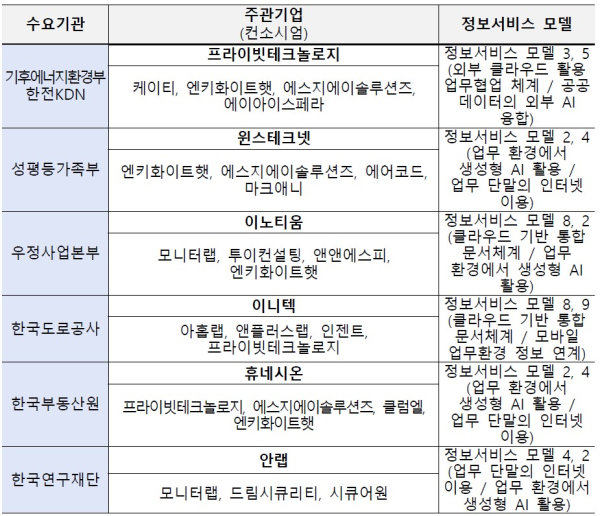
To ensure the smooth implementation of this policy in actual work environments, KISA launched a public call for the "2026 National Cybersecurity System Introduction Support Project" in March of this year, targeting national and public institutions and domestic security companies, with a budget of 4.5 billion won. This project is a follow-up to the empirical project conducted last year, focusing on applying the information service model of the National Cybersecurity System to actual business environments rather than remaining at the verification stage. The support targets include various information service models that reflect the operational characteristics of each institution, such as the application of generative AI (Model 2) and cloud-based document systems (Model 8).
This project is expected to serve as an opportunity to verify the technological competitiveness of domestic security companies in the transition to the National Cybersecurity System. Security technologies in areas such as zero trust, data security, access control, AI security, and cloud security will be applied to actual public business environments, which is anticipated to positively impact the expansion of the public market and the introduction of the system in the private sector. Following written and presentation evaluations, KISA finally selected six consortia on June 1, consisting of demand institutions including the Ministry of Climate, Energy and Environment·KEPCO KDN, the Ministry of Gender Equality and Family, the Korea Post, the Korea Expressway Corporation, the Korea Real Estate Board, and the National Research Foundation of Korea, along with security companies supporting these institutions. Participating companies will support the construction of the National Cybersecurity System and the application of information service models at each institution over approximately seven months (until December).
Meanwhile, KISA also plans to promote additional empirical projects targeting central administrative agencies in July to verify the security and applicability of National Cybersecurity System information service models, such as secure wireless business environments and generative AI applications. Lee Yong-pil, Head of the Digital Threat Prevention Division at KISA, stated that the transition to the National Cybersecurity System can provide new growth opportunities for the domestic security industry. Through this support project, he aims to enhance on-site understanding of the policy and actively support the stable integration of various new security technologies into actual business environments.
This article is compiled by Wedoany. All AI citations must indicate the source as "Wedoany". If there is any infringement or other issues, please notify us promptly, and we will modify or delete it accordingly. Email: news@wedoany.com