Fraunhofer IPMS Launches Quantum Random Number Generator Exceeding 4 Gbit/s
en.Wedoany.com Reported - Fraunhofer Institute for Photonic Microsystems (Fraunhofer IPMS) has introduced a quantum random number generator (QRNG) called Q-Dice, which obtains true random numbers by measuring quantum vacuum fluctuations, achieving a generation rate exceeding 4 gigabits per second (Gbit/s).

Traditional random number generation methods inherently rely on algorithms and are susceptible to attacks. In contrast, the quantum effects of Q-Dice are unpredictable and cannot be influenced, enabling higher data rates, making it particularly suitable for security-critical applications. The generated random numbers have been validated through internationally recognized procedures, including the German Federal Office for Information Security (BSI) AIS 20/31 standard and the NIST SP 800-22 test suite.
True randomness is a core prerequisite for modern cryptography and security-critical systems. Deterministic or insecure random number generators can lead to vulnerabilities in encryption and authentication processes. By measuring inherently unpredictable quantum vacuum fluctuations, Q-Dice can generate quantum entropy for applications such as secure communication, data encryption (e.g., via quantum key distribution QKD or post-quantum cryptography PQC), authentication and access management, as well as large-scale simulations.
The system is designed with a strong focus on security requirements, meeting BSI's stringent criteria under AIS 20/31, and has been rated EAL3 (Evaluation Assurance Level) and PTG 3 (Physical Random Number Generator), demonstrating its security.
Alexander Noack, Head of the Data Communication and Computing Department at Fraunhofer IPMS, stated that with Q-Dice, high-quality quantum randomness becomes practical and easily accessible. The technology can be deployed either as a robust 19-inch rack system for own infrastructure or provided via an online entropy-as-a-service platform, significantly lowering the barrier to entry for quantum security technologies.
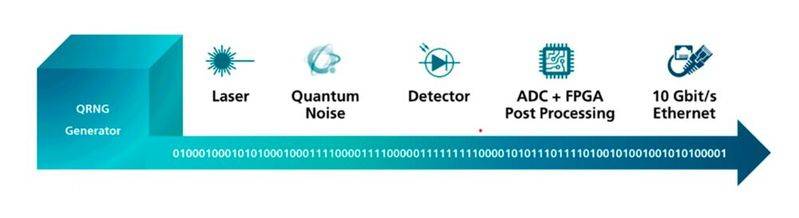
To ensure maximum reliability, Fraunhofer IPMS integrates all core competencies in-house, achieving a coherent development process from photonics to system integration. This includes the design of lasers and optical front-end systems for stable generation and control of quantum noise, a low-noise analog front-end (AFE) for detecting quantum vacuum fluctuations, high-speed data acquisition (analog-to-digital converter ADC), FPGA-based randomness extraction and post-processing, as well as system integration with high-throughput interfaces (including 10 Gbit/s Ethernet). The institute states that this end-to-end approach ensures precise control over the quality, stability, and performance of entropy extraction, with the same physical noise source forming the basis for both hardware-based and cloud-based quantum entropy access.

In terms of deployment, Fraunhofer IPMS offers Q-Dice in two configurations. The hardware version is the Q-Dice 19-inch rack system, suitable for data centers and on-premises deployment, with a random bit rate of 4.1 Gbit/s, providing a 10G Ethernet interface (other interfaces available upon request), and evaluated according to BSI AIS 20/31 and NIST SP 800-22. The other is an online QRNG on-demand service (entropy as a service), offering direct access to quantum-generated randomness via a secure online interface without the need for special hardware installation, supporting rapid evaluation, prototyping, and scalable integration of quantum entropy into software systems and cloud applications.
As the technology moves into the implementation phase, Noack stated that the goal is to jointly raise the standards of security and trust in the digital age, and invited partners to test the technology and collaboratively develop practical applications.
This article is compiled by Wedoany. All AI citations must indicate the source as "Wedoany". If there is any infringement or other issues, please notify us promptly, and we will modify or delete it accordingly. Email: news@wedoany.com
Related Products


TWP16 P-Band Tropospheric Wind Profile Radar
China Huayun Meteorological Technology Group Co., Ltd.




Multi-function Marine Monitoring Low-altitude Detection Radar Sea-air Boundary Ocean Dynamic Environment Measurement
Chengdu Dixin Technology Co., Ltd.

Industrial and Commercial Point-Type Gas Detector
Jinan Benan Technology Development Co., Ltd.
MUX Series Communication Interface Device for Security and Stability Control System
Nanjing NR Electric Co., Ltd.