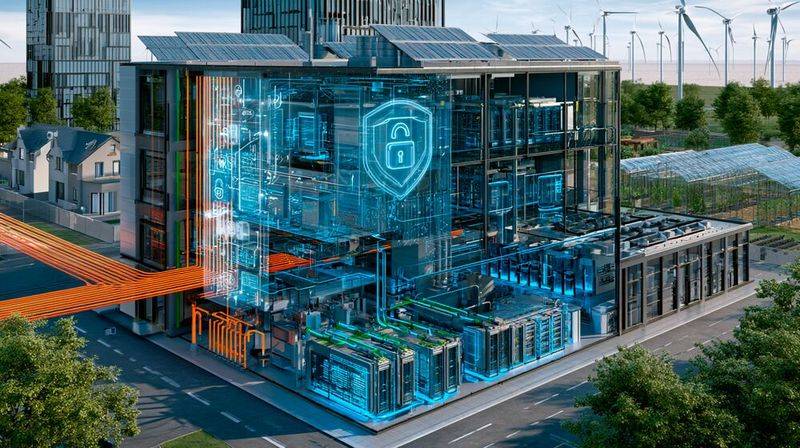
en.Wedoany.com Reported - Data centers have been included in the scope of heating and power supply infrastructure. As critical nodes for data and communication, they are system-relevant and must comply with the German Critical Infrastructure Act (KRITIS-DACH) and the Network and Information Systems Security Directive (NIS-2), along with corresponding reporting obligations. For investors, developers, and operators, this represents a paradigm shift: data centers are no longer viewed as isolated real estate or technical projects, but as highly regulated infrastructure projects where energy economics, regulatory, and operational requirements must be interwoven from the outset.
The criteria for financing decisions have fundamentally changed. Banks and investors are clearly focused on the security of power supply and the regulatory feasibility of the project. The key is not just nominal grid connection, but its actual implementability, scalability, and contractual guarantees. Additionally, reliable power procurement solutions are required, particularly long-term and price-stable Power Purchase Agreements (PPAs). Financiers also expect projects to meet energy efficiency, waste heat utilization, and ESG (Environmental, Social, and Governance) reporting requirements during the planning phase, with associated risks transparently presented. Long-term user contracts, stable cash flows, and clear allocation of responsibilities remain core prerequisites for successful financing.
The planning and construction phase is critical to project success, as data centers need to closely integrate technical, energy-economic, and regulatory requirements. The core challenge lies in securing infrastructure in a timely manner, particularly grid capacity, power procurement, fiber optic connections, and feasible efficiency and waste heat utilization solutions. In Germany, complex approval procedures and coordination processes often lead to delays, making coordinated and early project development indispensable. Technical requirements such as redundancy, cooling, energy efficiency, and scalability must be considered from a regulatory perspective during the early planning stages. Choosing the right project and procurement model is also crucial. Turnkey models using a general contractor (Generalunternehmer) enable clear risk allocation through a single point of responsibility. However, given the typically high investment volumes and associated liability risks, differentiated multi-contractor models or hybrid structures are increasingly being adopted.
These models allow for more flexible risk allocation and more precise control over complex technical trades, but they also significantly increase the complexity of the contract structure. Interface risks between various service providers must be carefully identified, addressed in contracts, and actively managed in project management. The owner should select a contract model suitable for the specific project and model, considering both technical complexity and their own management resources. Another key success factor lies in considering the special expansion and development logic of data centers. Projects are typically implemented in multiple expansion phases that are closely linked in terms of construction and energy economics. This creates additional legal requirements, particularly regarding the long-term securing of grid capacity, structuring of land use and development rights, and contractually securing expansion and extension options for users and investors.
Tax issues accompany the entire lifecycle of a data center. Early project phases involve acquisition structures, land transfer tax treatment, and the balance sheet classification between buildings, technical infrastructure, and IT components. Like other large infrastructure investments, the tax structuring of data center investments largely depends on the specific requirements of domestic or international strategic or financial investors. Common structures involve multi-tiered holding structures, including domestic and foreign holding and operating companies, allowing for flexible financing (equity and debt) and future exits at various levels. Due to high underlying land investment costs and substantial construction costs, land transfer tax is an important issue throughout the lifecycle. This tax typically arises upon land acquisition, but later restructurings or share transfers may also trigger it again. Another component of the tax structure is the structural and functional separation of the real estate from the operating business. For example, land and buildings are often held by a project company, while operations, technical equipment, and customer contracts are placed in a separate operating company. From a tax perspective, this aims to optimize trade tax burdens, but must be assessed on a case-by-case basis. Upon investor exit, two transaction structures are typically available: Share Deals at the level of the capital company can often provide broad tax exemptions on sale proceeds and may offer land transfer tax advantages; while Asset Deals generally lead to a full tax burden upon exit.
After a data center becomes operational, operations are primarily governed by the contract structure. Service-Level-Agreements, availability guarantees, and rules for maintenance, upgrades, and liability are crucial. These must ensure compliance with contractual and regulatory requirements during ongoing operations. Data centers are typically subject to the German Federal Office for Information Security Act (BSI-Gesetz, BSIG) and the Critical Infrastructure Framework Act (KRITIS-Dachgesetz). Once the IT installed power reaches 3.5 megawatts, a data center is generally classified as critical infrastructure, subject to corresponding IT security requirements. Operators are obligated to implement appropriate risk management measures, report security incidents, and document relevant processes. Therefore, IT security and compliance structures must be an integral part of the operational organization. Beyond technical measures, this particularly requires reliable governance structures, clear allocation of responsibilities, and functioning incident response and reporting processes. The ability to react quickly and in a regulatory-compliant manner to security incidents becomes a core element of lawful operational management.
This article is compiled by Wedoany. All AI citations must indicate the source as "Wedoany". If there is any infringement or other issues, please notify us promptly, and we will modify or delete it accordingly. Email: news@wedoany.com
Related Products


MUX Series Communication Interface Device for Security and Stability Control System
Nanjing NR Electric Co., Ltd.

Industrial and Commercial Point-Type Gas Detector
Jinan Benan Technology Development Co., Ltd.

Comprehensive Mining Automation Control System
Beijing Tianma Intelligent Control Technology Co., Ltd.
GYTA Type Non-Self-Supporting Aerial/Duct Optical Cable
TONGDING INTERCONNECTION INFORMATION CO., LTD.
20 Inch 1600*900 Full HD 60Hz TFT LED Monitor with VGA and DP Interfaces for Desktop Computers-Business Use
Guangzhou Zanying Optoelectronics Technology Co., Ltd.

Mine Explosion-proof and Intrinsically Safe Industrial Ethernet Ring Network (10 Gigabit/Gigabit)
Chongqing Mas Sci&Tech Co., Ltd.
G.652.D Wavelength-extended Non-dispersion Shifted Single-mode Optical Fiber
HONGAN GROUP CO., LTD.