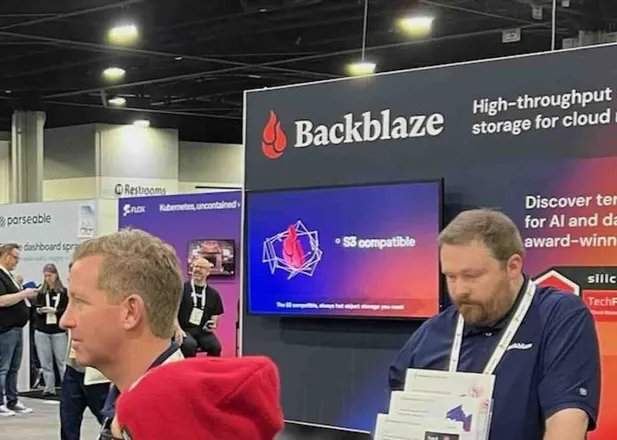
en.Wedoany.com Reported - Backblaze has signed a five-year, $335 million multi-exabyte storage agreement with AI cloud infrastructure provider CoreWeave, adding a low-cost HDD-based capacity tier to its managed storage platform. This partnership allows CoreWeave's customers to access the new object storage tier without modifying code, while highlighting a core constraint in AI infrastructure: where all data actually resides during production workloads.
For CoreWeave, the focus of this deal is not GPU capacity itself, but the storage architecture surrounding it. AI clouds are often seen as compute-driven, but training runs, checkpoints, model outputs, retrieval-augmented generation (RAG), data preparation, and inference pipelines all generate massive amounts of data. Some of these workloads require flash-level performance, but most have low storage performance demands. It is this type of demand that provides an entry point for Backblaze.
Backblaze will support the HDD-based storage tier within CoreWeave's AI object storage, including environments using CoreWeave's LOTA distributed caching technology. Existing customers are expected to access the new storage tier without rewriting applications, which holds significant commercial value.
From an economic perspective, CoreWeave aims to reserve high-performance storage for AI workloads that truly need it, while shifting latency-insensitive data to a cheaper capacity tier. If executed properly, this can improve infrastructure utilization and reduce the blended cost of running AI services. AI workloads do not have a single storage profile; model checkpoints, training datasets, prompt logs, and RAG corpora behave differently. Treating all as high-end storage is costly, while treating all as cold archive fails to meet usage needs.
Backblaze's business revolves around large-scale, cost-effective cloud storage, reportedly serving over 100,000 customers. CoreWeave brings the AI cloud demand side, including model developers, enterprises, and research institutions. The company states that its platform serves nine of the top ten AI model providers.
This agreement also reflects the maturing of the AI infrastructure stack. The first wave of spending benefited companies with GPU, power, and data center capacity. The next phase is more complex, involving storage layout, caching, networking, orchestration, energy efficiency, and cost control. Operators need to make AI infrastructure operate like a service business, not a science project.
A multi-exabyte agreement of this scale also raises practical questions: How much capacity will be deployed immediately? How will pricing adjust if AI storage demand changes? How will the situation evolve when customers demand more regional control over their data? Regulators and corporate risk teams will increasingly focus on where AI training data, generated outputs, and customer information are stored.
Backblaze has gained a major AI infrastructure customer and elevated its role in a market still dominated by the compute narrative. CoreWeave, in turn, has added a new storage tier to its managed storage platform without forcing customers to make application changes. Now, the harder-to-quantify work begins: filling capacity, keeping costs predictable, and making storage transparent enough that developers no longer need to think about it.
The significance of this agreement for AI buyers is that it may reduce storage costs for AI workloads by matching data types to cheaper capacity tiers, without requiring application-level changes. CoreWeave customers will be able to access additional storage tiers while retaining existing workflows and code paths. HDD storage is relevant to AI because many AI datasets, outputs, logs, and checkpoints do not require high-end storage performance. Infrastructure teams should evaluate latency, retrieval patterns, data residency, durability, integration complexity, and whether the tiering strategy matches production AI workload behavior. The main execution risk of this agreement is that economics depend on utilization, predictable performance, and careful placement of data across tiers.
This article is compiled by Wedoany. All AI citations must indicate the source as "Wedoany". If there is any infringement or other issues, please notify us promptly, and we will modify or delete it accordingly. Email: news@wedoany.com