en.Wedoany.com Reported - A research team led by Dr. Tomonori Saito, a researcher in the Soft Materials and Membrane Group of the Chemical Sciences Division at Oak Ridge National Laboratory (ORNL), has developed a novel reprocessable thermoplastic adhesive based on a controlled nylon depolymerization process. This adhesive effectively bonds dissimilar substrates such as steel and carbon fiber composites while maintaining excellent performance at high temperatures.
This research aims to address the challenges of nylon recycling. Nylon is widely used in industries such as textiles, automotive, and packaging, but traditional recycling routes like hydrolysis, alcoholysis, and aminolysis often face issues of high energy consumption and inconsistent efficiency. By controlling reactant concentrations, the ORNL team used an efficient organic catalyst to perform controlled alcoholysis of nylon, obtaining nylon oligomers of specific lengths. The team then copolymerized the resulting nylon oligomers with another polymer segment to produce a novel segmented copolymer that serves as a high-strength hot-melt adhesive. The temperatures required for this process are typically lower than those of traditional solvolysis techniques, potentially resulting in lower energy consumption. The research team stated that this method achieves 100% nylon recovery (complete conversion to oligomers) with no nylon loss or byproduct generation.
The adhesive developed by the ORNL team demonstrates remarkable performance. The nylon copolymer made from nylon waste achieved a lap shear strength of 21.1 ± 2.7 MPa on steel-to-steel substrates at room temperature. For bonding steel to carbon fiber composites, it reached 16.8 ± 2.3 MPa at room temperature and maintained an adhesive strength of 10.0 ± 1.6 MPa at 90°C. In comparison, a traditional epoxy adhesive (commercial product JB Weld ClearWeld) under the same test conditions exhibited a strength of 6.5 ± 0.6 MPa at room temperature, which dropped to 2.8 MPa at 90°C. This new adhesive is easy to thermally process, allowing bonded materials to be reused or repaired, thereby extending system lifespan.
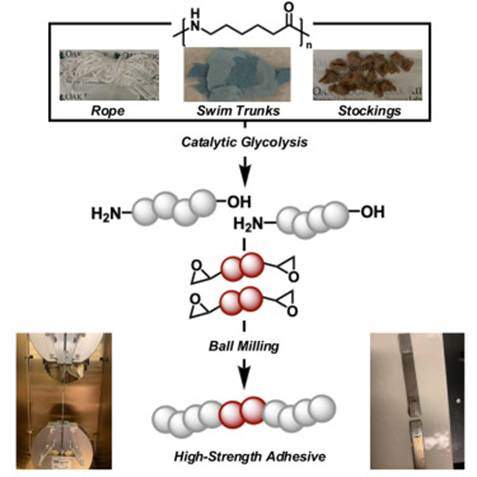
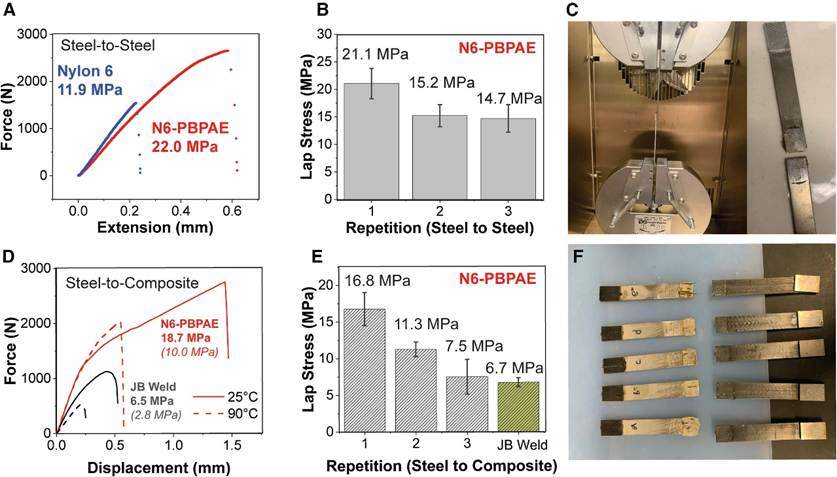
This process can handle nylon 6, nylon 66, and their mixed feedstocks. The research team noted that the flexibility to process different feedstocks is crucial for practical deployment. Currently, this technology has only been validated at the laboratory scale (approximately Technology Readiness Level 3). The ORNL team stated that achieving industrial application will require scaled-up system demonstrations. A platform technology based on a similar process is already undergoing scale-up commercialization process studies by the technology licensing company Re-Du. This work was led by ORNL, and the related research findings have been published in the journals Cell Reports Physical Science (2025, 6, 102928), Materials Horizons (2023, 10, 3360–3368), and J. Mat. Chem. A (2025, 13, 32111).
This article is compiled by Wedoany. All AI citations must indicate the source as "Wedoany". If there is any infringement or other issues, please notify us promptly, and we will modify or delete it accordingly. Email: news@wedoany.com