MIT Develops Ultrasonic Bracelet for Gesture-Controlled Robots
en.Wedoany.com Reported - Researchers at the Massachusetts Institute of Technology (MIT) have developed an ultrasonic bracelet that tracks hand movements and wirelessly controls robots, a technology that could transform human-computer interaction.
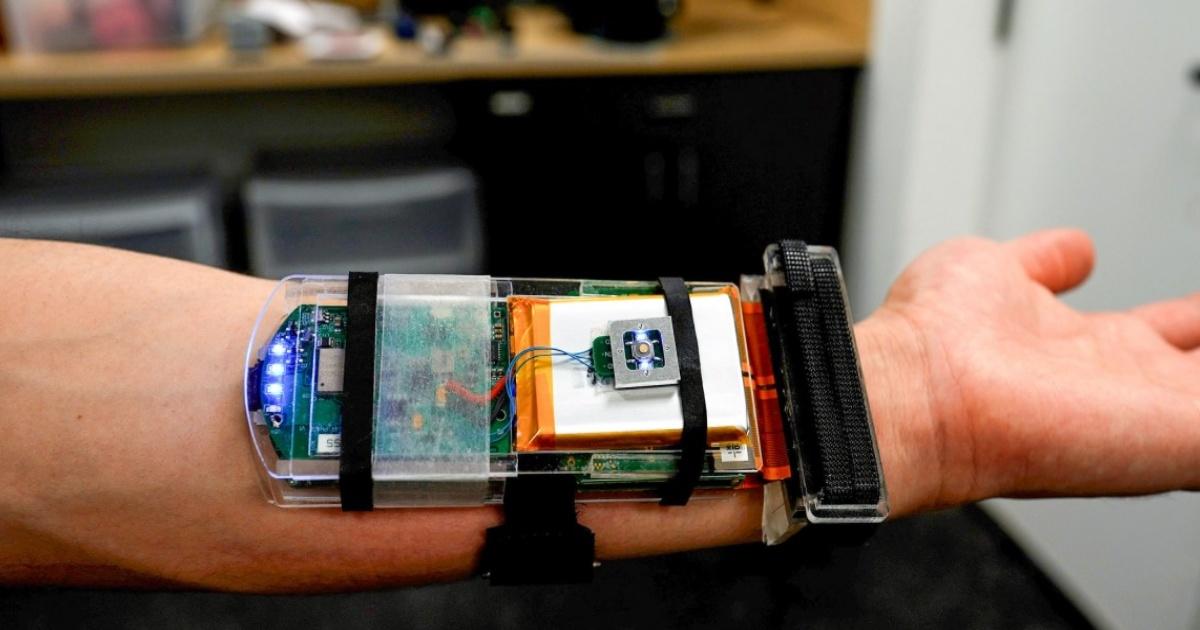
The bracelet combines miniature ultrasonic sensors with artificial intelligence to convert movements of wrist muscles and tendons into digital commands. Gengxi Lu, a former MIT postdoctoral fellow and lead author of the research paper, explained that the tendons and muscles of the wrist act like strings controlling a puppet, with the fingers as the puppet; capturing images of muscle states reveals the hand's condition.
The team, led by MIT mechanical engineering professor Xuanhe Zhao, designed the bracelet in collaboration with colleagues from MIT and the University of Southern California. The bracelet is equipped with miniaturized medical ultrasound probe "patches" combined with hydrogel that safely adheres to the skin. When the user moves their hand, the device generates ultrasound images of the wrist muscles, tendons, and ligaments. After processing by AI algorithms, these images are continuously converted into the corresponding positions of the five fingers and palm.
In demonstrations, wearers of the bracelet could wirelessly control a robotic hand to synchronously perform gestures or pointing actions, and manipulate the robot to play piano tunes or shoot a basketball. Users could also pinch their fingers to zoom in or out on virtual objects on a computer screen. The researchers plan to further miniaturize the hardware and train the AI software with hand movement data from more volunteers to accommodate different hand shapes and a wider range of motion patterns.
The team is working to build a large dataset of hand movements to train humanoid robots for complex tasks such as surgery. In the future, this bracelet could also be used for manipulating objects in virtual environments, such as design and video games, offering a more immersive experience. The team aims to create a highly agile, wearable hand tracker capable of wirelessly controlling humanoid robots or virtual objects in real time. Zhao stated that this represents the most advanced method for tracking dexterous hand movements through wearable wrist imaging.
The human hand coordinates 34 muscles, 27 joints, and over 100 tendons and ligaments, making it extremely dexterous. Previously, robotics struggled to mimic this dexterity, and MIT's innovation offers a practical solution. This technology also holds significant implications for the development of non-invasive brain-computer interfaces, as the bracelet operates externally, making it safer and more accessible. From medical rehabilitation to industrial robot control, the bracelet has a wide range of applications and could lay the foundation for a new generation of wearable devices. The team will focus on collecting data from more participants and optimizing AI algorithms to accommodate diverse hand shapes and sizes.
This article is compiled by Wedoany. All AI citations must indicate the source as "Wedoany". If there is any infringement or other issues, please notify us promptly, and we will modify or delete it accordingly. Email: news@wedoany.com
Related Products



One-Stop Steward Service for the Entire Logistics System Integration Chain
Zhongding Intelligent (Wuxi) Technology Co., Ltd.
Industrial and Commercial Point-Type Gas Detector
Jinan Benan Technology Development Co., Ltd.

GYTA Type Non-Self-Supporting Aerial/Duct Optical Cable
TONGDING INTERCONNECTION INFORMATION CO., LTD.



20 Inch 1600*900 Full HD 60Hz TFT LED Monitor with VGA and DP Interfaces for Desktop Computers-Business Use
Guangzhou Zanying Optoelectronics Technology Co., Ltd.