en.Wedoany.com Reported - Global copper mine investment is facing hard constraints on project delivery, rather than being driven by market optimism. Demand remains strong, but supply struggles to keep pace. New mineral discoveries are increasingly scarce, project development timelines are lengthening, and capital is becoming more selective in its deployment. The market is shifting its focus to projects that offer not just copper exposure but also additional value. Strategic investors are prioritizing assets with high grades, robust infrastructure, restart potential, or technological drivers—projects that don't require decades to become viable development options and already have reduced risk.
For copper exploration companies in Western Australia, while the financing environment is more challenging, constructive opportunities still exist for those that can demonstrate tangible project progress. Companies with existing resources, mining history, strong logistics, or regional scale potential are gaining a clearer window to prove how they fit into the next phase of copper supply.
James Rattenbury, CEO of GreenTech Metals (ASX:GRE), said this has changed how investors and financiers view the industry.
Rattenbury noted a shift in focus among strategic investors and financing providers. They realize that to advance the project pipeline, they need to get involved earlier, supporting projects by de-risking them, rather than just signing offtake agreements as part of project financing. He believes this shift could position projects like Whundo more favorably. He stated that large greenfield copper discoveries can take decades to find and de-risk, while smaller historical projects, including volcanic massive sulfide deposits like Whundo, can play a significant role because they offer high grades, scalability, and a lower de-risked base.
GreenTech has built a base metals portfolio around Whundo and Munni Munni in the West Pilbara region, providing exposure to copper, zinc, platinum group metals, and nickel in the area. The region boasts well-established roads, ports, power, and mining services. Whundo already has JORC 2012 compliant Indicated and Inferred Resources of 6.2 million tonnes at 1.12% copper and 1.04% zinc.
The next step is to test whether the project holds higher value than reflected in the current resource. GreenTech is conducting drilling to confirm gold and silver by-products within the ore body, which have not yet been included in the resource calculation. By September, Rattenbury expects the potential of Whundo to become clearer, and as these by-products and extensions of the ore body are factored in, the development plan may no longer be based solely on copper grades.
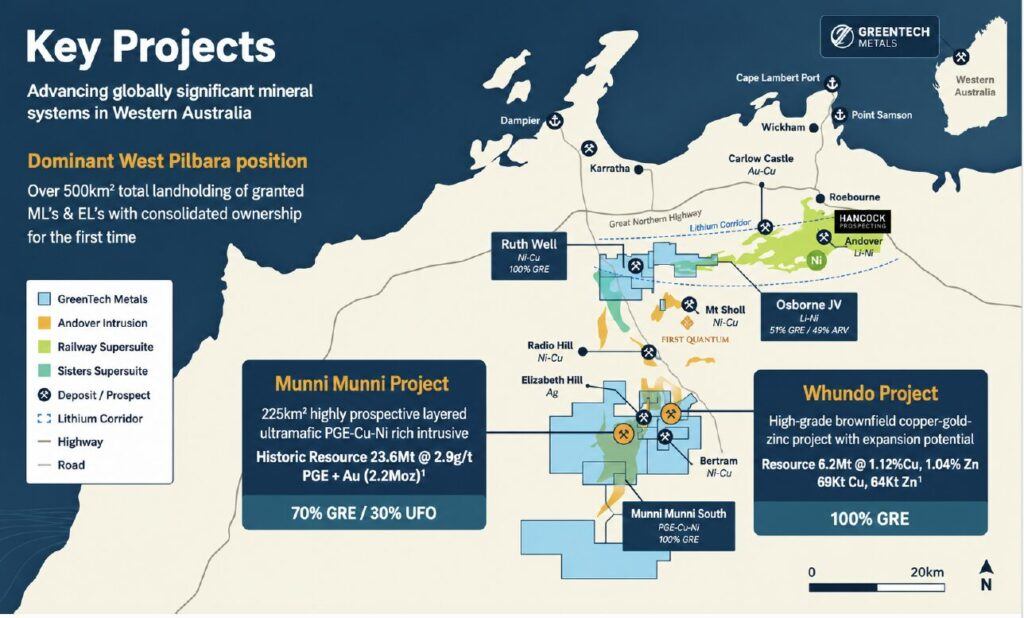
Munni Munni further adds depth to GreenTech's portfolio. The project is known for platinum and palladium, with a historical JORC 2004 estimate of 23.6 million tonnes at 2.9 g/t 4E, containing 2.2 million ounces. GreenTech is working to verify and restate this under JORC 2012 standards. However, Rattenbury said the company is viewing Munni Munni through a broader copper and multi-metal lens. He noted that Munni Munni is famous for high-grade platinum reefs, but GreenTech sees broader copper opportunities within the 225-square-kilometer intrusion, with copper associated in the platinum reefs, copper present in the surrounding halo, and a larger geochemical copper anomaly in the intrusion.
Copper was not a focus of previous exploration, so GreenTech's findings add new value to Munni Munni. Munni Munni now brings the layered mafic intrusion and its surrounding land under one explorer. Combined with Whundo, GreenTech's footprint in the West Pilbara region expands to over 500 square kilometers. The deal also gives GreenTech access to 21 kilometers of strike along the Ferguson Reef, where historical drilling has delineated continuous platinum group metal-copper-nickel mineralization. Rattenbury said investors should focus on whether GreenTech's overall systematic approach—including sulfide zones and using net smelter return cut-off grades that capture copper, nickel, and platinum group metals—can support larger resources and more scalable development plans.
Location remains central to the financing equation. With cost inflation, permitting delays, and infrastructure bottlenecks plaguing many junior companies, the Pilbara is seen as an advantage. GreenTech's Whundo project is located beside a highway, approximately 60 kilometers by road from Karratha. Rattenbury stated that the mature industrial base of the Pilbara is core to GreenTech's positioning. He said the Pilbara has well-developed infrastructure, access, and existing mining operations, along with extensive prior mining and exploration work, providing a solid foundation for GreenTech's further efforts, rather than starting from a greenfield state. GreenTech still faces challenges in funding, approvals, and technical work, but the Pilbara's infrastructure advantages offer financiers a tangible anchor point, as copper scarcity intensifies the competition for faster development options.
GreenTech's accelerated exploration efforts follow a major $400 million financing deal by global trading giant Trafigura, which will help Bill Beament's Develop Global (ASX:DVP) advance two projects. One is the Pioneer Dome lithium mine near Norseman, and the other is the brownfield Sulphur Springs copper-zinc project in the Pilbara region. For established developers, clear resources, reliable technical studies, and offtake potential provide a more direct path to financing feasibility. Brownfield and historical projects are also finding new opportunities in a strong copper market—with LME copper prices at historical highs of $13,371 per tonne, and zinc prices up about 30% over the past year to $3,492 per tonne.
Other Western Australian copper hopefuls, including Caravel Minerals (ASX:CVV), are also better positioned as the market seeks projects that can translate scale, technical work, approvals, and strategic interest into viable financing development pathways. Caravel is a large, low-grade project that could potentially produce over 60,000 tonnes of copper annually. While its capital costs are high, the porphyry deposit has substantial support from Indian conglomerate Adani as a proposed offtake partner.
Companies searching for truly company-making copper discoveries also hold optimism. Artemis Resources (ASX:ARV) has established gold resources in the Pilbara, but its most exciting asset may be a greenfield copper exploration project in the frontier Madura Province. Its backers seem to understand this strategy, as Artemis recently secured firm commitments for an $8 million placement led by Jupiter Asset Management to fund gold and copper exploration in its portfolio. The current focus is on the aforementioned Madura region, east of Kalgoorlie, where Artemis has established a 2,100-square-kilometer belt-scale land package and is preparing for the first drill program at the Cassowary iron oxide copper-gold target, pending heritage clearance. The Sharon Dam target, co-funded through Red Metal's (ASX:RDM) EIS program, provides a second copper-gold target.
Executive Director Matthew Greentree said the Develop Global-Trafigura deal reinforces the strategic importance of copper and shows that major trading houses are willing to support high-quality Australian projects.
Greentree believes it also highlights the premium on regional-scale opportunities in emerging copper districts. While Madura is still at an early stage, Greentree said it offers scale, a favorable jurisdiction, and a clear path to first drilling. Early exploration alone is unlikely to prove an economic discovery, but it can test whether Madura has the alteration, structure, host rock, and geochemical signals needed to support a fertile iron oxide copper-gold type mineralizing system. He said the first drill holes aim to answer key questions about the nature of the source body, alteration system, and structural controls, and even if significant mineralization is not encountered, they will provide valuable information that can rapidly improve target selection across the entire project area. Magnetic data, iron-rich alteration, and early signs of copper mineralization at Cassowary or Sharon Dam will help plan the next round of drilling and could increase interest in these targets.
This article is compiled by Wedoany. All AI citations must indicate the source as "Wedoany". If there is any infringement or other issues, please notify us promptly, and we will modify or delete it accordingly. Email: news@wedoany.com