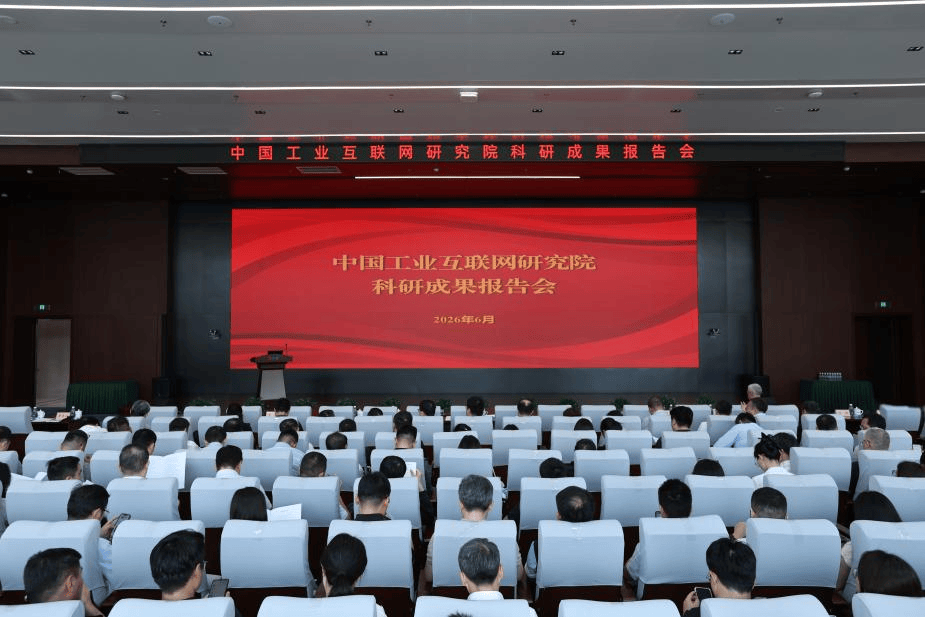
en.Wedoany.com Reported - On June 26, the China Academy of Industrial Internet (CAII) released seven representative independent research achievements at its scientific research results report conference, covering cutting-edge and hot topics such as the intelligent economy, green and low-carbon development, industrial 5G, future industries, artificial intelligence, and post-quantum cryptography.
Chen Jiehao, Director of the Institute of Data Management and Application, released the "Research Report on Token-Driven Intelligent Economy." This report, for the first time, elucidates the evolutionary logic of tokens transitioning from technical measurement units to new production factors, revealing their core value as an integrated product of "energy + chips + datasets + large models." It constructs a three-layer architecture of token "production—scheduling—consumption" and recommends defining token value based on China's scenarios and leading factor allocation with Chinese standards, providing valuable insights for exploring innovative development in the intelligent economy.
Guo Gang, Head of the Green and Low-Carbon Center Task Force, released "Carbon Accounting Theory Research and Practice." Targeting China's overall requirements for dual control of carbon emissions, this report focuses on the "new three" industries—photovoltaics, batteries, and new energy vehicles. It systematically reviews the issues in existing carbon accounting mechanisms and proposes two methods: a direct data collection model based on Continuous Emission Monitoring Systems (CEMS) and an industry extrapolation accounting method based on corporate ESG disclosures, aiming to improve the quality and accuracy of industry carbon emission data.
Zhu Hao, Director of the Institute of Standardization Technology, released "Research on Industrial 5G Independent Private Networks Empowering Key Technologies, Industrial Development, and Regulatory Strategies for High-End Manufacturing." This report systematically compares the characteristics and advantages of virtual, hybrid, and independent private network architectures, analyzes key technology pathways such as millimeter wave, network slicing, and edge computing, defines quantitative network performance indicators for typical scenarios like smart factories and unmanned mines, and proposes standardized recommendations for resource supply and service provider management.
Jiang Xinhao, Director of the Institute of Platforms, released "Research on Major Issues and Countermeasures for the Development of Future Industries in China." Focusing on five major fields—embodied intelligence, quantum technology, the low-altitude economy, solid-state batteries, and biomanufacturing—this report reviews the latest technological and industrial progress both domestically and internationally. It innovatively constructs two evaluation mechanisms: "industrial maturity" and "regional development," revealing the "smile curve" and "inverted smile curve" characteristics of China's future industry regional layout, providing local governments with quantitative evaluation tools to implement differentiated layouts based on resource endowments and avoid homogeneous competition.
Niu Yan, Director of the Institute of Security, released "Research on Systematic Security Detection and Risk Assessment Methods for Artificial Intelligence Systems." Addressing issues such as the strong concealment of security vulnerabilities in large models and the difficulty in quantifying cross-level threats, this report proposes a seven-layer model for AI security vulnerabilities (AI-S7), ranging from hardware to data, models, and applications. It constructs a cross-level dynamic security quantitative assessment mechanism covering threat propagation, risk diffusion, and defense cost-effectiveness, and develops a corresponding security detection prototype tool.
Gu Weixi, Director of the Institute of Intelligence, released "Research on the Implementation Path of AI Empowering New Industrialization." Taking the application of data, algorithms, and computing power in industrial scenarios as a starting point, this report proposes a six-level architecture for the digital and intelligent transformation of manufacturing (equipment, production line, workshop, factory, enterprise, ecosystem). It elaborates on strategies for building high-quality datasets and computing power deployment plans at each level, and constructs a new integration paradigm and evaluation indicators for "Industrial Internet + Intelligent Agents."
Zha Qiwen, Director of the Institute of Cryptographic Technology, released the "Research Report on Post-Quantum Cryptography Technology and Applications." This report systematically assesses the security threats posed by quantum computing development to traditional cryptographic systems, comprehensively reviews mainstream technical routes for post-quantum cryptography (PQC) based on lattice-based cryptography and hash functions, as well as the international standardization process. It deeply analyzes the challenges of PQC migration in terms of performance, cost, and compatibility, and proposes a scientific migration path based on asset identification, risk assessment, and agile deployment.
Experts attending the conference believe that these achievements feature precise topic selection and solid research, closely addressing industrial pain points in areas such as the intelligent economy, green and low-carbon development, and artificial intelligence. They combine technological frontier with industrial applicability, providing a reference basis for industry regulation and corporate decision-making. Experts suggest that all parties establish a closer industry-university-research-application collaboration mechanism to jointly promote the deep integration of technological innovation and industrial innovation, transforming research results into real productive forces.
More than 300 people attended the conference, including officials from relevant departments of the Ministry of Industry and Information Technology, leaders from local governments and industry and information technology/communication authorities, as well as representatives from research institutes, industry associations, and leading enterprises.
This article is compiled by Wedoany. All AI citations must indicate the source as "Wedoany". If there is any infringement or other issues, please notify us promptly, and we will modify or delete it accordingly. Email: news@wedoany.com