en.Wedoany.com Reported - Japan's FANUC has reduced the time required for robots to learn by imitating human actions, known as "imitation learning," from 60 hours to 4.8 hours, approximately one-twelfth of the original time. Kenichiro Abe, Senior Managing Executive Officer of the company, revealed this achievement during a speech on the second day of "AWS Summit Japan 2026" held on June 26, and indicated a stance to accelerate the development of physical AI by leveraging AWS cloud infrastructure.
FANUC has a track record of approximately 70 years in machine tool control (NC) and about 50 years in robotics. Over 1.2 million FANUC-manufactured robots are operating in factories worldwide. In recent years, the company has collaborated with technology firms such as NVIDIA and Google to promote the application of physical AI, which uses AI to control physical devices. Abe pointed out that in an era where securing a workforce is challenging, physical AI is indispensable for companies to maintain international competitiveness by performing production activities on behalf of humans.
To drive robots with physical AI, it is necessary to have a foundation model learn various actions. One example Abe cited is the manipulation of soft objects, such as clothing, which is difficult to achieve with traditional rule-based control. FANUC enabled a Vision-Language-Action (VLA) model to master this action through imitation learning that mimics human movements. Previously requiring 60 hours of learning time on local GPUs, this was reduced to 4.8 hours by utilizing the "Amazon EC2" GPU instance "P5." In addition to learning on real robots, parallel learning in virtual spaces is also employed.
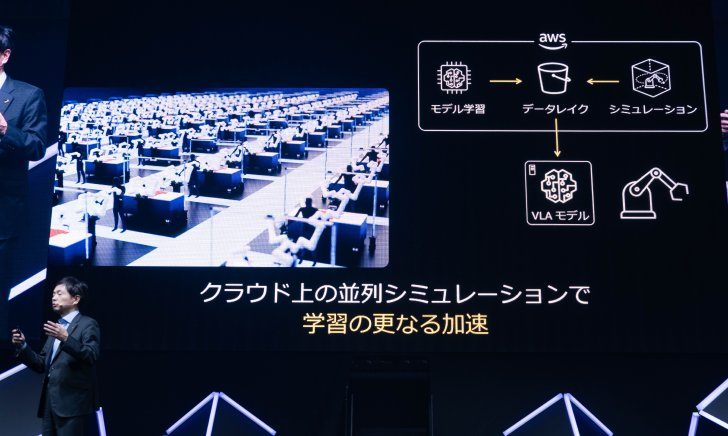
Abe stated that the company aims to combine industrial robots with physical AI to address Japan's declining labor population and expressed a willingness to expand collaboration with other companies, including startups.
Yasuhiro Kose, Senior Managing Executive Officer of Amazon Web Services Japan (AWS Japan), positioned physical AI as "a key to solving Japan's social issues and driving industrial growth," and indicated that AWS would support its development from both cloud and edge perspectives. In January 2026, AWS Japan launched a "Physical AI Development Support Program" for domestic companies, offering up to $6 million in funding.
One of the selected companies for this program, Omron Sinic X, is exploring the automation of "experiments" in research and development. Yoshitaka Ushiku, Vice President of Research at the company, noted that while the emergence of generative AI is accelerating the R&D cycle, the experimental phase has not yet benefited from this, creating a bottleneck. He stated: "Robots are not meant to replace humans, but to expand human creativity."
This article is compiled by Wedoany. All AI citations must indicate the source as "Wedoany". If there is any infringement or other issues, please notify us promptly, and we will modify or delete it accordingly. Email: news@wedoany.com