en.Wedoany.com Reported - West Point Gold Corp. (WPG:TSXV; WPGCF:OTCQX; LRA0:FSE) recently disclosed the latest drilling results from its Gold Chain project in northwestern Arizona. The company stated that it intersected one of the best-grade and thickest mineralized zones to date at its Northeast Tyro (NE Tyro) deposit.
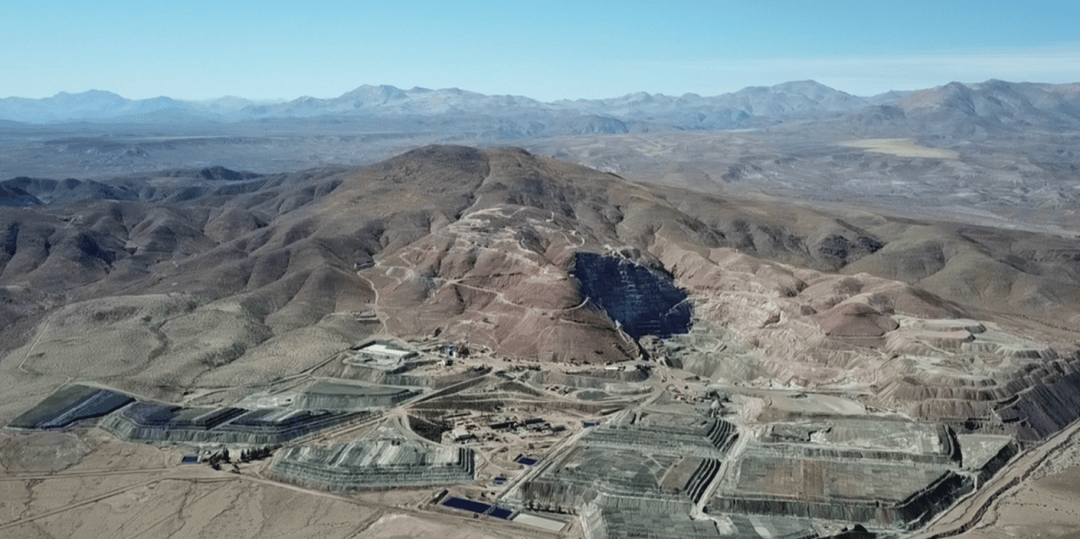
The Gold Chain project is a large, low-sulfidation epithermal gold system distributed across approximately 11,760 acres of patented and BLM land in the historic Oatman district. The project lies along the southern extension of the renowned Walker Lane structural belt, the same geological corridor that hosts Round Mountain (over 20 million ounces) and the Bullfrog district, where AngloGold Ashanti Ltd. (AU:NYSE; ANG:JSE; AGG:ASX; AGD:LSE) spent several years and over $500 million on consolidation. The company holds water rights on its patented land, VanEck, the world's largest gold ETF manager, appears on its shareholder register, and global senior gold producer Kinross Gold Corp. (K:TSX; KGC:NYSE) holds a strategic option arrangement on one of its Nevada assets.
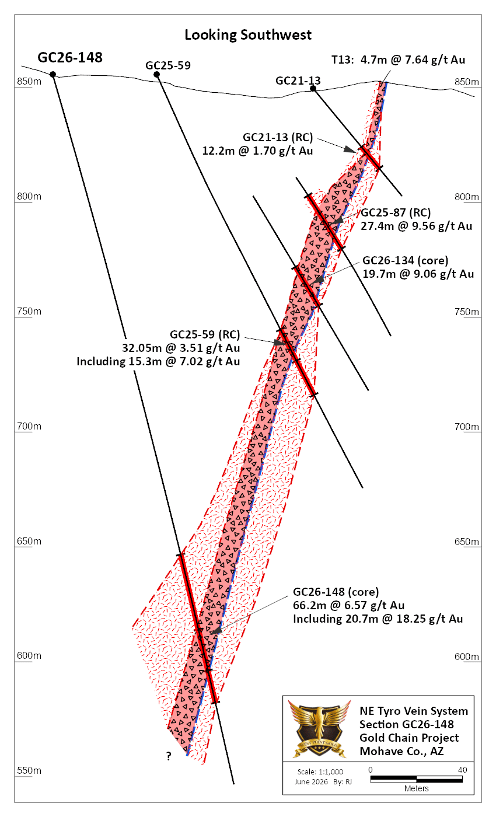
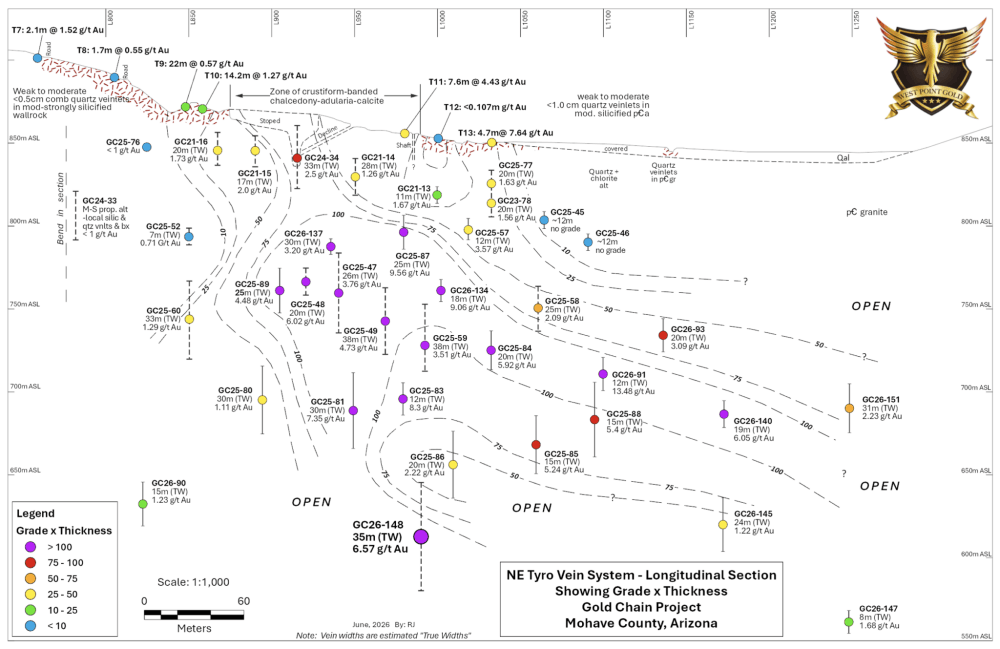
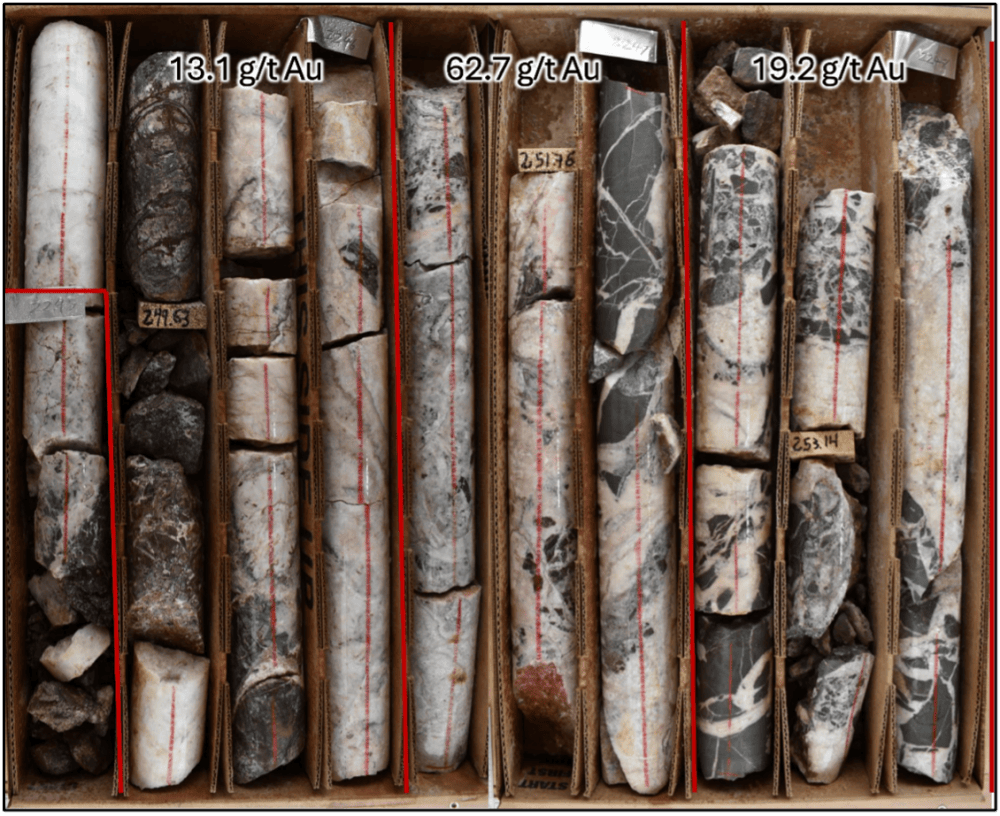
The announced results come from drill hole GC26-148, which intersected 66.2 meters grading 6.57 grams per tonne gold from 219 meters, including a high-grade core of 20.7 meters grading 18.25 g/t. The company stated that these internal grades are approximately 35 times the average grade of open-pit gold mines in the southwestern United States. The hole extends high-grade mineralization to over 250 meters below surface, and the company noted that the zone may remain open even after its upcoming maiden resource estimate.
Geologically, the intercept is described as a broad zone of quartz veinlets, stockwork, and vein breccia with a true thickness of approximately 35 meters, forming a steeply dipping bonanza shoot. The company stated that the NE Tyro vein system exhibits robust and uniform characteristics with consistent dip and widths ranging from 10 to 35 meters. The mineralized zone is a multi-stage breccia cemented by multiple crustiform stages of quartz-calcite-adularia, with one sample returning 1.73 meters grading 62.7 g/t. Bladed calcite lattice textures and native gold were observed in the zone, both textbook indicators of boiling conditions where gold precipitates from solution.
Paradigm Capital initiated coverage on West Point Gold on June 14, 2026, with a "Speculative Buy" rating and a 12-month target price of C$3.30 per share. According to the firm's independent estimates, the two Tyro zones alone already host approximately 1.1 million ounces at 2.1 g/t gold, with the high-grade NE Tyro zone containing about 600,000 ounces at 3.5 g/t. Based on a conceptual mine model, at a gold price of $4,500, the project yields an after-tax internal rate of return (IRR) of approximately 54% and a net present value (NPV) of about $1.09 billion. Its net asset value (NAV) at $4,500 gold is C$9.65 per share, while the company's market capitalization at the time of the report was only about $107 million.
Notably, Paradigm specifically highlighted the extension of the NE Tyro zone at depth as a key catalyst in its model. The firm estimates that every 100 meters of extension at NE Tyro is worth approximately 70,000 ounces, and adding just 200,000 ounces in the high-grade zone would increase its NAV by about 20%. The announced GC26-148 hole is part of this extension and returned even higher grades.
In addition to the Tyro zone, the company is exploring for gold at three other targets across the entire claim block: Black Dyke, Sheep Trail, and Bull 8. Furthermore, a covered target called the Frisco Graben is considered a potential area for a deeper system. President and CEO Derek Macpherson stated that the high grades at NE Tyro continue at depth, and deeper drilling will resume under a funding program from fall 2026 to spring 2027. Assays for seven additional holes at the same depth at NE Tyro are pending, part of approximately 6,550 meters of assays to be analyzed.
This article is compiled by Wedoany. All AI citations must indicate the source as "Wedoany". If there is any infringement or other issues, please notify us promptly, and we will modify or delete it accordingly. Email: news@wedoany.com