API Laser Tracker from the United States Used for Micron-Level Precision Calibration of Paper Machinery
en.Wedoany.com Reported - The API brand Radian Plus laser tracker is used for systematic precision calibration of large paper machinery. With micron-level 3D accuracy, a 160-meter measurement range, and a 1000 Hz data acquisition rate, this device addresses challenges such as ultra-large structural measurements, dynamic form and position tolerance evaluation, high-precision inspection, and reduced downtime, which are difficult to achieve with traditional optical instruments and mechanical gauges.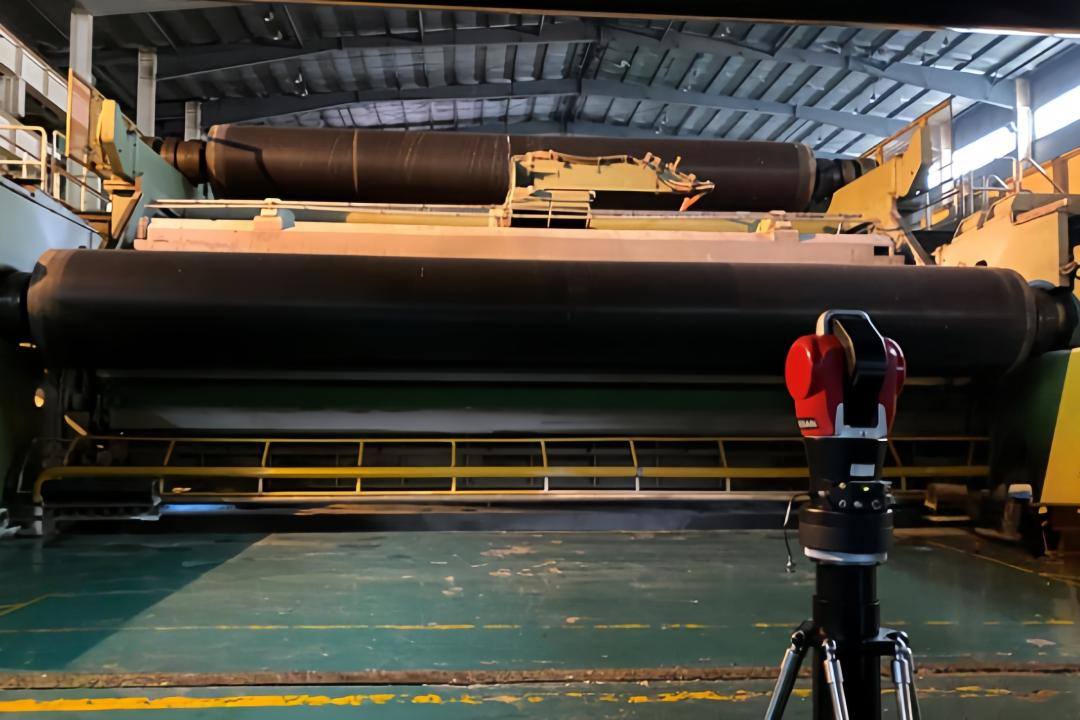
Due to issues such as paper wrinkling, uneven thickness during high-speed operation of paper machinery, and precision requirements for new products, a paper company decided to conduct systematic precision calibration of large paper machines. Traditional optical instruments and mechanical gauges are limited by measurement range, accuracy, and dynamic capabilities, making it difficult to efficiently complete comprehensive verification and adjustment of the overall geometric precision of the machine. Challenges include: the drying cylinder group exceeding 30 meters in length, making it difficult for traditional tools to measure coaxiality and parallelism as a whole; the need for dynamic precision measurement to evaluate the form and position tolerances of rollers under simulated operating conditions; high precision requirements for key components such as coaxiality, roller surface runout, and flatness of bearing seat mounting surfaces; and the need to minimize downtime while efficiently completing inspection and adjustment.
For the measurement in this case, API provided the Radian Plus model laser tracker to meet the relevant measurement requirements. The Radian Plus laser tracker is portable, precise, has a large measurement range, and is highly efficient. It offers micron-level 3D measurement accuracy and an ultra-high data acquisition rate of 1000 Hz, ensuring excellent performance in both static and dynamic measurement needs. The tracker has a measurement range of over 160 meters and is equipped with a battery-powered system and wireless data transmission module, enabling fully wireless precision measurement operations with simple handling.
In this case, the Radian Plus laser tracker was used to measure and evaluate the following: coaxiality and parallelism of press rolls, guide rolls, and drying cylinders; flatness and levelness of bearing seat mounting surfaces; circular runout of drying cylinder end faces and straightness of roller surface generatrices; and symmetry and perpendicularity of the machine frame.
The measurement process is as follows: Set up the laser tracker at a suitable location around the paper machinery to be measured, ensuring a clear line of sight to all components to be measured; establish a global measurement coordinate system in the measurement software; use a 1.5-inch high-precision SMR target ball with various pins and seats to quickly collect coordinates of the center holes of each bearing seat, measure key cross-sectional circumferential points on the drying cylinder end faces and roller surfaces, and scan important mounting planes of the machine frame; track and measure the radial runout and axial movement of key rollers at low speed, collect coordinate changes of key points during the temperature rise process of the drying cylinders, and evaluate the impact of thermal deformation during operation; based on the collected data, use the measurement software to obtain coaxiality errors, parallelism deviations, flatness errors, and circular runout values for each roller, generating intuitive deviation reports and detailed data lists. Use the measurement report as data support to guide on-site adjustments, such as adding or removing bearing seat shims and fine-tuning the machine frame position to precisely correct deviations.
After measurement and calibration using the Radian Plus laser tracker, the coaxiality of key roller groups, flatness of mounting surfaces, and dynamic runout errors during operation all met design standards. The measurement tasks, which would traditionally take several days, were completed in a very short time, significantly improving work efficiency.
The API brand has also launched the iLT laser tracker. Building on the fully wireless measurement capability of the Radian Plus/Core models, the iLT reduces the overall size of the laser tracker by 50% compared to the Radian series, with a total weight of only 4.9 kg, making it suitable for applications such as field use, outdoor environments, confined spaces, and multi-unit integration.
The API brand's 9D laser radar product enables non-contact measurement without the need for cooperative targets, based on micron-level high measurement accuracy. Using OFCI core measurement technology, the spatial coordinate data of the laser contact point can be fed back to the measurement software in real time for recording, with a data acquisition rate of up to 20 KHz, enabling point cloud data collection.
The API brand was founded in 1987 by Dr. Kam Lau in Rockville, Maryland, USA. It is the inventor of the laser tracker and holds numerous globally leading measurement technology patents. The company is dedicated to the research, development, and production of precision measurement instruments and high-performance sensors for the mechanical manufacturing industry, and its products are widely used in advanced manufacturing fields around the world.
Related Products