Twin Towers of South Navigational Channel Bridge of China's Hangzhou Bay Sea-Crossing Railway Bridge Topped Out
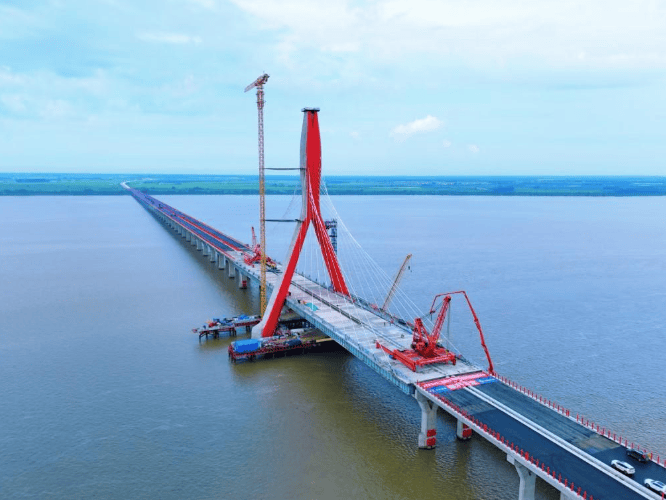
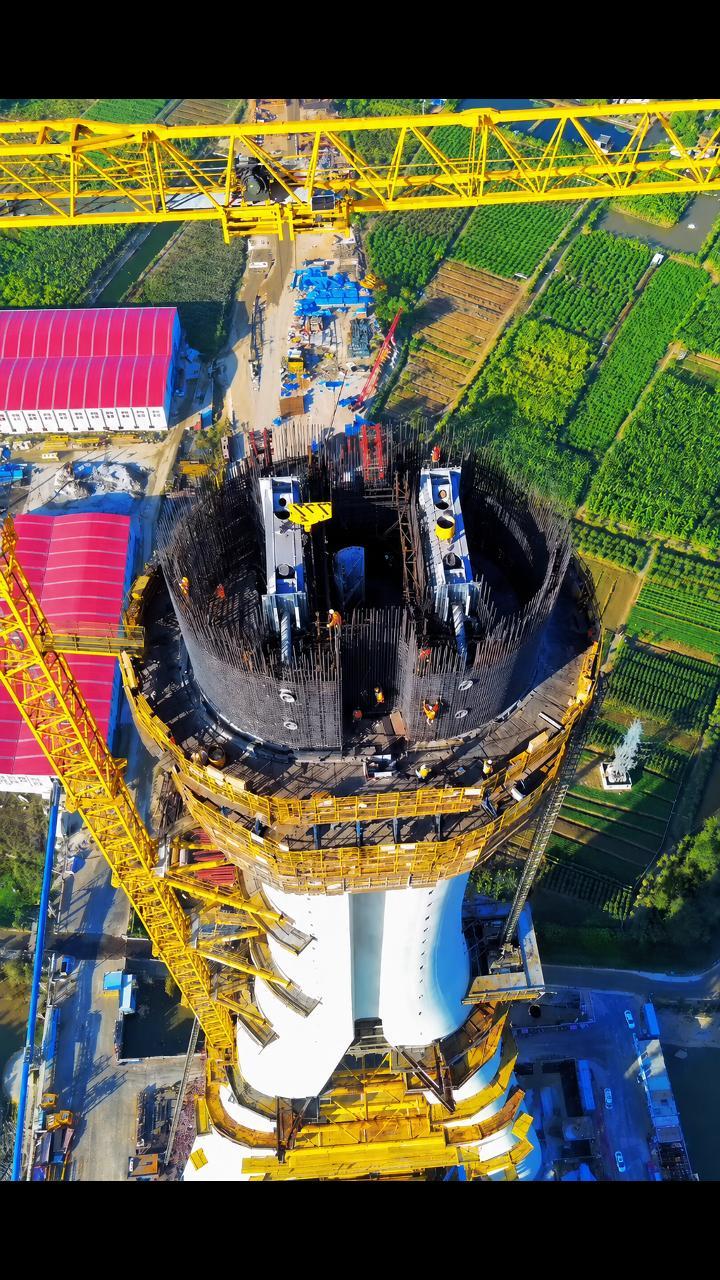
en.Wedoany.com Reported - Recently, the concrete pouring for the main tower No. 159 of the South Navigational Channel Bridge of China's Hangzhou Bay Sea-Crossing Railway Bridge was completed, marking the topping out of the two main towers. This bridge is a key project of the Tong-Yong High-Speed Railway, with a total length of 29.27 kilometers and a design speed of 350 kilometers per hour. It is currently the world's highest-standard and longest sea-crossing high-speed railway bridge under construction.
On the day of the topping out, a team of 15 builders from CCCC Second Harbor Engineering Co., Ltd. worked continuously for over 10 hours on an intelligent hydraulic climbing formwork to complete the final segment of the main tower. The South Navigational Channel Bridge has a total length of 814.5 meters and a main span of 364 meters, adopting a steel-truss composite girder cable-stayed bridge structure. The two main towers, each 157.5 meters high, were constructed in 29 segments, equivalent to the height of a 56-story building. Above the deck, the towers are inverted Y-shaped, tapering to a diamond shape below the deck. The final segment, 4.8 meters high, required the pouring of 120 cubic meters of C55 concrete.
With the topping out of the twin towers, construction of the superstructure, including the steel truss girders, will commence in full. The intelligent hydraulic climbing formwork at the top of the main towers will be gradually dismantled, while the erection of the steel truss girders on the north side will begin. The steel truss girders of the South Navigational Channel Bridge are designed in 29 segments, with a total weight of approximately 10,673 tons. All segments will be manufactured and assembled into 10 large sections at a specialized steel girder factory, then transported by ship to the bridge site for installation. The largest section measures 100.8 meters in length and weighs approximately 1,291 tons. The stay cables will be installed simultaneously with the steel truss girder sections. According to the plan, the South Navigational Channel Bridge will complete all steel truss girder erection by mid-July and achieve closure around September 10.
Since the first pile foundation steel casing was driven in August 2023, the project team has been working tirelessly for nearly 700 days. Facing the harsh sea conditions of large tidal ranges and rapid ebb and flow in Hangzhou Bay, as well as the complex geology of repeated strong scouring and siltation, the team overcame challenges such as ultra-deep large-diameter bored piles, the lowering of 2,500-ton deep-water steel cofferdams, intelligent temperature control of mass concrete, and linear control of high-altitude irregular tower columns. They innovatively applied an intelligent hydraulic climbing formwork system, integrating formwork support, intelligent climbing, spray curing, and stress-displacement monitoring, ensuring safe and efficient construction of variable-section ultra-high tower columns.
The Hangzhou Bay Sea-Crossing Railway Bridge is the world's highest-standard and longest sea-crossing high-speed railway bridge under construction. The topping out of the entire South Navigational Channel Bridge lays the foundation for the bridge's completion and opening to traffic as scheduled. Once completed, the project will further shorten the spatial and temporal distance between core cities in the Yangtze River Delta, playing a significant role in building a "rail-based Yangtze River Delta" and promoting high-quality integrated regional development.
Related Products



Industrial and Commercial Point-Type Gas Detector
Jinan Benan Technology Development Co., Ltd.

Acoustic Mineral Fiber Ceiling Tile 595x595x12mm
Shanxi Pano Trading Co., Ltd
West China Xiamen Hospital of Sichuan University
Wuhan Huakang Century Clean Technology Co., Ltd.
ERW Welded Pipe (Black Pipe and Hot-dip Galvanized Steel Pipe)
Handan Zhengda Steel Pipe Co., Ltd.