Tencent's AI Application Generation Platform "Toast" iOS Version Officially Launched, Achieving Dual-Platform Coverage on Mobile
en.Wedoany.com Reported - On July 6, the iOS version of "Toast," an AI application generation and inspiration co-creation platform under Chinese internet company Tencent, was officially launched. Currently, Toast has achieved full coverage across both iOS and Android mobile platforms, allowing users to input inspiration, generate applications, use them on the desktop, and share them socially on their phones. The product is positioned as a zero-barrier Vibe Coding tool, enabling users to generate and customize exclusive apps by describing their needs in natural language.
Toast's product logic shifts the application development process from traditional coding to a low-barrier path of "idea description—AI decomposition—application generation—multi-round adjustment—sharing and use." Ordinary users do not need to master programming languages, framework configurations, or packaging processes. They only need to input functional requirements, and the system can generate a previewable product form encompassing pages, features, interactions, and application structure. Compared to code assistance tools for professional developers, Toast is closer to application generation and creative co-creation scenarios, emphasizing enabling non-technical users to turn everyday ideas into usable small applications.
With the launch of the iOS version, Toast has achieved dual-platform mobile coverage, marking a transition from early Android validation to a more comprehensive user reach phase. Mobile platforms are crucial for such AI application generation platforms because many inspirations do not occur in desktop office environments but in daily life, study, meetings, social interactions, and fragmented work scenarios. Users can directly describe ideas on their phones, generate application prototypes, continue adjusting details, and share them with others. This usage chain is shorter than traditional PC development environments and closer to the actual needs of ordinary users.
The core of Toast's Vibe Coding is essentially having AI take on more functional decomposition and code generation tasks, while users are responsible for expressing intent, evaluating results, and making continuous corrections. For example, if a user wants to create a travel checklist tool, meeting minutes organizer, study check-in app, event registration page, or lightweight workflow tool, they can first describe the goal in natural language, and then AI generates a preliminary application. If the user is unsatisfied, they can continue adjusting the page layout, functional fields, interaction logic, and display methods through dialogue. This process lowers the entry barrier for application development but also requires the platform to continuously improve in generation quality, stability, editability, and result controllability.
Social sharing is another capability that distinguishes Toast from ordinary AI programming tools. User-generated applications can be shared via links, QR codes, etc., and can also form templates and inspiration reuse within the platform. If an application generation tool only serves a single user, its usage frequency is easily limited; if it can form a cycle of "I create an app—others use or modify it—a new version is generated," it becomes closer to a combination of a content community and a tool ecosystem. By incorporating inspiration co-creation into its product positioning, Toast indicates that Tencent does not just aim to create an AI code generator but hopes to integrate lightweight application generation, template dissemination, and user co-creation on the same platform.
More significant changes will emerge after the developer ecosystem opens up. Toast plans to fully open one-stop listing services, commercial component capabilities, and more API capabilities to the developer ecosystem in August. If an application generation platform remains only a personal creative tool, its value will be limited; if it subsequently integrates capabilities for listing, payments, accounts, data, components, APIs, and commercialization, it may enable generated applications to have stronger distribution and operational space. Developers can provide templates, components, interfaces, and services around the platform, while ordinary users can also leverage more mature capabilities through low-barrier methods.
Tencent's push for Toast in the AI application generation direction is also consistent with the trend of large model applications evolving from Q&A tools to production tools. In the past, users primarily used AI for writing, searching, summarizing, and Q&A; now, AI is entering areas like application building, process automation, lightweight tool generation, and personal software customization. With the launch of the iOS version, Toast's product coverage has further expanded, and the next phase will shift towards developer services, commercial components, and API capability opening. After the ecosystem capabilities are opened in August, whether Toast can accommodate more templates, components, and application listing demands will determine its speed in transitioning from a single AI tool to an application generation platform.
Related Products


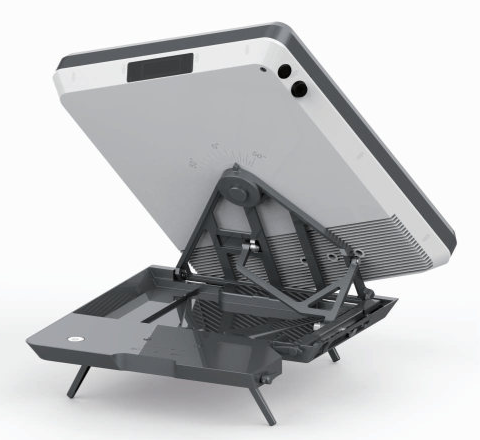
Flat Portable Satellite Terminal 0.35m Aperture Manual Portable Terminal
China Starwin Science & Technology Co., Ltd.

Automatic Aiming Laser Remote Obstacle Removal Robot
Pinggao Group Weihai High-Voltage Apparatus Co., Ltd.

Mine Explosion-proof and Intrinsically Safe Industrial Ethernet Ring Network (10 Gigabit/Gigabit)
Chongqing Mas Sci&Tech Co., Ltd.
Multi-function Marine Monitoring Low-altitude Detection Radar Sea-air Boundary Ocean Dynamic Environment Measurement
Chengdu Dixin Technology Co., Ltd.