Russia's Skoltech Demonstrates Room-Temperature High-Sensitivity Infrared Detector in 2026
en.Wedoany.com Reported - A research team from the Skolkovo Institute of Science and Technology (Skoltech) in Russia has demonstrated an infrared detector capable of operating at room temperature with high sensitivity, achieving high-performance infrared detection without the need for cryogenic cooling.
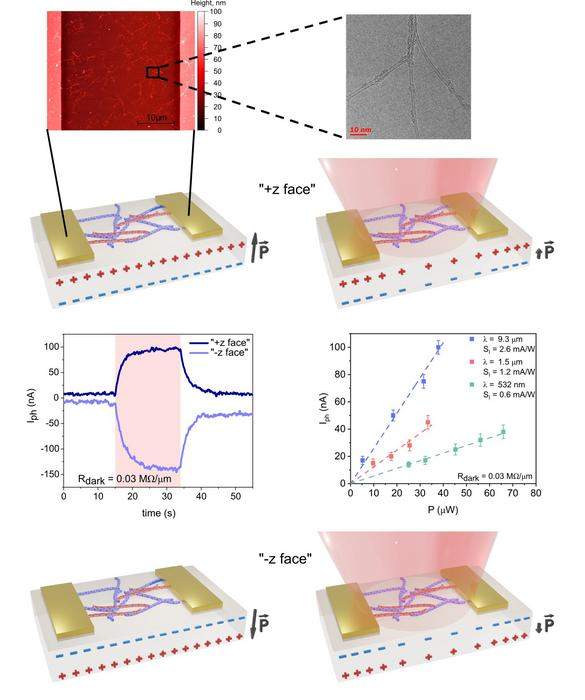
Infrared light is widely used in applications such as thermal imaging, night vision, gas sensing, and optical communications. However, traditional high-sensitivity infrared detectors typically require expensive cryogenic cooling systems, limiting their deployment in portable and low-cost scenarios. A team led by Dr. Svetlana I. Serebrennikova and Professor Albert G. Nasibulin from Skoltech has constructed a novel detector using two complementary materials. The device combines a single-walled carbon nanotube (SWCNT) network with a lithium niobate (LiNbO3) crystal. SWCNTs are hollow carbon cylinders approximately one nanometer in diameter, whose electrical conductivity is highly sensitive to changes in gate voltage; the LiNbO3 crystal can operate over a wide infrared wavelength range and exhibits nonlinear properties. The research findings were published on May 14, 2026, in the journal Opto-Electronic Advances, Volume 9, Issue 5.
The core principle of the detector relies on the pyroelectric effect in LiNbO3. When the crystal absorbs infrared light, it undergoes a slight temperature increase, altering its internal electric polarization and briefly generating an electric field. This field acts like a gate voltage, changing the conductivity of the connected carbon nanotube network by up to a factor of 10^5, thereby converting the heat from incident light into a strong electrical signal, forming a pyroelectric phototransistor. The research team noted that earlier similar devices based on graphene performed poorly because graphene lacks an electronic band gap, resulting in a weak response to the gate electric field. In contrast, semiconducting carbon nanotubes possess a band gap, enabling drastic changes in conductivity.
During fabrication, the team grew high-quality, sparse SWCNT networks using an improved aerosol chemical vapor deposition (CVD) method and employed a novel capillary transfer technique to deposit the sub-percolation film onto the surface of z-cut LiNbO3. This dry transfer method avoids damage to the nanotube properties caused by surfactants and contaminants in traditional processes. The resulting detector operates at room temperature, with a detection range covering visible light to 9.3 micrometers, and a specific detectivity as high as 10^10 cm·Hz^1/2/W, several orders of magnitude higher than graphene-based devices, approaching the theoretical limit of uncooled thermal detection.
With no need for cryogenic cooling and broad spectral sensitivity, the detector is suitable for portable, low-power infrared sensing applications, such as thermal imaging in firefighting and building inspection, environmental monitoring, quality control in manufacturing, and short-range optical communications. The research team stated that the next step is to improve response speed. The current response time is approximately 2 seconds, limited by heat diffusion in the 500 µm thick LiNbO3 substrate; using thinner substrates or membrane structures could significantly accelerate the thermal response. The team also plans to stabilize performance with protective coatings, improve the reproducibility of the semiconducting channel network, and optimize thermal coupling to enhance imaging speed and spatial resolution. This research demonstrates the potential of SWCNT-based pyroelectric phototransistors to approach the theoretical detectivity limit, paving the way for a new generation of compact, broadband, room-temperature infrared sensors.
Related Products


Standard Nozzle Flowmeter
Jinggong Automatic Control Instrument Complete Technology Development Company
Excavator Bucket Teeth Heat Treatment Production Line
Suzhou Hezhongju Intelligent Equipment Co., Ltd.

CAP1400 main feedwater flow nozzle flowmeter.
Jiangsu Hongda Instrument Technology Co., LTD.

LBH4000 Batch Environmental Protection Asphalt Mixing Plant | Asphalt Batching Plant | Asphalt Mixing Plant
Jilin Province Road Construction Machinery Co., Ltd.


Double-Boom Computerized Rock Drilling Jumbo WD200E
Hunan Wuxin Intelligent Equipment Group Co., Ltd.