British Antarctic Survey to Deploy Autonomous Robots to Explore Greenland Glaciers
en.Wedoany.com Reported - The Giant (Greenland Ice Sheet to Atlantic Tipping points) project, led by the British Antarctic Survey (BAS), will deploy a fleet of autonomous marine robots from the Royal Research Ship RRS Sir David Attenborough on an international expedition to Greenland. The mission aims to study how glacier melting affects the Atlantic circulation. This six-week expedition is part of a five-year project funded by the Advanced Research + Invention Agency (ARIA).
Scientists and engineers will combine autonomous vehicles, aerial drones, satellites, and sensors to study Greenland's glaciers and surrounding oceans. The collected data will be used in climate and ocean models. The RRS Sir David Attenborough will serve as a floating laboratory, supporting autonomous surface and underwater vehicles while conducting detailed measurements of fjord depth and shape, as well as ocean temperature, salinity, and currents.
Among the deployed instruments is the Autosub Long Range autonomous underwater vehicle (AUV), known as Boaty McBoatface. It will explore beneath the mélange—a mixture of sea ice and icebergs forming in front of the glacier—to assess its geometry and study how it influences glacier behavior.
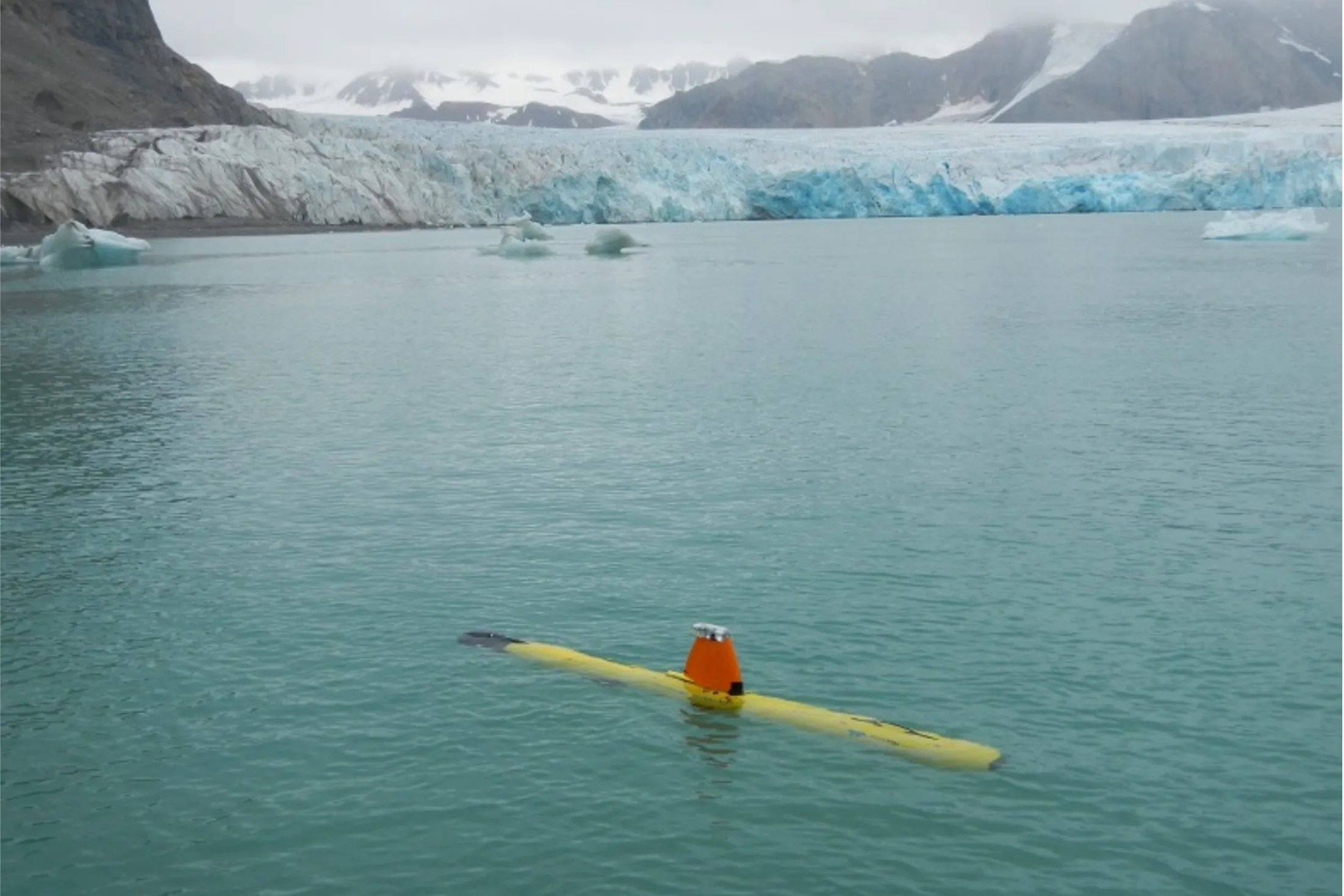
The expedition will also deploy the DriX unmanned surface vehicle, using multibeam sonar to map the underwater shape of the glacier front. According to BAS, its 50-centimeter resolution maps will reveal daily or even hourly melt rates, while collecting data on current strength, direction, temperature, and salinity. The Gavia autonomous underwater vehicle, operating underwater, will map the submerged glacier face and collect oceanographic measurements at depths of up to 500 meters. Four hand-launched ecoSub autonomous underwater vehicles will accompany the DriX or Gavia, using Sonardyne underwater positioning technology (since GPS networks do not work underwater) to obtain precise melt and turbulence readings in areas immediately adjacent to the glacier front.
Researchers will also deploy the Meltstake, a first-of-its-kind instrument lowered from a remotely operated vessel to drill 100 meters into the ice, measuring how water transfers heat to the glacier. The RRS Sir David Attenborough is 129 meters long, weighs 15,000 tons, has a cruising speed of 13 knots (24 km/h), a range of 19,000 nautical miles, can break through ice up to 1 meter thick at 3 knots (5.6 km/h), and accommodates 90 people (approximately 30 crew and 60 scientists, engineers, and support staff). The ship offers 750 square meters of built-in laboratory space, at least 10 scientific container slots, and features a 4-meter by 4-meter moon pool for deploying scientific equipment through the hull.
The information collected during the expedition will be used in ice, ocean, and climate models, including the next-generation UK Earth System Model, potentially improving predictions of how Greenland ice loss affects global climate change. The project also aims to develop a prototype early warning system capable of providing advance alerts of rapid glacier changes. Kelly Hogan, a marine geophysicist at the British Antarctic Survey and lead researcher for the Giant project, stated: "We are at a moment where the tools have finally caught up with the questions. With autonomous vehicles, advanced sensors, and powerful modeling—plus a boost from artificial intelligence—we can explore glacier-ocean interactions in ways that were unimaginable just a few years ago."
Related Products


CAP1400 main feedwater flow nozzle flowmeter.
Jiangsu Hongda Instrument Technology Co., LTD.

Industrial and Commercial Point-Type Gas Detector
Jinan Benan Technology Development Co., Ltd.


Strip Coating and Plating Production Line Equipment
MCC-SFRE HEAVY INDUSTRY EQUIPMENT CO., LTD.

Double-Boom Computerized Rock Drilling Jumbo WD200E
Hunan Wuxin Intelligent Equipment Group Co., Ltd.
Excavator Bucket Teeth Heat Treatment Production Line
Suzhou Hezhongju Intelligent Equipment Co., Ltd.