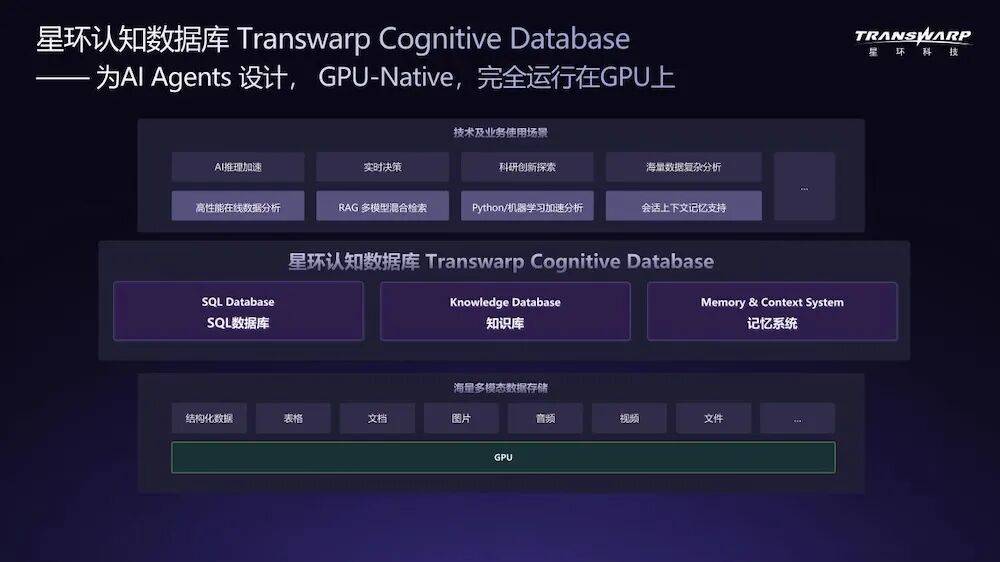
en.Wedoany.com Reported - China's Transwarp has launched the GPU-native Transwarp Cognitive Database, integrating SQL databases, knowledge bases, and memory systems to provide AI Agents with comprehensive data, knowledge, and memory support, reducing the cost and barriers to large-scale deployment of AI-native applications.
Enterprise AI is evolving from large model Q&A to AI Agents. Unlike traditional large language models that provide a single response, AI Agents execute a multi-cycle loop of "reasoning—action—observation—correction" around a goal, repeatedly accessing data, retrieving knowledge, invoking tools, and updating task status. Transwarp notes that traditional CPU architectures have only tens to hundreds of general-purpose computing cores with memory bandwidth of approximately 100-400 GB/s. When handling high-frequency, multi-round, concurrent tasks, data transfer between CPU and GPU becomes a key bottleneck. Reconstructing the database computing architecture with GPU at its core leverages tens of thousands of parallel cores and TB/s-level high-bandwidth memory to handle high-parallelism workloads such as large-scale data scanning, complex aggregation, document parsing, and vector computation. Additionally, through GPU-Initiated Direct Storage (GIDS) technology, the GPU directly initiates storage access, reducing data relay and memory copying.
The database achieves five technological breakthroughs. First, GPU-accelerated structured data analysis. In the TPC-DS SF1000 test, it completed 99 query tasks, achieving 70 times the performance of the open-source CPU database DuckDB; compared to Snowflake and Databricks, performance improved by up to 66 times, and cost-effectiveness by up to 14 times. Second, GPU-accelerated document processing and knowledge retrieval. Based on the COSMIC document parsing service, processing performance on complex OmniDocBench documents improved by 10 times; GPU vector index construction performance improved by up to nearly 50 times, and retrieval throughput by up to 238 times. In terms of domestic computing power adaptation, it has completed optimization for Hygon DCU, reducing vector index construction from days to minutes, with retrieval performance up to 58 times higher than CPU. Third, memory utilization improved by 20 times. Through data offloading and index search optimization, memory consumption is reduced to approximately 5%. Even when offloading 95% of computation-related data to memory or SSD, search throughput still reaches 12 times that of traditional CPU indexes. Fourth, memory capabilities achieved overall accuracy of 79.6% and 92.8% on the BEAM 500K long-term episodic memory and LongMemEval-S long-dialogue memory benchmarks, respectively. Fifth, natural language-driven operation automatically converts user requirements into executable data workflows, integrating the entire process of data development, governance, analysis, and report generation.
In real-world scenario validation, the OfficeQA Pro complex enterprise knowledge Q&A test, involving nearly 10,000 pages of U.S. Treasury bulletins spanning nearly a century and 133 reasoning tasks, achieved an end-to-end AI reasoning performance improvement of approximately 6 times, with an accuracy of 79.3%. In financial quantitative factor backtesting, performance improved by up to 5,881 times compared to CPU solutions. In full-chain credit business and risk analysis, handling 480 million detailed data records, overall performance improved by 449 times.
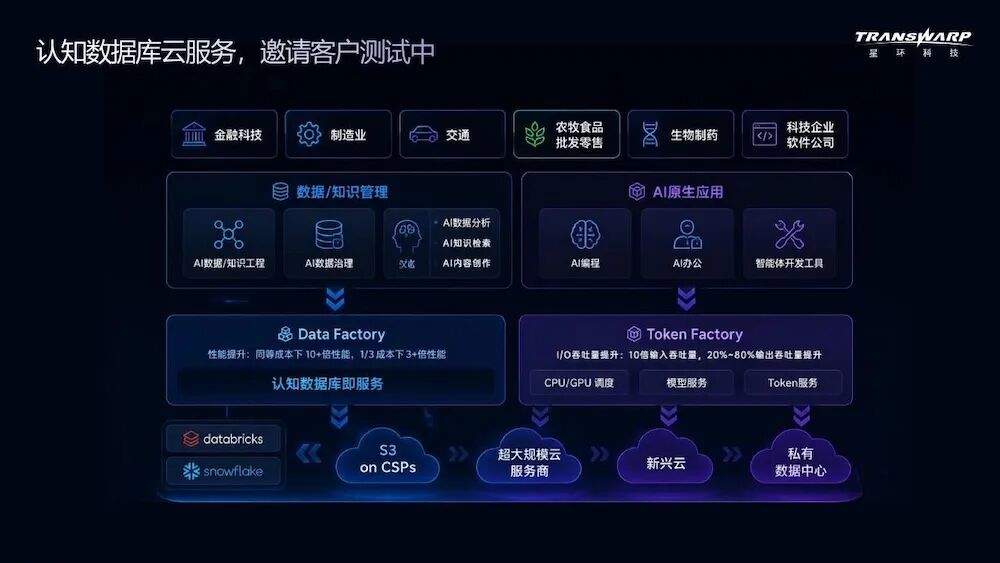
Additionally, Transwarp will launch a cognitive database cloud service, including Data Factory and Token Factory. Data Factory achieves over 10 times performance improvement at the same cost, supporting one-click migration from cloud databases such as Snowflake and Databricks. Token Factory achieves a 10-fold increase in input throughput and a 20% to 80% increase in output throughput, enhancing enterprise-level AI reasoning efficiency.
Note: The performance and evaluation data in this article are from Transwarp's internal test results and public benchmarks. Actual performance may vary depending on hardware and software configurations, data scale, and testing methods.