Maputo Port in Mozambique to Deploy Kale Logistics Port Community System
en.Wedoany.com Reported - The Maputo Port Development Company (MPDC) in Mozambique has awarded the Port Community System (PCS) to Kale Logistics Solutions, a global integrated port technology provider, bringing all stakeholders—including shipping lines, customs, trucking, rail, warehouses, banks, and regulatory agencies—into a single digital ecosystem for the first time. The system replaces fragmented, paper-based processes with real-time visibility and automation, handling vessel scheduling, cargo clearance, transportation, and financial transactions through a secure platform, fully integrated with the Mozambique Customs Single Window (JUE). The Ministry of Transport and Logistics of Mozambique positions this initiative as a cornerstone of the national competitiveness strategy.
In contrast, South Africa's Transnet Port Terminals (TPT) operates a proprietary system at ports such as Durban. Durban relies on the Navis N4 terminal operating software for container handling, integrated with Transnet's Cargo Dues and TNPA systems, and connected to the South African Revenue Service (SARS) customs platform. While robust, these systems operate in silos; shipping lines, freight forwarders, and transport operators typically interact through multiple portals with limited cross-platform visibility. Maputo's PCS promises a single source of truth, where all participants share the same data in real time, whereas Durban's model is efficient within the terminal but lacks seamless integration across the broader logistics chain.
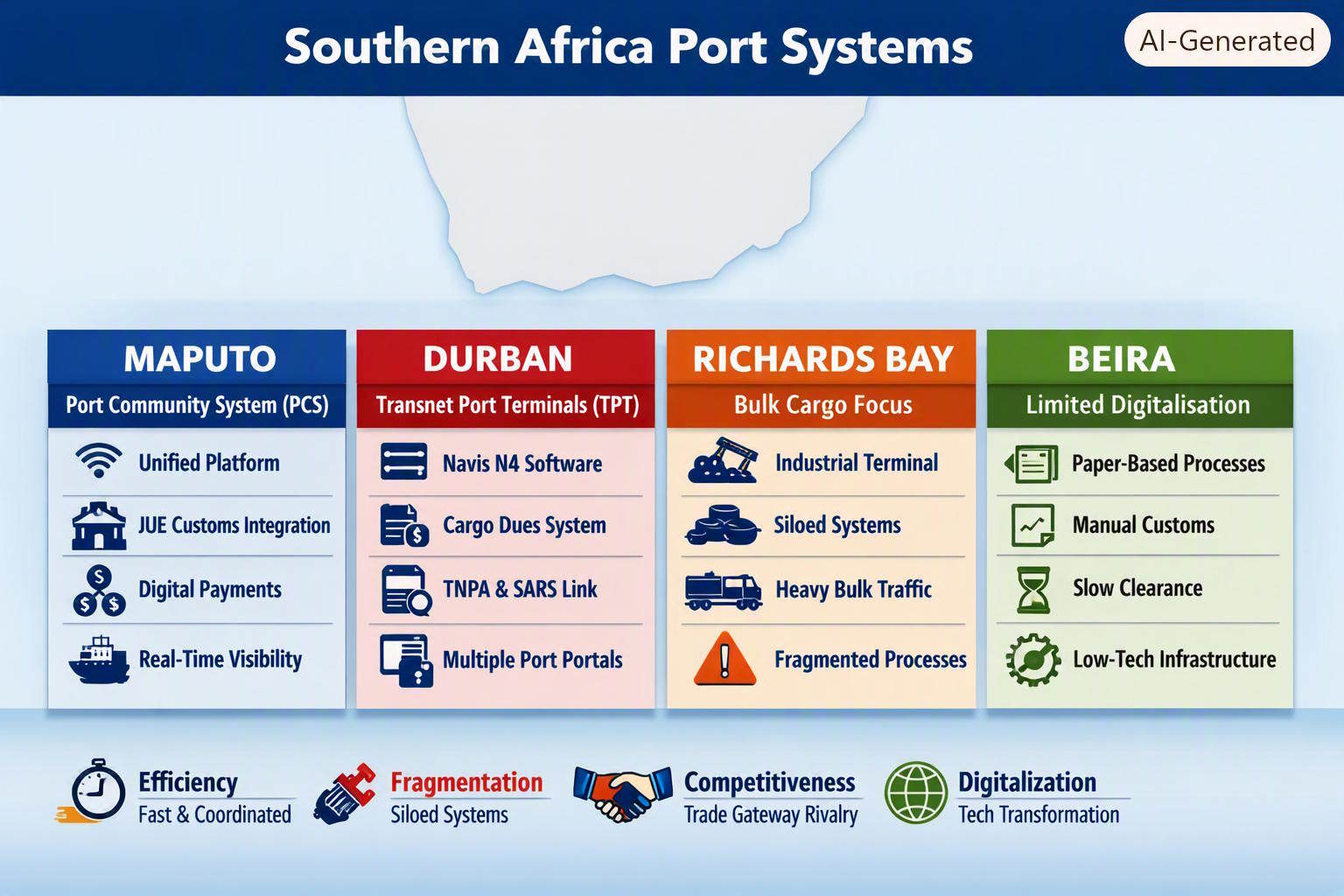
Other ports operated by Transnet, such as Richards Bay and Cape Town, follow a similar pattern, each with specific terminal systems connected to Transnet's broader architecture, creating a layered digital environment. The Port of Beira in central Mozambique is less digitized, with many processes still paper-based. This gives Maputo a competitive advantage, positioning it as the country's flagship digital gateway. Maputo's PCS offers a unified platform, real-time data sharing, and integrated customs and payment systems, aiming to reduce duplication and congestion; Durban's TPT is powerful but fragmented, with multiple portals and limited end-to-end visibility; Richards Bay focuses on bulk commodities, relying on Transnet's siloed systems; Beira has low digitization, primarily using paper-based processes.
Maputo's PCS can reduce vessel turnaround times and alleviate gate congestion, while Durban's layered system remains vulnerable to bottlenecks. The PCS provides auditable cargo flows, reducing informal operations; Transnet's systems offer compliance but poorer overall visibility. For landlocked neighbors such as Eswatini and Zimbabwe, Maputo's PCS may offer a faster and cheaper alternative to Durban. Maputo aligns with global PCS standards, positioning it for smoother integration into the African Continental Free Trade Area (AfCFTA) trade corridors. The launch of Maputo's PCS is a strategic move to compete head-on with Durban using digital transparency and speed. Durban, Richards Bay, and Cape Town still rely on scale and infrastructure, but the lack of a true PCS leaves South African ports digitally fragmented. The southern African port landscape is entering a new phase where digitization, rather than capacity, defines competitiveness. Maputo's PCS could serve as a catalyst, prompting the region to rethink the role of ports in the era of trade corridors.
![IVECO Cash-in-Transit [DMT5048XYCL3-AM] - Chongqing Dima Industry Co., Ltd](https://img.wedoany.com/2026/0911/20260911030157582.png)