Industry Standard for "Specification for Quality Traceability System of Edible Vegetable Oil Products" to Be Implemented Soon
en.Wedoany.com Reported - According to the standard work plan of the Ministry of Industry and Information Technology, the industry standard "Specification for Quality Traceability System of Edible Vegetable Oil Products" (QB/T 8211—2026), proposed and supervised by the China National Light Industry Council and led by the China Light Industry Information Center, was released in February 2026 and will be officially implemented on September 1.
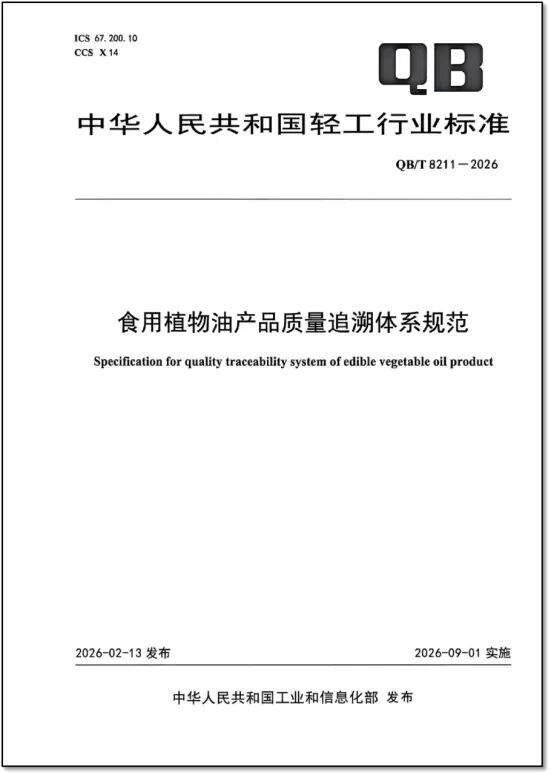
The standard was jointly developed by leading grain and oil enterprises such as COFCO, Yihai Kerry, and Xiwang Group, along with research institutions, digital service providers, and universities. It is China's first specialized standard for traceability at key nodes of edible vegetable oil. Focusing on the digital management of grain and oil for people's livelihoods, the standard implements the national "Three Products" action for consumer goods and the requirements of relevant documents on enhancing the manufacturing industry's supply chain. It addresses the shortcomings in traceability standardization within the grain and oil sector, establishes a full-chain traceability system covering raw materials, production, distribution, and consumption, and leverages digital means to fortify the safety line of edible oils. Balancing the implementation needs of both large and small enterprises, it forms a unified traceability specification that is both versatile and practical, helping to drive the industry towards safer, more digital, and standardized upgrades.
Establishing a Problem-Oriented Core Framework
This standard closely aligns with GB 44917 "Hygienic Requirements for Bulk Transport of Edible Vegetable Oil" and relevant management regulations. Addressing four major challenges in the current edible vegetable oil industry chain—long chain length, numerous risk points, inconsistent traceability standards, fragmented upstream and downstream data, lack of risk handling mechanisms, and opaque consumer traceability information—the standard focuses on pre-packaged edible oils. It builds a complete system covering basic management, coding and labeling, full-process information collection, a three-tier traceability platform, graded information disclosure, digital risk control, green storage and transportation, cross-border traceability, and long-term evaluation and improvement. It specifies mandatory data items for the entire process, establishes a system for unique traceability codes for individual products, and integrates commercial, logistics, and information flows. Ultimately, it enables oil sources to be checked, destinations to be traced, responsibilities to be investigated, and defects to be recalled.
Deploying Follow-up Plans with Empowerment as the Goal
The implementation of this standard can provide four-fold empowerment: helping enterprises reduce costs and control risks, breaking down industry data barriers to cultivate new productive forces, achieving full-chain transparent traceability for consumers, and providing digital verification basis for regulatory authorities.
In the next step, the China Light Industry Information Center, under the coordination of the Ministry of Industry and Information Technology and the China National Light Industry Council, will carry out online and offline standard promotion and training, output replicable implementation templates from leading enterprises to assist small and medium-sized oil enterprises in benchmarking and building their systems, and continuously collect practical industry challenges to iteratively optimize the supporting evaluation system. This will promote the safe, green, and digital long-term development of the edible oil industry through standardization.
Related Products



714CD Series C-Band Weather Radar
Chengdu Zhongdian Jinjiang Information Industry Co., Ltd.
4HS-8 High-efficiency Peanut Inverted-laying Harvester
Hebei Yongfa Hongtian Agricultural Machinery Manufacturing Co., Ltd.



Industrial and Commercial Point-Type Gas Detector
Jinan Benan Technology Development Co., Ltd.