en.Wedoany.com Reported - China Module Market (CMM) index fell 0.91% week over week to $0.109/W, according to the OPIS Global Solar Markets Report released on July 28. The index is OPIS' benchmark assessment of free-on-board (FOB) prices for TOPCon modules with power ratings below 645 W in China, with spot price indications ranging from $0.104/W to $0.119/W.
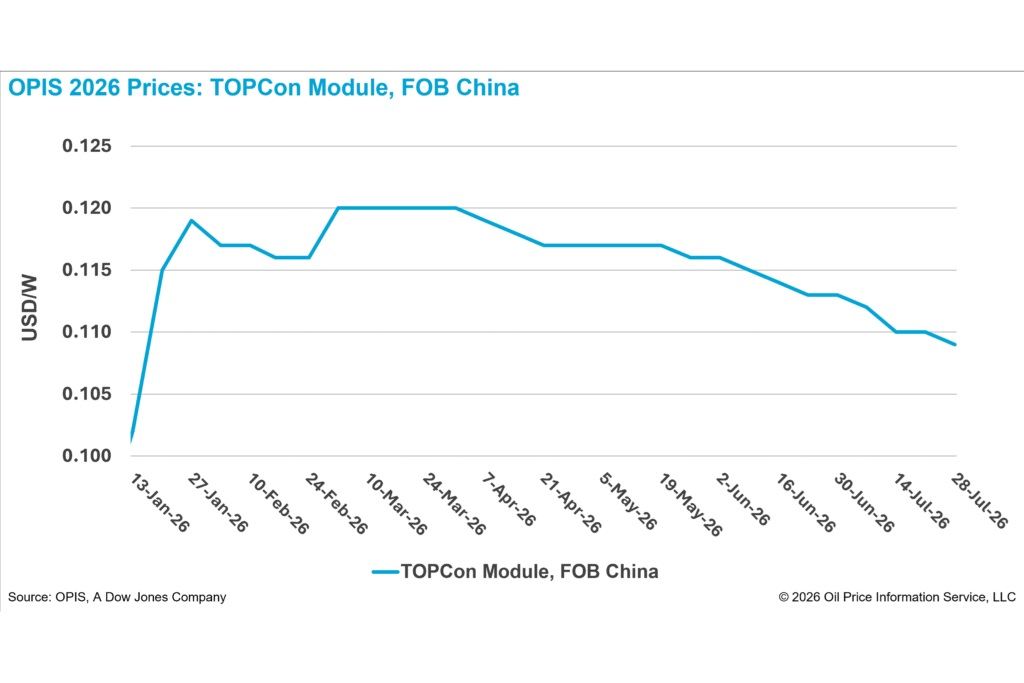
Forward delivery sentiment also weakened, with China FOB TOPCon module forward curve prices declining across the board. Forward prices for cargoes shipped in Q3 and Q4 2026 fell 0.91% week over week to $0.109/W; cargoes shipped in Q1 2027 dropped 1.82% to $0.109/W. Cargoes shipped in Q2 and Q3 2027 both declined 0.92%, to $0.108/W and $0.109/W, respectively.
Conventional China FOB TOPCon module prices weakened due to lower negotiable indicative prices on one hand, and on the other, increased supply of high-efficiency modules prompted manufacturers to lower quotes, putting greater pressure on the overall module market.
This week, quotes for high-efficiency TOPCon modules (defined as products with power ratings exceeding 650 W) were lowered, with heard prices on a China FOB basis around the high end of $0.100/W and the mid-range of $0.110/W. Back-contact (BC) modules maintained an FOB premium of up to $0.02-0.03/W over high-efficiency TOPCon modules.
The shift toward higher-efficiency modules is partly driven by recent policy measures. A national energy efficiency standard released at the end of June introduces a three-tier classification for crystalline silicon photovoltaic modules, effective January 1, 2027. Under the standard, Tier 1 energy efficiency requires minimum efficiencies of 24.0%, 23.8%, and 24.2% for TOPCon, heterojunction (HJT), and BC modules, respectively, with corresponding minimum power thresholds of 650 W, 645 W, and 655 W.
Regulatory efforts also extend to pricing practices. The China Photovoltaic Industry Association (CPIA) released the "General Rules for Cost Accounting Models in the Photovoltaic Industry," unifying cost calculation methods for polysilicon, wafers, cells, and modules to provide a consistent basis for cost comparison. The framework divides manufacturing costs into cash costs, production costs, and total costs, requiring vertically integrated manufacturers to transfer products between manufacturing stages at the previous stage's total production cost, avoiding underestimation of downstream stage costs and thereby improving comparability with specialized manufacturers. The framework also covers different technology routes, with CPIA planning to publish reference values for TOPCon, HJT, and BC products separately.
CPIA Executive Secretary-General Liu Yiyang stated that a unified cost accounting model will enable prices to better reflect production costs, product quality, and technological competitiveness, allowing high-efficiency manufacturers to earn reasonable returns. Trina Solar Chairman Gao Jifan added that greater cost transparency can accelerate the elimination of inefficient capacity, support more sustainable pricing, and curb excessive cost-cutting at the expense of product quality.
An industry insider told OPIS that the framework's practical impact ultimately depends on its adoption in commercial negotiations, pricing practices, and cost information transparency.
The momentum behind this shift could strengthen further. Market sources told OPIS that rumors suggest regulators are considering an export tax rebate of up to 4% for Tier 1 high-efficiency cells and modules. A source from a top-tier manufacturer said that if confirmed, the rebate would clearly benefit high-efficiency products, as more competitive export prices could incentivize buyers while encouraging manufacturers to adjust existing production lines to obtain higher-efficiency products. The manufacturer also revealed that the current expansion toward 650 W modules primarily involves technical upgrades and adjustments to existing production lines rather than new facility construction.
A source from another top-10 manufacturer said that if the export tax rebate framework favors higher-efficiency products, lower-efficiency modules would face increasingly significant cost disadvantages. However, multiple industry sources emphasized that the rebate has not yet been confirmed, with one advising market participants to await official announcements from regulators.
OPIS, a Dow Jones company, provides energy prices, news, data, and analysis covering gasoline, diesel, jet fuel, LPG/NGL, coal, metals, and chemicals, as well as renewable fuels and environmental commodities. In 2022, OPIS acquired the price data assets of the Singapore Solar Exchange and currently publishes the OPIS APAC Solar Weekly Report.