Quantinuum, NVIDIA, and Pfizer Validate Quantum AI for Drug Discovery, Reducing Generation Time by 3-4 Orders of Magnitude
en.Wedoany.com Reported - A research team from Quantinuum, NVIDIA, and Pfizer Inc. has proposed a generative quantum AI framework named ADAPT-GQE for automating the synthesis of ground-state quantum circuits for drug molecules. The framework has been validated on Quantinuum's 98-qubit Helios-1 ion-trap processor.
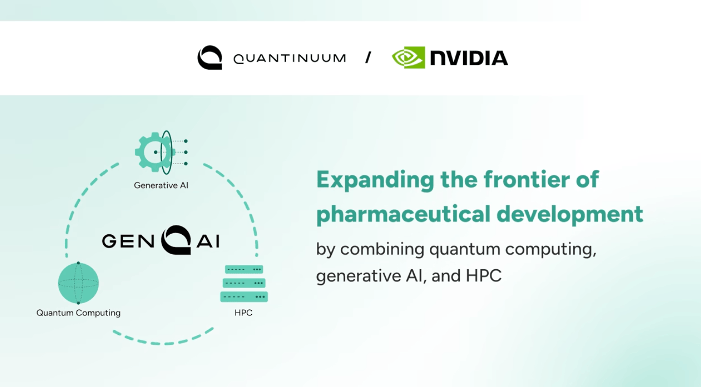
The related paper, titled "Learning to Prepare Molecular Ground States with Transformer Models," has been released. The proposed generative quantum AI (GenQAI) framework combines classical high-performance computing (HPC), generative Transformer models, and quantum processing units (QPUs) to compute ground-state preparation circuits for complex active pharmaceutical ingredients (APIs).
This experiment addresses a computational bottleneck in recent variational quantum eigensolver (VQE) algorithms. Standard adaptive algorithms such as ADAPT-VQE require evaluating thousands of operator gradients and re-optimizing the parameter landscape at each step, making systems with more than approximately 15 qubits computationally intractable. ADAPT-GQE uses a generative Transformer to directly synthesize compact, low-energy circuit structures in a single forward pass.
ADAPT-GQE is a generative AI model trained on quantum chemistry datasets produced by GPU-accelerated classical supercomputing. The model predicts the complete ground-state quantum circuit for imipramine, a tricyclic antidepressant. Imipramine is an industry-standard benchmark drug commonly used in forced degradation and shelf-life stability studies.
The framework's synthesis pipeline consists of three stages. The data generation stage is based on ADAPT-VQE circuits accelerated by NVIDIA CUDA-Q, combined with OpenMM and MACE-OFF for molecular dynamics conformational sampling, with active-space qubit mapping scales ranging from 12 to 16 qubits; the circuit synthesis stage employs fine-tuned NVIDIA Nemotron models and Gemma 3 / Nemotron-Nano Transformer architectures; the execution validation stage uses the Quantinuum Helios-1 processor and the InQuanto chemistry platform.
The AI-synthesized circuits achieved or exceeded the ground-state accuracy of the reference ADAPT-VQE training data, reducing circuit generation time by 3 to 4 orders of magnitude across 12-, 14-, and 16-qubit active spaces.
The research team also applied group relative policy optimization (GRPO) directly to the generated circuit outputs, enabling the model to learn to propose new operator sequences, thereby improving accuracy over the underlying ADAPT-VQE training baseline.
For hardware execution, the framework compiled synthesized circuits for imipramine conformers via Quantinuum's InQuanto™ software platform and executed them on the Helios-1 ion-trap processor, demonstrating the feasibility of AI-driven quantum algorithm generation on a commercial QPU.
This work, a collaboration between Quantinuum, NVIDIA, and Pfizer's chemistry R&D team, establishes an open-source reference framework for automated, practical-scale quantum computational chemistry.