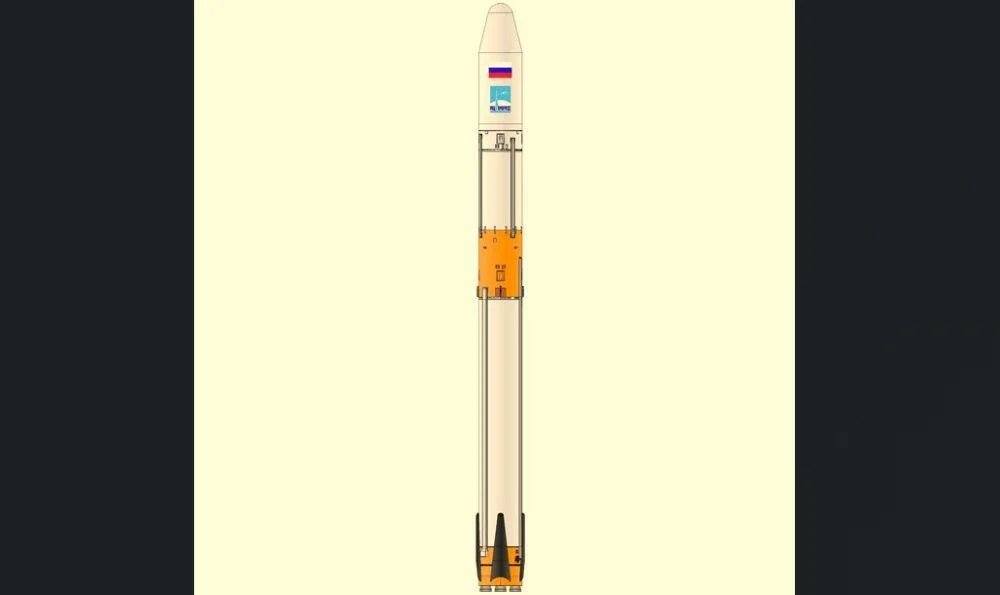
Russia's Reusable Rocket Amur SPG First Flight Delayed to 2031
en.Wedoany.com Reported - The first flight of Russia's first reusable launch vehicle, the Amur SPG, has been postponed to 2031, five years later than the timeline originally proposed when the project was first introduced.
This date is also three years later than what Russian officials had previously disclosed. In April, First Deputy Prime Minister Denis Manturov stated at the Russian Space Forum that the prototype would fly in 2028. On August 11, Leonid Mikhailenko, CEO of the Progress Space Center design organization in Samara, provided the revised 2031 timeline during an interview with local television.
The Amur SPG will replace the Soyuz-2, a Soviet-era rocket that remains the workhorse to this day, and is positioned as a medium-lift launch vehicle. The rocket features a two-stage configuration with a reusable first stage, with an estimated launch cost of $22 million per mission, partly reduced thanks to the reuse of the first stage. Both stages are powered by liquefied natural gas (methane), and SPG stands for the Russian abbreviation of "liquefied natural gas," Szhizhenny Prirodny Gaz.
The Amur SPG has a launch mass of 380 metric tons and a low Earth orbit payload capacity of 9,500 kilograms (20,944 pounds), approximately 15% more than the Soyuz-2. When paired with the Fregat upper stage used on Soyuz rockets, it can deliver a 1,200-kilogram spacecraft to geostationary orbit.
In 2020, Roscosmos awarded the design contract for the Amur SPG to the Progress Space Center design organization, with the initial first-flight target set for this year.
According to Roscosmos, the reusable first stage is equipped with landing legs and aerodynamic grid fins, a design similar to SpaceX's Falcon 9. The first stage is powered by five RD-0169A oxygen-methane engines developed by KB Khimavtomatiki, with the center engine handling the powered landing burn. The second stage uses a single RD-0169V engine of the same type but with four combustion chambers. The first stage is expected to fly at least 10 times during the testing phase.
Mikhailenko said that the Progress Space Center has completed the design of the new rocket, "and now we are directly working on hardware-related tasks."
Roscosmos plans to operate the Amur SPG from the Vostochny Cosmodrome, a commercial spaceport in Russia's Far East, which already has launch pads for the Soyuz-2 and the heavy Angara A5 rocket.
Related Products



3m intelligent buoy combining navigation safety and real-time marine monitoring integrated navigation and marine monitoring system for real-time maritime data
Chengdu Dixin Technology Co., Ltd.

Industrial and Commercial Point-Type Gas Detector
Jinan Benan Technology Development Co., Ltd.
![IVECO Cash-in-Transit [DMT5048XYCL3-AM] - Chongqing Dima Industry Co., Ltd](https://img.wedoany.com/2026/0911/20260911030157582.png)