USDA NASS Modernization Phase One Focuses on Corn and Soybeans, Details to Be Announced at September Farm Show
en.Wedoany.com Reported - The U.S. Department of Agriculture (USDA) is advancing the modernization of its National Agricultural Statistics Service (NASS) data collection system, with the first phase focused on corn and soybeans. Project details are expected to be announced at the Farm Progress Show in Boone, Iowa, opening September 1. The initiative is being led by Indiana farmer and former U.S. Ambassador to the United Nations agencies for food and agriculture, Kip Tom, selected by Agriculture Secretary Brooke Rollins.
Tom told Agri-Pulse that NASS must move "from the analog era to the digital era," ensuring the agency has the tools to deliver information in the ways needed. This effort could ultimately fundamentally change how the USDA estimates planted acreage and yields. Satellite imagery can now scan nearly every acre of land at five-meter resolution, and private companies are operating increasingly sophisticated satellite constellations capable of gathering information globally. Tom believes combining these images with farm machinery data could help narrow the gap between projected and actual yields, and could also allow the agency to make estimates more frequently than it does now.
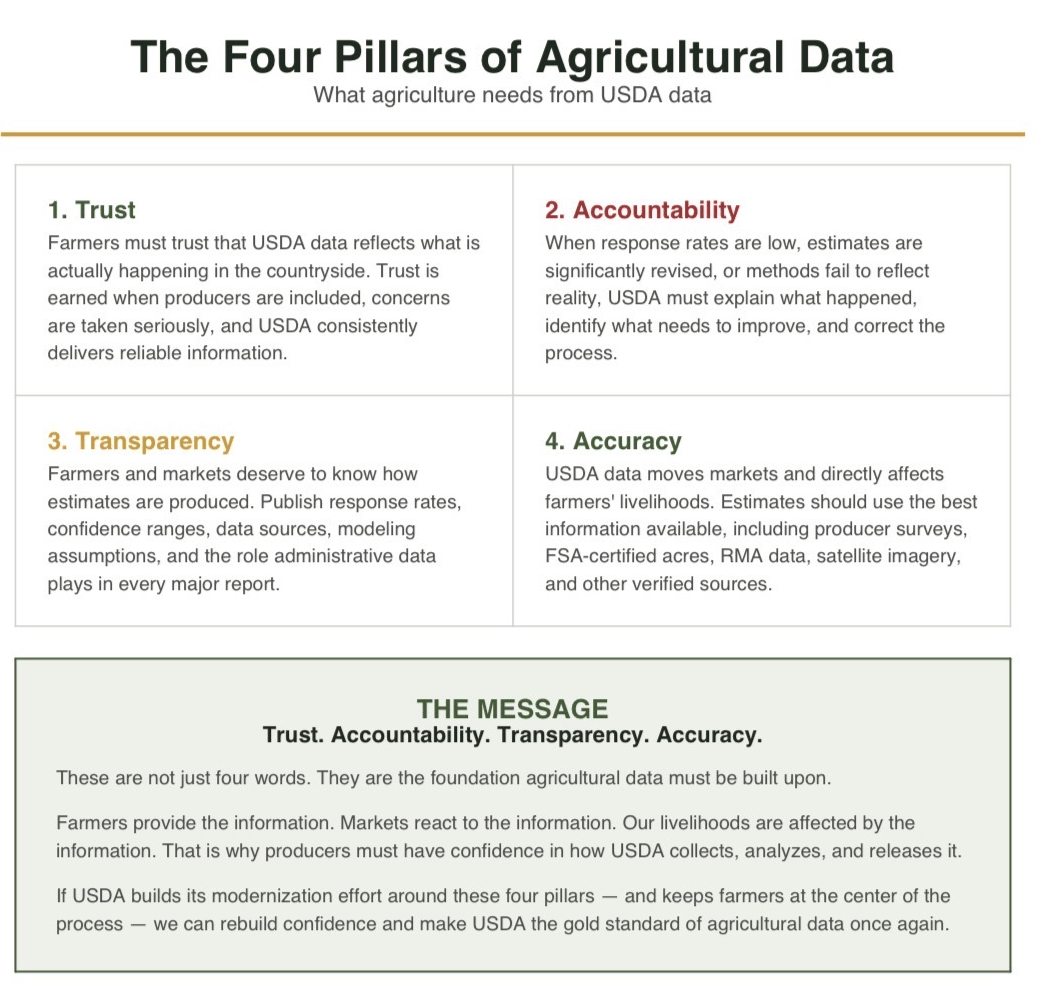
NASS has long relied on surveys and thousands of enumerators to collect information directly from farmers, but farmer participation has declined markedly. "We've gone from over 80 percent participation rates to just over 30 percent today," Tom said. "That clearly indicates we need to move from talking to an enumerator with a pen and paper to collecting information digitally." Meanwhile, NASS's workforce has also been shrinking. According to the American Statistical Association, its full-time equivalent staff fell from 839 in fiscal year 2023 to 389 in fiscal year 2026; data from the U.S. Office of Personnel Management shows more than 300 employees have left since January 2025.
As participation and staffing decline, farmer and agricultural organization confidence in NASS estimates is under strain. In its January 2026 report, NASS made a record upward revision of 4.5 million acres to harvested corn acreage, and grain prices fell more than 5 percent within minutes of the report's release, triggering significant backlash and internal review. The USDA solicited public comments on statistical programs earlier this year. The Iowa Corn Growers Association, citing a 37.6 percent response rate for the March 31 Prospective Plantings report in its submitted comments, said declining participation rates have led to a loss of confidence among farmers, grain traders, and others across the supply chain. Submitted recommendations included greater use of satellite technology to improve acreage and yield estimates. NASA Harvest researchers specifically suggested that satellite data could be used to determine active and fallow farmland, identify crop types, and improve early warning and sampling systems used for crop condition and yield estimation.
The USDA is hearing directly from farmers at listening sessions across the country about their needs for modernizing the data system. Earlier this month, officials met with Missouri farmers at the Missouri State Fair to discuss ways to improve data collection and rebuild statistical confidence. Richard Fordyce, USDA Under Secretary for Farm Production and Conservation, emphasized that NASS data influences decisions across the department. "Conservation Reserve Program (CRP) rental rates are 100 percent based on NASS soil survey rental rate data. That's our starting point for setting CRP rental rates," he said. "There are many programs that reference this data. We have to do better." Fordyce also stressed that any modernization effort must protect the information collected. "If USDA has one pillar, it's data security."

Garrett Hawkins, president of the Missouri Farm Bureau, cautioned that farmers have heard promises of modernization before. "Some of us are old enough to have seen multiple previous administrations try to truly modernize the system, and we've been talking about this for decades," he said. "It's exciting, but it's also a massive undertaking. Ultimately, how do we get this done within the time you're given?" Brooke Appleton, USDA Deputy Under Secretary for Farm Production and Conservation (FPAC), said the current effort enjoys broad support within the department. "We haven't hit any obstacles or roadblocks anywhere. The lanes are open." She also noted that the USDA has brought in IT personnel from the private sector who were shocked by the department's current state of technology—"they were shocked by the technology we've been using for the past 25 years."
The new system Tom envisions would combine satellite imagery, machine data, and traditional on-the-ground verification. "You're going to need more satellite data. It becomes very accurate. But I still think you have to have field staff to go check." This could change the role—and possibly the number—of NASS enumerators. The National Association of State Departments of Agriculture (NASDA) employs thousands of part-time enumerators to conduct NASS surveys. NASDA told Agri-Pulse on Monday that its focus remains on providing enumerators with training, tools, and support to improve the producer experience and participation; the organization is working with the USDA and NASS on the broader modernization effort but is not involved in NASS data analysis. Tom said modernization will not eliminate enumerators. "We still need them. Do we need 2,000? I'm not sure."
Technology could also allow the USDA to move beyond its current reporting cadence. Tom said the agency could eventually release updates every two weeks instead of relying on monthly estimates. "If we can do something passive, collecting information on crop size, and not only improve accuracy but also shorten the interval between reports, we might not be monthly but weekly or biweekly for certain reports." Private companies are already publishing more frequent estimates. "Some companies have been publishing yield estimates since July 1 and adjusting them weekly," Tom said. "I'd like to see us get to the point where we see that on the government side as well." Weekly crop condition reports could build on satellite data, providing more timely and granular insights to help farmers make planting and marketing decisions and help input suppliers plan their businesses. More granular data could also drill down to the county level, providing companies considering investments in feed mills, poultry operations, or processing facilities with a reference for local production.
Tom views NASS modernization as an urgent task to ensure the federal government remains the most credible source of agricultural data. "If we don't do this, the private sector will, and they'll own that information." He noted that companies such as COFCO and Sinograin have financial incentives to develop their own estimates when they cannot rely on USDA data. He looks forward to NASS becoming the "gold standard" for digital agricultural reporting, expanding beyond corn and soybeans to commodities such as citrus, dairy, vegetables, and fruits, while also noting that "it's important to understand what's happening in Brazil, Argentina, Europe, and Australia."
Data ownership and security concerns are also part of the discussion. Tom said farmers who voluntarily provide machine data should control how that information is shared, and that anonymizing and aggregating farm-level data is critical so individual producers cannot be identified. Satellite data should flow directly into the USDA and be protected by the agency. "It's about data ethics. We have to make sure our data is not compromised in any way that would allow anyone to access this information ahead of time. We have to build firewalls." Regarding potential partners, "all options are on the table," but any partnering entity would need the capacity for continuous technological evolution while meeting strict security requirements. "I want to build this system so that we have the gold standard of digital reporting across the entire agricultural supply chain—from companies producing genetics, vaccines, or pharmaceuticals for livestock, all the way to the consumer's table."
Related Products


Industrial and Commercial Point-Type Gas Detector
Jinan Benan Technology Development Co., Ltd.

714CD Series C-Band Weather Radar
Chengdu Zhongdian Jinjiang Information Industry Co., Ltd.

4HS-8 High-efficiency Peanut Inverted-laying Harvester
Hebei Yongfa Hongtian Agricultural Machinery Manufacturing Co., Ltd.