UK industrial electricity prices are the highest among all comparable economies, with Ofgem raising the household energy price cap by 4% in October
en.Wedoany.com Reported - In the UK's electricity mix, 28% comes from wind power and 5% from solar, a level surpassed among large economies only by Germany; yet British households paid the fourth-highest electricity prices in the EU (including taxes and levies) in the second half of last year, while industrial electricity prices were the highest among all comparable economies. This contradiction has sparked months of controversy in the UK, reignited this week by the regulator's announcement of an increase in the household energy price cap.

The trigger for the controversy was an announcement by the Office of Gas and Electricity Markets (Ofgem). The maximum rate it sets for households—the price cap—will rise by 4% on October 1, pushing the average dual-fuel bill to £1,723 per year, the highest level in three years, affecting 22 million households. Consultancy Cornwall Insight expects the cap to rise a further 9% in January next year.
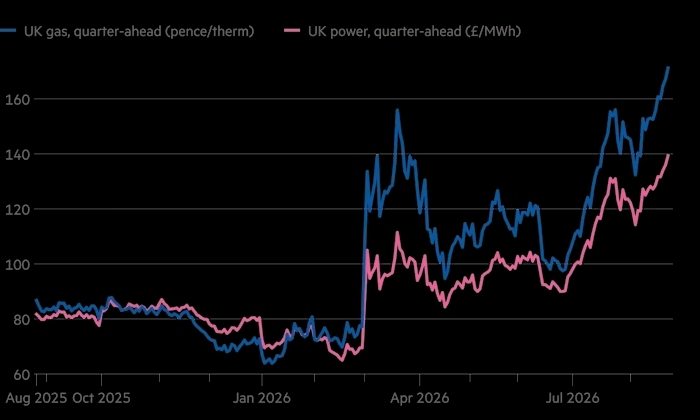
The current government (Prime Minister Andy Burnham, in office since July) attributes the problem to external factors. Secretary of State for Energy Security and Net Zero Miatta Fahnbulleh said in media interviews yesterday that the UK is heavily dependent on a globalised fossil fuel market it cannot control, and the solution is to accelerate renewable energy development. The data partly supports this assessment: after the blockade of the Strait of Hormuz (through which one-fifth of the world's crude oil and LNG passes), wholesale gas prices rose 61% within three months; current bills remain 70% higher than pre-2022 levels.
The opposition and several think tanks, by contrast, point the finger at decarbonisation policies. Robert Jenrick of Reform UK called it "ideological"; Conservative Claire Coutinho noted that Labour had promised to cut bills by £300, yet bills have actually risen by nearly £400. At the industry level, UK industry paid £238 per megawatt-hour for electricity last year, compared with £138 in Germany, £112 in France, $65 in the US, and ¥44 in China over the same period; had UK industry paid US electricity prices, its 2024 industrial electricity bill would have been £11.4 billion lower.
Data supporting the government's argument also exists. In the first quarter of 2026, renewables covered 53.1% of UK electricity, a share the Department for Energy Security and Net Zero (DESNZ) called a record; wind accounted for 35.6%, with output up 30% year-on-year. Natural gas used for power generation fell 17%. Energy think tank Ember estimates that, thanks to the Contracts for Difference mechanism, around 15% of generation is already decoupled from gas prices, a share set to reach 36% by 2030. 2025 data show that when gas accounts for less than 20% of the electricity mix, UK wholesale electricity prices average around £60/MWh; when the share exceeds 50%, wholesale prices rise to £130. In the most recent auctions, solar PV won contracts at £65/MWh and offshore wind at £91.2/MWh, both below or close to current gas-fired generation costs.
Data from Boston Consulting Group (BCG) show that UK household electricity bills have doubled over the past decade, with only 38% of the increase driven by higher wholesale prices and 45% by grid costs and policy decisions, including subsidies such as the Renewables Obligation. Grid costs have risen from £136 per bill in 2019-20 to £250 in 2026; generation subsidy costs have increased from £127 to £159 per bill.
High electricity prices have triggered a contraction in demand, which in turn pushes up unit costs. UK electricity consumption has fallen 11% since 2015, spreading fixed system costs over fewer units of electricity. BCG calculates that if demand continues to decline, the average electricity bill will rise by £264 to £1,145 by 2030. Raoul Ruparel of the consultancy warns that people focus on how electricity will be generated in the future, but that focus becomes meaningless if the path is too expensive; the UK is not unique because its system is more expensive, but rather depends on how that system is paid for.
Market design is also a point of contention. Natural gas accounted for 31% of UK generation in 2025 but set the marginal electricity price more than 90% of the time. Fahnbulleh wrote in The Times that gas set the price around 90% of the time at the start of this decade, close to 60% now, and will fall to 50% by 2030; she said the UK is taking decisive steps to break the link between gas prices and electricity prices. Mike McWilliams, co-author of a report by Civitas (The Institute for the Study of Civil Society), counters that part of the UK's costs stem from past errors that could not actually be fixed, and part from geography—despite heatwaves, the UK is unlikely to enjoy cheap solar power for long periods as Spain does.
Around cost allocation, various proposals have been put forward. Think tank E3G estimates that electricity bill levies will exceed £100 per bill by 2027 and calls for them to be shifted to general taxation. Think tank Common Wealth estimates that if all generators moved to fixed-price contracts (a model already adopted by 89 countries), households could save £130 to £270 per year by 2030. BCG offers the opposite approach: boosting electricity demand through data centres could reduce bills by £324 by 2035. Utility EDF expects the average bill to reach £1,790 by 2030; the UK Office for Budget Responsibility (OBR) estimates that environmental levies will rise from £10 billion to £19 billion over the same period.
There are common misconceptions about how the Ofgem price cap works. Ofgem sets a reference maximum price covering energy procurement costs, grid charges, operating costs, and supplier margins, reviewed quarterly; the cap does not apply to the total bill amount but to unit rates and standing charges. The more electricity used, the more the actual bill exceeds £1,723. This figure, compared with the current £1,663, corresponds to a medium-usage household, not an individual cap.
Greg Jackson, founder and chief executive of Octopus Energy, the UK's largest electricity supplier, acknowledges that the government's measures—removing VAT on electricity and stripping some network charges and levies from bills—have eased the impact this winter, but bills remain too high. He says the UK remains overly exposed to volatile global gas prices, with wars in Ukraine and Iran creating an unprecedented double crisis and gas prices more than doubling since the start of the year.
Jackson argues for urgent electricity market reform to make better use of wind power and allow consumers to benefit from lower prices when green energy is abundant; he is a leading advocate of zonal pricing, a proposal rejected by the UK government last year.
This controversy is not unique to the UK. According to AleaSoft data, the UK wholesale average price in the second week of August was €157.07/MWh, below Italy's €172.17 and above Spain's €128.92, at a time when TTF prices were rising and European wind output was falling. The comparison with Spain is instructive because the two countries have different mechanisms: Spain has no equivalent retail price cap, the Spanish National Markets and Competition Commission (CNMC) does not restrict supplier rates, and both a voluntary small-consumer price index (PVPC) linked to day-ahead and forward markets and an unregulated free market exist; its "Iberian exception" intervenes in gas costs for power plants (the wholesale market), not in what suppliers charge per kilowatt-hour. In short, the UK intervenes in the retail market, while Spain intervenes in the wholesale electricity market. As in Spain, the core of the UK debate is not whether to develop renewables, but who bears the levies, grid costs, and backup capacity—and whether the bill will ultimately penalise the electrification the government wants to drive.
Related Products





Double-slide Triple-sealed Hot Air Isolation Door
Xi'an Yingchuan Electric Power Equipment Co., Ltd.
IGBT Hydrogen Production Power Supply - High Power Air Cooling
Beijing Zhengzhuo Engineering Technology Co., Ltd.
MESS8201-2507/5015-BN Prefabricated Liquid-cooled Energy Storage Battery Container
Xuchang Xuji Electric Science Energy Storage Technology Co., Ltd.
Global Sulfur Hexafluoride Gas Supply and Cylinder Export
Foshan Yuexin Industrial Gas Co., Ltd.