Diagnostic Imaging Market Heads Toward $33 Billion: The Triple Game of AI Integration, Tightening Reimbursement, and Healthcare Accessibility
en.Wedoany.com Reported - According to the latest research by Wissen Research, the global diagnostic imaging market is projected to grow from $26.5 billion in 2026 to $33.2 billion in 2031, with a compound annual growth rate of 4.6% from 2026 to 2031. This growth rate is not particularly aggressive, yet it carries clear structural significance: the diagnostic imaging industry has shifted from a hardware market reliant solely on equipment replacement and hospital expansion to a new phase driven jointly by artificial intelligence, cloud-based imaging, portable devices, and precision diagnostics.
On the surface, the high incidence of chronic diseases, population aging, and rising demand for early screening are the direct drivers of imaging market expansion. But the deeper change lies in the fact that imaging equipment is moving from "imaging more clearly" to "imaging faster, more intelligently, and more accessibly." At the same time, reimbursement pressures, high equipment costs, radiologist shortages, and data security concerns are also reshaping the competitive landscape of the industry. Over the next five years, the core question for the diagnostic imaging market is not "whether it will grow," but "who can strike a balance between efficiency, cost, and clinical value."
I. Growth Drivers: Early Screening Demand Pushes Imaging to the Core of Healthcare Infrastructure
Diagnostic imaging has long been a critical component of modern healthcare systems. Whether for cancer screening, cardiovascular and cerebrovascular disease diagnosis, or orthopedic, obstetric and gynecological, and pulmonary disease management, imaging examinations are an important entry point for clinical decision-making. As the global elderly population increases and the burden of chronic diseases such as cancer, cardiovascular disease, and neurodegenerative diseases rises, the healthcare system's demand for early detection and early intervention continues to strengthen.
The report notes that X-ray systems still held the largest market share in 2025. This is not surprising. Compared with high-end equipment such as MRI and CT, X-ray offers advantages including high examination volume, lower installation barriers, and relatively simple infrastructure requirements, making it widely applicable in primary hospitals, outpatient centers, and developing markets. Meanwhile, 2D imaging remains the largest technology category because of its fast acquisition speed, lower cost, and the fact that many AI triage algorithms are still developed around standard two-dimensional radiographic images and ultrasound workflows.
This indicates that the growth of the diagnostic imaging industry comes not only from high-end technology replacement but also from the popularization of basic imaging capabilities. Especially in regions such as Asia-Pacific, Latin America, the Middle East, and Africa, there is still room for improvement in the accessibility of imaging equipment. Certified refurbished equipment, portable ultrasound, and mobile CT products are expected to lower the threshold for capital investment, enabling more primary healthcare institutions to possess basic diagnostic capabilities.
II. Technology Inflection Point: AI Is Moving from "Reading Assistance" into the "Scanning Process"
In recent years, when the outside world discussed medical AI, the focus was more on "post-processing" links such as image recognition, lesion detection, and automated reporting. However, the report emphasizes that the most important change in diagnostic imaging is moving forward: AI is being embedded into the imaging acquisition process itself.
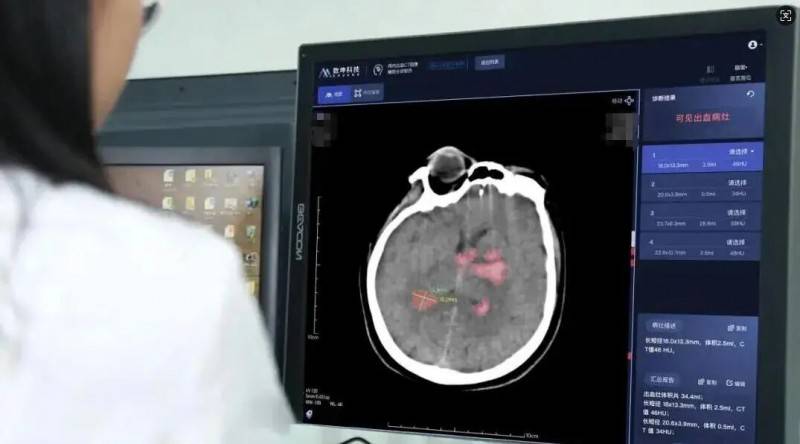
Taking deep learning reconstruction technology as an example, manufacturers have begun integrating algorithms directly into the image acquisition chain of MRI, CT, and other equipment to reduce noise and improve image quality at the signal generation stage, rather than retouching images after the scan is completed. This change brings more direct clinical value: on the one hand, it can shorten scan time and increase the daily throughput of a single device; on the other hand, it helps obtain high-quality images at lower radiation doses or shorter acquisition times.
The report mentions that GE HealthCare's Sonic DL sequence has enabled complex multi-sequence brain and joint MRI examinations to be completed within 15 minutes. Such cases show that AI's value to the imaging industry is not only "assisting physicians in judgment" but also improving equipment utilization, reducing patient waiting times, and alleviating hospital capacity expansion pressure. For imaging departments with high capital expenditures, if the same device can perform more examinations, the return-on-investment model will be recalculated.
It is worth noting that radiology has become one of the fields with the most AI medical devices approved by the U.S. FDA, with the report stating that the number of related approvals has exceeded 1,100. This means AI imaging is moving from proof of concept to routine clinical application. However, the industry should also remain cautious: the generalization ability of AI models across different populations, different devices, and different medical workflows still requires continuous validation, and issues of regulation, attribution of responsibility, and clinical interpretability have not been fully resolved.
III. Cloud PACS and Teleradiology: Data Security Challenges Behind Efficiency Gains
In addition to AI, cloud-native PACS and teleradiology platforms are changing the way imaging data is managed. Traditional hospitals typically rely on local image archiving systems, with limited efficiency in cross-campus retrieval, consultation, and report collaboration. Cloud-based systems can support unified storage across multiple campuses, remote reading, and expert resource sharing, offering clear value to large medical groups, regional medical alliances, and primary healthcare institutions.
Against the backdrop of radiologist shortages, teleradiology can alleviate report backlogs and shorten the time from examination to diagnosis. For patients in remote areas, cloud-based imaging platforms also help improve access to specialty diagnosis.
But cloud migration does not only bring efficiency gains. Medical imaging data is large in volume and highly privacy-sensitive; once leaked or subjected to ransomware attacks, it will directly affect the operations of medical institutions and the rights and interests of patients. As imaging systems move from closed in-hospital networks to cloud-based and multi-institutional collaboration, cybersecurity, data compliance, access permission management, and disaster recovery capabilities will become important indicators in procurement decisions. In the future, competition among imaging companies will not only be about equipment specifications but also about data governance capabilities.
IV. Regional Landscape: North America Leads, Asia-Pacific Grows Fastest
From a regional perspective, North America held the largest market share in 2025, mainly benefiting from mature healthcare infrastructure, higher per capita imaging examination volumes, stronger hospital procurement capacity, and a relatively well-developed reimbursement system. Large medical groups and group purchasing organizations have also enhanced the stability of long-term procurement and service contracts for high-end equipment.
The Asia-Pacific region is regarded as the fastest-growing market. Markets such as China, India, Japan, South Korea, and Australia continue to advance in healthcare infrastructure construction, private hospital expansion, and government investment in healthcare modernization. Especially in China and India, the huge population base and the need for primary healthcare capacity building provide development space for portable imaging, AI-assisted diagnosis, and mid-to-high-end domestic equipment.
However, there are significant differences within the Asia-Pacific market. Japan and South Korea are more focused on high-end equipment replacement and precision diagnostics; China has both high-end hospital upgrading needs and primary care capacity-building needs; India and parts of Southeast Asia place more emphasis on cost-effectiveness and accessibility. Therefore, if companies attempt to cover the entire Asia-Pacific market with a single product strategy, they may find it difficult to achieve ideal results.
V. Reimbursement Pressure: The Contradiction Between High-End Equipment Investment and Tightening Reimbursement Intensifies
Although the diagnostic imaging market continues to grow, it is not without obstacles. The report specifically points out that the U.S. Centers for Medicare & Medicaid Services (CMS) introduced efficiency adjustments in the 2026 Medicare Physician Fee Schedule, permanently reducing the work relative value units of approximately 7,700 diagnostic and procedural codes by 2.5%. Some new combined head and neck CTA codes even caused overall payment reductions of up to 30.8%.
This change has industry-wide significance. Imaging equipment is becoming increasingly expensive, and hospitals need to invest in AI software, cloud systems, maintenance services, and cybersecurity; but the reimbursement side is trending toward compression, leading to a mismatch of "rising technology investment and declining reimbursement returns." The result may be that some medical institutions extend the lifecycle of equipment, delay high-end equipment replacement, or turn to refurbished equipment and service outsourcing.
For manufacturers, this means that the model of simply selling high-end hardware faces pressure. In the future, a more competitive approach may be a combination of "equipment + software + services + proof of operational efficiency." Whoever can demonstrate that their products can shorten examination time, reduce repeat scan rates, improve diagnostic accuracy, and enhance hospital financial performance will be more likely to gain purchaser recognition.
VI. Competitive Landscape: Giants Accelerate Integration, Differentiation Becomes Key
The report lists major companies including GE HealthCare, Siemens Healthineers, Philips, Canon Medical, Fujifilm, Samsung Medison, United Imaging Healthcare, Butterfly Network, and others. Recent moves show that industry competition is evolving toward platformization and scenario-based solutions.
For example, GE HealthCare launched its next-generation SIGNA MRI technology and AI workflow solutions in 2026; Siemens Healthineers released an integrated workflow for CT-guided percutaneous coronary intervention, connecting CT imaging, plaque analysis, pre-procedural planning, and catheterization laboratory guidance; Fujifilm launched the ARIETTA Deep Insight x ultrasound platform applying AI and deep learning; Samsung Medison integrated its U.S. imaging business, positioning itself in AI ultrasound, digital radiography, portable CT, and photon-counting detector technologies.
These cases indicate that imaging manufacturers are no longer competing solely on standalone machine performance but are attempting to penetrate clinical pathways and provide integrated solutions from scanning, analysis, and reporting to treatment guidance. Especially in high-value areas such as cardiovascular, oncology, and neurology, imaging is gradually transforming from a diagnostic tool into a clinical decision-making platform.
Conclusion: Growth Is Certain, but Value Reconstruction Matters More
Overall, the forecast that the global diagnostic imaging market will reach $33.2 billion by 2031 reflects the robustness of long-term industry demand. But the 4.6% compound growth rate also reminds the market: this is not an industry that wins by runaway scale, but one that finely balances technology, cost, regulation, and clinical value.
In the future, medical institutions should avoid blindly pursuing high-end equipment and instead formulate imaging capacity-building plans based on disease spectrum, patient flow, reimbursement structure, and physician resources. Manufacturers should shift from equipment sales to clinical efficiency solutions, providing quantifiable evidence of return on investment. Regulators and payers should also establish more scientific value assessment mechanisms and provide reasonable reimbursement support for technologies that genuinely improve diagnostic quality and reduce long-term healthcare costs.
For developing markets, expanding basic imaging coverage and developing portable devices and teleradiology platforms will be more practical than simply introducing expensive high-end equipment. The next round of competition in the diagnostic imaging industry is not just about "seeing more clearly," but about "seeing earlier, seeing faster, and seeing more equitably."