Dutch ECTMarine Delivers Custom Workboat to Arab Potash Company of Jordan
en.Wedoany.com Reported - On October 30, the Dutch marine engineering company ECTMarine delivered the custom workboat "Custom Workboat 104" to Jordan's Arab Potash Company (APC). The vessel completed on-site acceptance testing (SAT) last week at APC's brine evaporation ponds at the Dead Sea, with APC represented on site by its main contractor Alghanem; the tests covered the performance of the propulsion system, deck crane and onboard systems under actual operating conditions. Following delivery, the vessel entered daily operational service at APC's evaporation ponds.
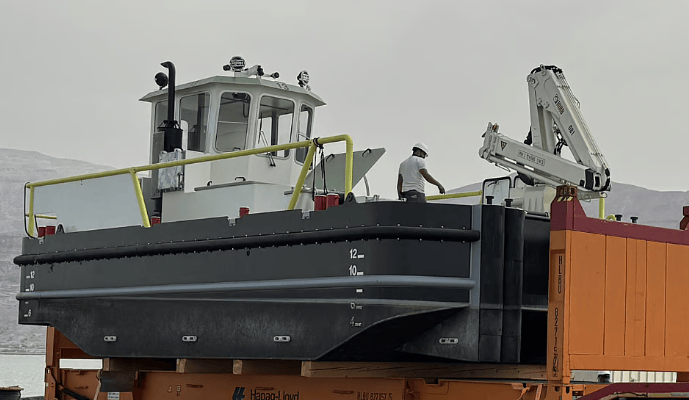
The vessel is customized based on ECTMarine's Workboat 104 standard design. Its core parameters are an overall length of 10 meters, a beam of 4 meters, a depth of 1.5 meters and a draft of 1 meter. It is powered by a Doosan diesel engine rated at approximately 166 kW, with single-screw propulsion, a bollard pull of 2 tonnes and a fuel capacity of 4 cubic meters. The deck layout consists of a forward wheelhouse, an open working deck and a knuckle-boom deck crane (Hiab brand), and is equipped with a windlass and towing bitts, making it suitable for dredging support, material transfer, anchor handling and light push-tow operations in shallow, enclosed and coastal waters.
The operating environment of the Dead Sea was the core constraint in this custom design. The salinity of these waters is approximately 34%, ten times that of ordinary seawater, and APC's evaporation ponds lie about 400 meters below sea level. The dense, highly corrosive brine directly attacks the hull materials, propulsion system and cooling circuits. Jesse Boerma, Commercial Director of ECTMarine, stated that because the brine in the evaporation ponds is itself the extracted product, the cooling system cannot use the water body in which the vessel operates; the engine therefore adopts an air-cooled solution, and the entire drivetrain and propulsion system have been adapted to Dead Sea conditions.
After construction was completed in the Netherlands, the vessel was shipped to Jordan on a flat rack and then transported by truck along the causeways of APC's evaporation ponds to the launch point, where it was finally lifted directly from the trailer into the brine by a mobile crane equipped with a twin lifting beam. This procedure replaced conventional port launching facilities and is a direct result of the absence of dock facilities at the evaporation pond site. The hull and deck layout were adapted at the design stage to the dimensional requirements of standard flat-rack road transport.
The vessel completed factory acceptance testing (FAT) in the Netherlands in the summer of 2026. During the two-day program, the buyer's delegation observed sea trials, system demonstrations, and presentations of operating modes and configurations, and adjustments agreed during the FAT were completed before shipment. The vessel was then shipped to Jordan, where on-site lifting and SAT were completed. The SAT was jointly executed by ECTMarine, Alghanem and APC; upon passing, the vessel was approved to enter daily service, and ECTMarine continues to provide technical support during the initial period of operation.