Russia's Baltic Shipyard Completes Hull Structure Assembly of the Leningrad Nuclear-Powered Icebreaker
en.Wedoany.com Reported - On November 24, the Baltic Shipyard under Russia's United Shipbuilding Corporation completed the hull structure assembly of the Leningrad, a Project 22220 universal nuclear-powered icebreaker. The vessel is the sixth nuclear-powered icebreaker in the Project 22220 series. It has now had its bow and stern posts installed and its ice belt structure completed. It is scheduled to be launched in St. Petersburg on December 3, 2026, after which mooring trials and sea trials will be conducted.
The key work involved in completing the hull structure included the installation of the bow and stern posts and the forming of the ice belt. The bow post bears the impact loads from ice during icebreaking operations, while the stern post supports the propellers and steering gear. The ice belt is made of high-strength special steel, with a maximum thickness of 45 mm, to withstand concentrated loads when the vessel operates in ice-covered waters.
The shipyard is still carrying out hull painting, equipment installation, and construction of the propellers and steering gear. Unlike the completion of hull structure assembly, the overall construction of the vessel has not yet been finished; after launching, onboard equipment installation and system commissioning will still need to be completed.
The Leningrad is equipped with two Russian-developed RITM-200 nuclear reactors, which were installed onboard in August 2026. This type of icebreaker uses a nuclear-powered steam turbine and electric propulsion system, with three propulsion motors arranged on both sides of the stern and in the middle respectively. Each motor has a power of 20 MW, with a total shaft power of 60 MW.
Mooring trials after launching will include startup of the nuclear power plant and testing of related systems. Subsequent sea trials will focus on checking the nuclear power plant, electric propulsion system, steering performance, speed, and maneuverability. After completing builder's sea trials and acceptance, the vessel will be delivered to Atomflot, the nuclear icebreaker fleet under Rosatom. According to the construction contract signed in February 2023, delivery is scheduled for December 2028.
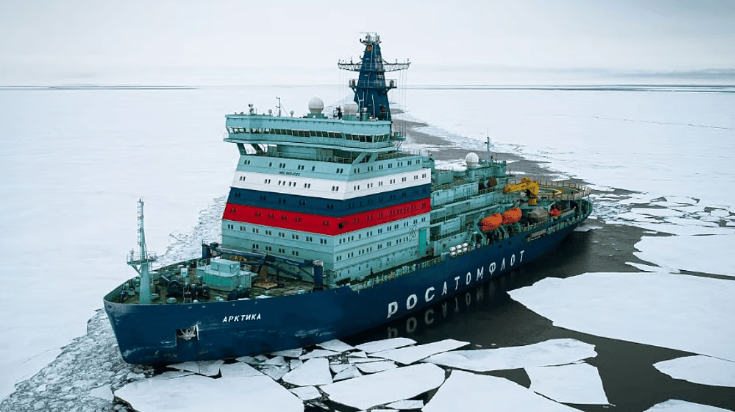
Project 22220 nuclear-powered icebreakers are mainly tasked with ensuring year-round navigation on the Northern Sea Route and providing icebreaking escort for merchant ships, and can adapt to different water depth conditions such as the deep-water routes of the Arctic and the estuaries of Siberian rivers. This type of vessel has an overall length of 173.3 m, a beam of 34 m, a full-load displacement of about 33,540 t, a shaft power of 60 MW, a designed crew of 54, and a design service life of 40 years.
At present, the Project 22220 nuclear-powered icebreakers already in operation in Russia include the Arktika, the Sibir, the Ural, and the Yakutia. The Chukotka is undergoing mooring trials and is scheduled for delivery in 2027; after the Leningrad, the Stalingrad of the same series is also under construction at the Baltic Shipyard.
Related Products


D12 Humanoid Robot
Automation Research Institute Co., Ltd. of China South Industries Group Corporation
Industrial and Commercial Point-Type Gas Detector
Jinan Benan Technology Development Co., Ltd.

Wheel and Track Technology Business
Beijing Research & Design Institute of Rubber Industry Co., Ltd.

Pantograph-Catenary Comprehensive Detection Device (1C)
CHENGDU TANGYUAN ELECTRIC CO., LTD.