
Researchers at the Institute of Applied Ecology, Chinese Academy of Sciences in Nanjing have developed a new environmentally friendly fertilizer additive that significantly increases crop yields while reducing harmful gas emissions.
Published in Soil & Tillage Research, the study marks a major advance in sustainable agriculture and soil nitrogen management.
The additive, 2-cyclopenten-1-one (CCO), is a plant-derived compound that acts as a dual nitrogen inhibitor. It slows nitrogen transformation and loss in soil, thereby improving nitrogen use efficiency. Traditional inhibitors such as NBPT (N-(n-butyl) thiophosphoric triamide) and DMPP (3,4-dimethylpyrazole phosphate) face persistent challenges including rapid degradation, high production costs, and ecological concerns, whereas CCO offers a more environmentally friendly and effective alternative.
Fertilizer inhibitors are often described as "microchips" for stabilized fertilizers, as they optimize nutrient efficiency in a manner analogous to how microchips enhance electronic device performance. To evaluate CCO's effectiveness, the team conducted field trials and metagenomic sequencing at the Shenyang National Agroecosystem Integrated Observation Station, comparing CCO with conventional nitrogen inhibitor formulations combining NBPT and DMPP (ND).
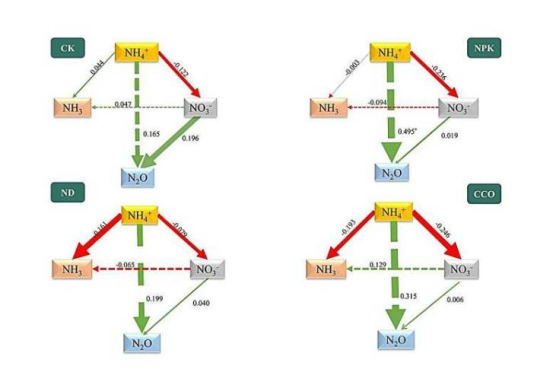
Results showed that both treatments reduced nitrogen loss and greenhouse gas emissions while increasing crop yields. Specifically, CCO and ND treatments suppressed ammonia (NH₃) volatilization, decreased nitrous oxide (N₂O) and carbon dioxide (CO₂) emissions, and enhanced soil methane (CH₄) uptake. However, the two treatments exhibited significant differences in their underlying molecular mechanisms.
ND primarily regulated genes involved in the nitrogen cycle (e.g., amoB, nirS, and nosZ), whereas CCO exerted stronger regulation on genes directly involved in denitrification (e.g., norB and nirD).
Furthermore, metagenomic analysis revealed that CCO has unique effects on soil microbial communities and key nitrogen metabolism pathways. Notable changes included shifts in the abundance of microbial genera such as Nocardia and Nitrosospira, as well as alterations in KEGG pathway expression, such as the assimilatory nitrate reductase electron transfer subunit (K00360) and NADH-dependent nitrite reductase small subunit (K00363).
This breakthrough not only enriches the portfolio of green inhibitor materials but also represents a significant advance in understanding the microbiological basis of fertilizer efficacy.
The researchers stated that the study strengthens China's international standing in eco-friendly fertilizer technology and lays a solid foundation for the future development of sustainable stabilized fertilizers. As agriculture faces increasing pressure to reduce its carbon footprint, innovative technologies like CCO provide vital tools for the green transition.