
An international team of scientists has for the first time used a superconducting quantum processor to experimentally simulate spontaneous symmetry breaking at zero temperature, achieving a fidelity exceeding 80% and marking a new milestone for both quantum computing and condensed matter physics research. The results have been published in Nature Communications. During the experiment, the system spontaneously evolved from a classical antiferromagnetic state (where particle spins alternate in direction) into a ferromagnetic quantum state (where all spins align in the same direction), forming an ordered structure through quantum correlations.
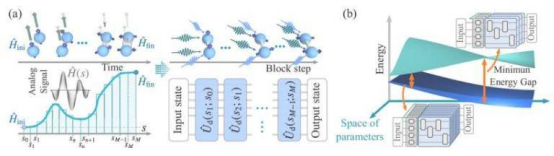
The team consists of researchers from Southern University of Science and Technology (Shenzhen, China), Aarhus University (Denmark), and the Federal University of São Carlos (Brazil). Theoretical co-organizer Alan Santos stated: "The key lies in simulating dynamics at absolute zero temperature. Previous related studies were conducted only at finite temperatures, but our experiment demonstrates that symmetry breaking can still be observed at zero temperature even when considering only nearest-neighbor interactions." Since absolute zero cannot be physically achieved, the team simulated the system's behavior using quantum circuits, constructing a nearest-neighbor coupling structure with seven superconducting qubits and applying an adiabatic evolution algorithm to emulate a zero-temperature environment.
The experiment used correlation functions and Rényi entropy to quantify the degree of quantum entanglement, revealing for the first time the cooperative formation of ordered patterns and quantum entanglement at zero temperature. Santos explained: "Entanglement is the core resource of quantum computing; it enables instantaneous correlation of particle states across space—a feature impossible to replicate on classical computers." He illustrated this with the analogy of unlocking a door: a classical computer must test keys one by one, whereas a quantum computer can test many keys simultaneously, dramatically reducing computation time. The study also validated the scalability of superconducting qubits—quantum chips based on aluminum-niobium alloys operated stably at 1 millikelvin, providing a technical pathway toward large-scale quantum processors.
This breakthrough not only deepens understanding of symmetry-breaking mechanisms but also proves the feasibility of using quantum computing to simulate complex quantum systems. Santos emphasized: "Symmetry breaking is a fundamental concept in physics that explains the origin of conservation laws and complex structures. This research provides a powerful new tool for exploring frontier topics such as high-temperature superconductivity and quantum magnetism."