
Technicians have recently installed the solar arrays on NASA's Nancy Grace Roman Space Telescope, one of the final major steps in assembling the observatory. Collectively known as the Solar Array Sunshield, these panels will both generate power for the observatory and provide critical shading to keep instruments cool and ensure successful observations.
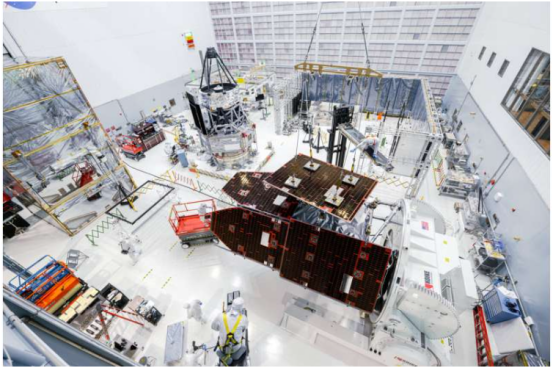
The Roman Space Telescope's solar arrays are covered with 3,902 individual solar cells that convert sunlight directly into electricity — much like plants turn sunlight into chemical energy. When tiny photons strike the cells, some of their energy is transferred to electrons in the material, exciting them into higher energy states or accelerating their motion. These excited electrons break free and flow through a circuit, generating electricity that powers the observatory.
"Right now, the observatory is about 90% complete," said Jack Marshall, Solar Array Sunshield lead at NASA's Goddard Space Flight Center in Greenbelt, Maryland. "We just need to mate the two large assemblies together and then perform a series of tests on the full Roman observatory. We're currently several months ahead of our committed launch date of no later than May 2027."
The solar arrays have now been attached to the exterior of the spacecraft, and technicians are preparing for vibration testing to confirm they can withstand the intense shaking of launch. The team is working toward a potential launch as early as autumn 2026. They plan to join the two main sections of the observatory before the end of this year, completing Roman's construction.
The Solar Array Sunshield consists of six panels, each covered with solar cells. Two central panels will be fixed to the Outer Barrel Assembly (the observatory's outer shell), while the four outer panels will deploy in space, swinging upward to align with the central panels.
Throughout the mission, the solar arrays will remain pointed toward the Sun, providing steady power to the observatory's electronics. This orientation also shields most of the spacecraft from sunlight, helping keep instruments cold — essential for an infrared observatory, where heat appears as infrared light and excess warmth from the spacecraft itself could saturate detectors and render the telescope inoperable.
"With the solar arrays now installed, the outer structure of the Roman observatory is complete," said Aaron Vigil, mechanical engineer working on the arrays at Goddard. Next, technicians will test deployment of both the solar arrays and the observatory's deployable aperture cover (the "sunshade"), followed by testing of the core spacecraft, electronics verification, and thermal-vacuum testing to ensure the system performs as planned in the harsh environment of space.
These efforts will keep the project on track, with the inner and outer sections of the Roman telescope expected to be joined in November, the full observatory completed by the end of the year, and pre-launch testing to follow.