
In early July, Shandong University released the world's first mineralogical "examination report" of the lunar magnesium-rich ring, based on lunar soil samples returned by China's Chang'e-6 mission. The findings reveal the true composition of the Mg-rich pyroxene ring (the "Magnesium Ring") in the South Pole–Aitken (SPA) Basin on the Moon's far side, filling a critical gap in humanity's understanding of deep rock types and origins within the SPA Basin on the lunar far side. The results have been published in Communications Earth & Environment, a sub-journal of Nature.
An "X-ray Scan" of the Moon's Deep Interior
Dr. Cao Haijun, first author and member of the Planetary Science Team at Shandong University's Institute of Space Sciences, stated that through on-site sampling by Chang'e-6 and subsequent laboratory analysis, researchers have for the first time obtained "ground-truth data" from this region — akin to performing a deep X-ray scan of the Moon. This allows us, for the first time, to understand the composition of previously unknown areas inside the lunar far side and uncover the latest secrets of far-side lunar regolith.
For a long time, the Moon's far side has been considered mysterious, with observations relying solely on remote sensing and lacking physical samples. Using Raman spectroscopy, the Shandong University team analyzed the Chang'e-6 lunar soil samples and successfully obtained the world's first mineralogical ground truth for the Mg-rich pyroxene ring in the SPA Basin.
"Ground truth" refers to high-precision, reliable mineral composition data obtained through laboratory analysis of actual lunar samples — essentially a "geological examination report" of the Moon. The "Mg-rich pyroxene ring" indicates that rocks in this area contain abundant low-calcium pyroxene, a magnesium-rich, calcium-poor mineral.
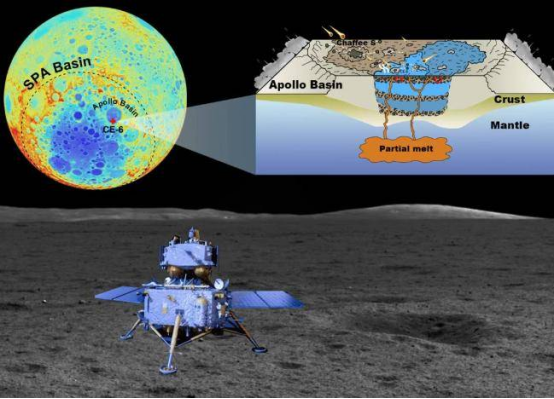
The SPA Basin is the largest, deepest, and oldest impact basin on the Moon — and the largest crater on any terrestrial planet in the solar system — covering nearly one-eighth of the lunar surface. Dr. Cao Haijun noted that the massive impact that formed the SPA Basin likely penetrated the lunar crust and exposed mantle material, making the SPA Basin of immense scientific value for studying the Moon's early thermal evolution, impact processes, and crust-mantle composition.
New Study Maps the Evolution of Far-Side Lunar Regolith
Corresponding author Professor Ling Zongcheng from Shandong University stated that through mineralogical statistical analysis of the Chang'e-6 samples, 16 mineral species were identified, dominated by plagioclase and pyroxene, with significant contributions from exogenous material. However, olivine and ilmenite contents were markedly lower than in lunar samples from the near side.
Approximately 31%–40% of the Chang'e-6 regolith originates from the Chaffee S impact crater, a Mg-rich pyroxene feature within the SPA Basin. In simple terms, this crater acted like a giant "bullet hole," ejecting material that was gravitationally drawn to nearby areas, mixing with local soil to form the observed regolith composition.
Researchers found that the Mg-ring material in the SPA Basin consists primarily of ferroan anorthosite composed of 63%–67% plagioclase and 25%–27% low-calcium pyroxene. Compared to the initial plutonic rocks formed from the SPA impact melt sheet, the plagioclase content in the Mg-ring is significantly higher. This indicates that during the late stages of the SPA impact event, 61%–63% lunar crustal material was re-incorporated into the original anorthosite, undergoing a post-impact "reworking" process that ultimately formed the ferroan anorthosite geological unit within the SPA Basin's ring structure.
Based on spectroscopic and mineralogical characteristics of the samples, the team constructed for the first time an impact-mixing evolution model for the regolith at the Chang'e-6 landing site, dividing its formation into five stages:
The first stage was the eruption and cooling of basaltic units approximately 2.8 billion years ago, establishing the parent-rock foundation for the regolith; the second stage involved large distant impacts ejecting magnesium-rich anorthosite debris onto the landing area; the third stage saw the landing area experience multiple secondary impacts that further fragmented the ejecta; the fourth stage consisted of continuous small impact events that not only replenished coarse-grained material but also induced low-temperature shock metamorphism, gradually refining the regolith; the fifth stage, under long-term space weathering, ultimately produced abundant fine-grained particles, agglutinitic glass, and metallic iron components.