
It may look like an ordinary construction site, but Akmatbek Uraimov's new house in Kyrgyzstan is being built with rice husk bricks. This eco-friendly alternative to traditional building materials is gaining rapid popularity in the Central Asian country, which is highly vulnerable to global warming and faces severe water shortages.
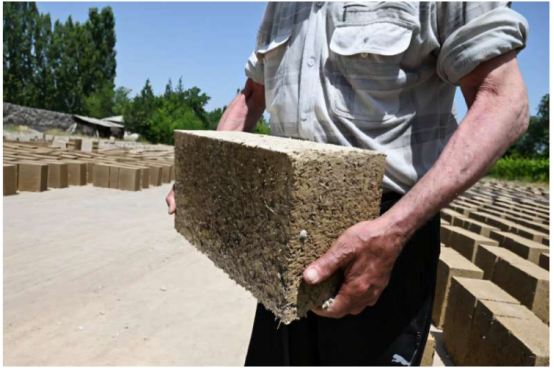
Before choosing this unconventional material, Uraimov explored other options and concluded that relatively inexpensive blocks made from rice husks were the best choice. Living in the village of Kyzyl-Kiya in southern Kyrgyzstan, he said: "From the perspective of thermal insulation, cost, and ease for builders, it's very convenient." He added that people previously knew nothing about rice husk brick construction, but now, after seeing it, they are very interested and keep calling to inquire.
Nursultan Tabaldiyev is one of the pioneers of this technology in Central Asia – a method hailed as an environmentally friendly substitute for water-intensive concrete. In a workshop in his hometown of Batken, rice dust floats from the husks – the rough outer shells of rice grains that are usually discarded or burned. Workers wearing protective masks hurriedly press the bricks, dry them, and load the finished products onto trucks for customers.
Cement is more expensive in Kyrgyzstan than in the rest of Central Asia, and rice husks are emerging as a viable alternative. Tabaldiyev explains that the bricks are "made of 60% rice husks, with the rest being clay, cement, and glue that contains no chemicals." Thanks to the natural silica in the husks, the dried bricks become as strong as cement. He says the idea came from working with wood alongside his father when he was young. In just five years, the 27-year-old has built "300 houses" using rice husk bricks – initially with sawdust, later switching to rice.
At first there was a lack of in-depth research on the technology, but that is now changing. Several preliminary studies in various countries have highlighted the potential economic and environmental benefits of using rice husk bricks in construction. Crucially, they require far less cement – which, according to 2023 World Economic Forum data, accounts for about 8% of global CO₂ emissions. The raw material is readily available: the Batken region produces one-third of Kyrgyzstan's rice.
In a village in the arid mountainous region, Ykhval Boriyeva also chose rice husk bricks for her home, praising their excellent insulation properties. Thanks to their low thermal conductivity, her house is "warm in winter and cool in spring" and saves on coal.
Tabaldiyev says: "Rice waste used to be dumped in fields where it smouldered slowly, harming the environment and unable to be used as fertilizer, so we decided to recycle it." In major rice-producing countries like India, the problem of rice waste disposal is even more severe. According to a study published late last year by Springer Nature, "31.4 million tonnes of rice husks fill landfills and cause environmental problems." Tabaldiyev notes that farmers are delighted they can get rid of rice waste, as poorly ventilated piles pose a fire risk to grain storage. Regarding fire hazards of rice-brick buildings, a regional official from Kyrgyzstan's Ministry of Emergency Situations said "there is no particular danger."
Farmer Abdimamat Saparov welcomes Tabaldiyev's innovative approach. Pointing to mountains of rice waste, he says: "After harvesting and drying the rice, about 40% remains as waste that we can't deal with." Such abundant supply makes the blocks cheaper than ordinary construction bricks – a key factor in southern Kyrgyzstan, where the average monthly wage is around $230. Cement prices are so high in the country that the government is considering adding it, alongside bread and oil, to the list of socially sensitive products to curb soaring prices.
Having proven the concept works in mountainous areas, Tabaldiyev dreams of scaling up to industrial production, expanding internationally, and finding more potential materials. He says: "I want to go to (neighbouring) Kazakhstan and make bricks from crushed reeds and straw."