Wedoany.com Report on Mar 10th, 5G Standalone (SA) is becoming a critical foundation for next-generation telecommunications networks, offering lower latency and enhanced quality of service control, supporting advanced features like network slicing. An Ookla report highlights that 5G SA directly connects devices to the 5G core network, without relying on LTE infrastructure, thereby improving network efficiency and responsiveness.
Global adoption of 5G Standalone is uneven. China leads with approximately 80% of samples, while India's near 50% adoption rate is primarily driven by a single operator. The US has a penetration rate close to one-third, while most of Europe remains in the low single digits, as operators there focus more on returns from earlier Non-Standalone deployments.
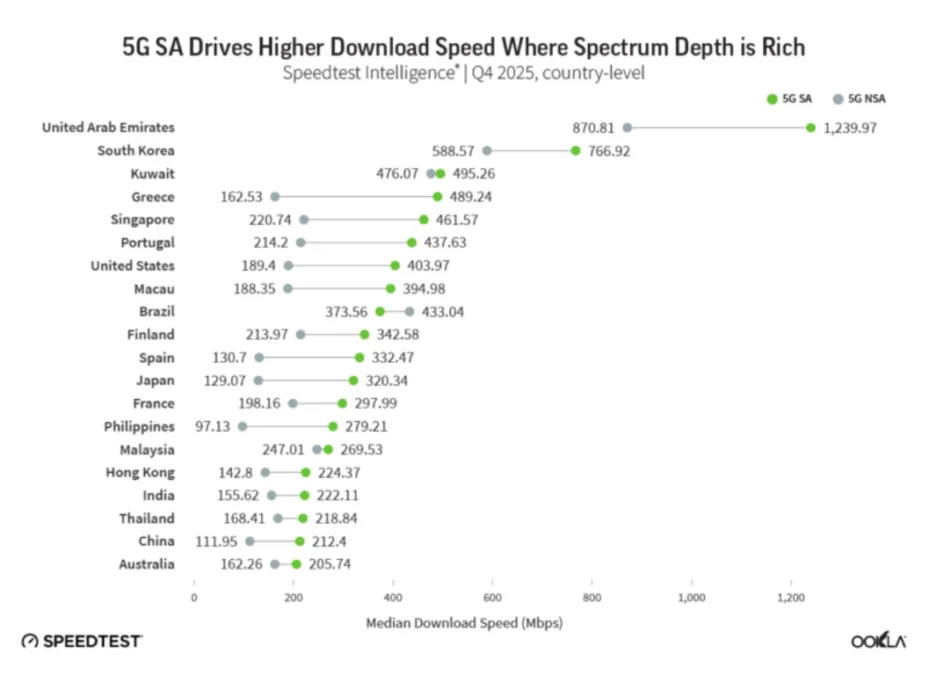
5G Standalone significantly improves network latency, which is crucial for real-time applications. Compared to Non-Standalone networks, latency is reduced by about 23%. Hong Kong saw a reduction of about 43%, and France an improvement of about 31%, enhancing network consistency. Regarding download speeds, the UAE recorded a median speed of approximately 1.2 Gbps in Q3 2025, South Korea exceeded 700 Mbps, and the US surpassed 300 Mbps.
Network performance is influenced by spectrum strategy and core network location. Mid-band spectrum increases capacity but may face indoor coverage challenges. Technical improvements in 5G SA include lower latency and faster speeds, but monetization challenges differ. Consumer revenue stems from reliability features, while enterprise customers are willing to pay for performance guarantees to support applications like industrial automation.
In 2025, telecommunications networks are viewed as critical national infrastructure, with events like power outages highlighting connectivity vulnerabilities. Network resilience depends on factors such as backup power and redundant routing, with policymakers emphasizing cybersecurity. Regional strategies vary: Europe is advancing network resilience policies, China is integrating telecom with AI development, India is building local technological capabilities, the US prioritizes supply chain security, and Gulf nations link digital transformation with 5G Advanced deployment.
5G Standalone lays the groundwork for the evolution to 5G Advanced. Early deployments have already appeared in China and Gulf countries, with more launches expected in 2026. Discussions on 6G are accelerating, with commercial deployment anticipated around 2030, but operators remain focused on migrating to 5G SA. Future networks will need to integrate with digital ecosystems, and competition will increasingly rely on actual performance rather than speed claims.