Wedoany.com Report on Mar 19th, US quantum computing company Infleqtion announced progress in biomarker discovery through its Q4Bio project, successfully executing relevant algorithms using 12 logical qubits on its Sqale neutral-atom quantum computer. This project is supported by a $2 million Phase 3 contract from Wellcome Leap and involves collaboration with academic partners at the University of Chicago and MIT. It integrates a quantum-classical hybrid workflow to identify key feature sets from complex multimodal cancer data.
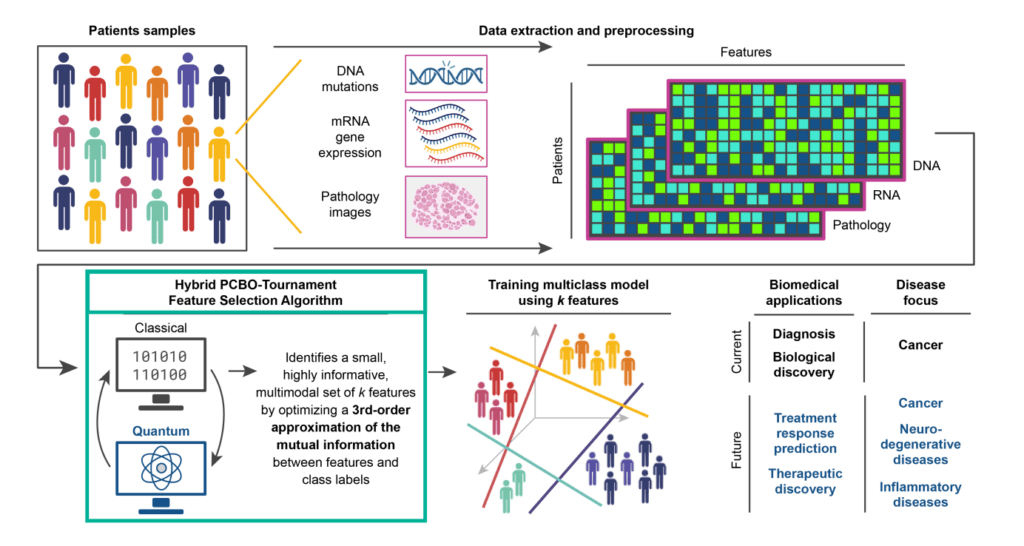
The platform aims to advance precision diagnostics by capturing high-order correlations that are difficult for classical systems to handle. This achievement was showcased at NVIDIA GTC 2026 and represents one of the more complex applications of logical qubits to date, achieving a relative error of 0.04% compared to the optimal mathematical solution.
The technical framework employs the Instantaneous Quantum Polynomial (IQP) model, a type of quantum neural network optimized for GPU training and QPU sampling. Using the IQPOpt library and JAX, Infleqtion trained the model on NVIDIA A100 nodes of the NERSC Perlmutter supercomputer, handling instances scalable to tens of logical qubits. This "split-hardware" approach uses GPUs for linear algebra computations and the Sqale QPU for inference acceleration, enabling the system to select multi-qubit correlations via hypergraph structures.
To validate the model before physical execution, Infleqtion used the NVIDIA CUDA-Q platform for high-fidelity simulation. The team established a "noiseless upper bound" and performed "noise validation" using device-calibrated noise models, achieving simulation acceleration of over 50x compared to CPU-only backends. This seamless code path allows the same core to be tested in a virtual environment on NVIDIA GH200 Grace Hopper superchips before deployment to neutral-atom hardware, reducing the risk of large-scale biomarker feature set experiments.
A key part of the Sqale platform's fault-tolerant roadmap is the integration of NVIDIA NVQLink, facilitating real-time control loops between the QPU and classical accelerators. With round-trip latency as low as 3.96 microseconds, NVQLink enables measurement data to be transferred directly to GPU memory for immediate syndrome decoding and parameter updates. This microsecond-level feedback is crucial for maintaining active error correction of logical qubits, allowing Infleqtion's pulse processing unit to perform adaptive operations within the atomic coherence window.
Looking ahead, Infleqtion will showcase the integration of Sqale with NVQLink at GTC 2026, highlighting the transition towards production-level quantum-GPU supercomputing. The successful operation of 12 logical qubits provides a proof-of-concept for the Q4Bio program, which is now entering its final phase. The company plans to scale the architecture to support over 30 logical qubits later in 2026, targeting more complex genomic and proteomic data analysis tasks that require the error suppression capabilities of fault-tolerant quantum hardware.