en.Wedoany.com Report on Mar 23rd, At the NVIDIA GTC conference, the company's founder and CEO, Jensen Huang, delivered a keynote address where the evolution and ecosystem layout of robotics technology became a crucial thread running throughout the entire event. From announcements to live demonstrations, NVIDIA is attempting to outline a vision of comprehensive penetration by Physical AI. In his speech, Huang announced a strategic judgment that has garnered widespread attention: every enterprise needs to formulate an OpenClaw strategy. OpenClaw, as an AI agent framework capable of directly controlling computers to perform tasks based on natural language instructions, is sparking a global "Agentic AI" trend. This statement signifies that NVIDIA is extending AI capabilities from traditional cloud-based training and inference towards autonomous task execution and software system control, providing foundational support for the intelligent transformation of enterprise workflows. An even more visually impactful segment was the live demonstration of the robot snowman Olaf, developed in collaboration with Disney. This robot appeared on stage with an adorable cartoon-like appearance, but it embodies several of NVIDIA's core capabilities in the field of robotics technology. Olaf can perceive environmental changes in real time, respond to voice commands, and perform a series of fluid physical movements. During the demonstration, it not only engaged in interactive dialogue with the host but also showcased flexible motion control and stable balancing abilities, earning rounds of applause from the audience.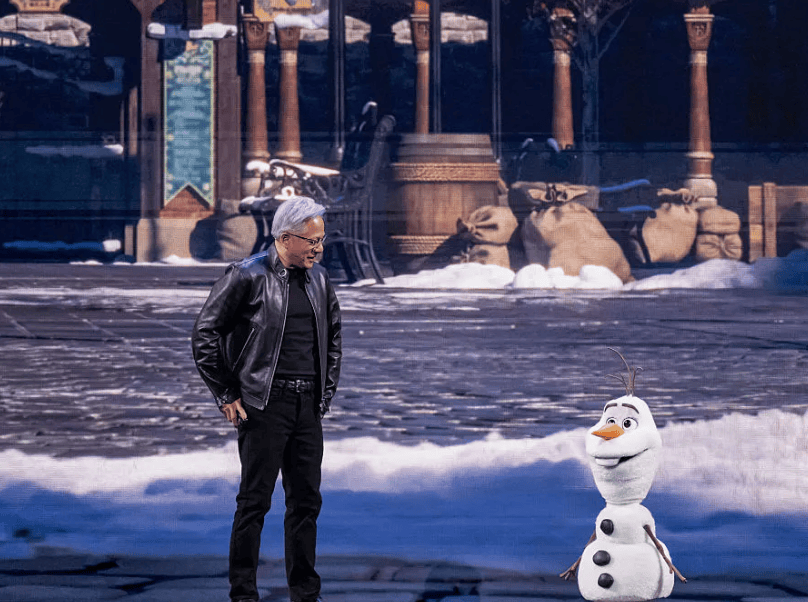
Olaf's debut is a concrete manifestation of the "Physical AI" concept previously proposed by Jensen Huang. The so-called Physical AI refers to AI systems with the ability to interact with the real world, capable of perceiving the environment, making autonomous decisions, and executing physical actions. Unlike general AI that only processes text and images, Physical AI requires the integration of multiple technologies such as perception, planning, and control, placing higher demands on computing platforms, sensor fusion, and real-time response. Through the Isaac robotics platform, Omniverse simulation environment, and the Jetson edge computing product line, NVIDIA provides developers and enterprises working on Physical AI with a full-stack solution ranging from simulation training to actual deployment.
Following the demonstration, Jensen Huang stated that robotics technology is undergoing a critical leap from "seeing" to "doing." Through collaborations with creative companies like Disney, NVIDIA hopes to showcase the broad application prospects of robotics technology in fields such as entertainment, services, and manufacturing. He also emphasized that the proliferation of Physical AI will usher in a new era of computing, and NVIDIA's full-stack platform will become the core infrastructure for this transformation.
From the snowman Olaf to the OpenClaw strategy, the robotics-related announcements at the GTC conference clearly indicate that NVIDIA is pushing the boundaries of AI from the digital world into the physical world. Whether it's intelligent agents serving enterprises or robots interacting with humans, they all point in a common direction: AI is learning to "take action."